




















Search
Astrophysics
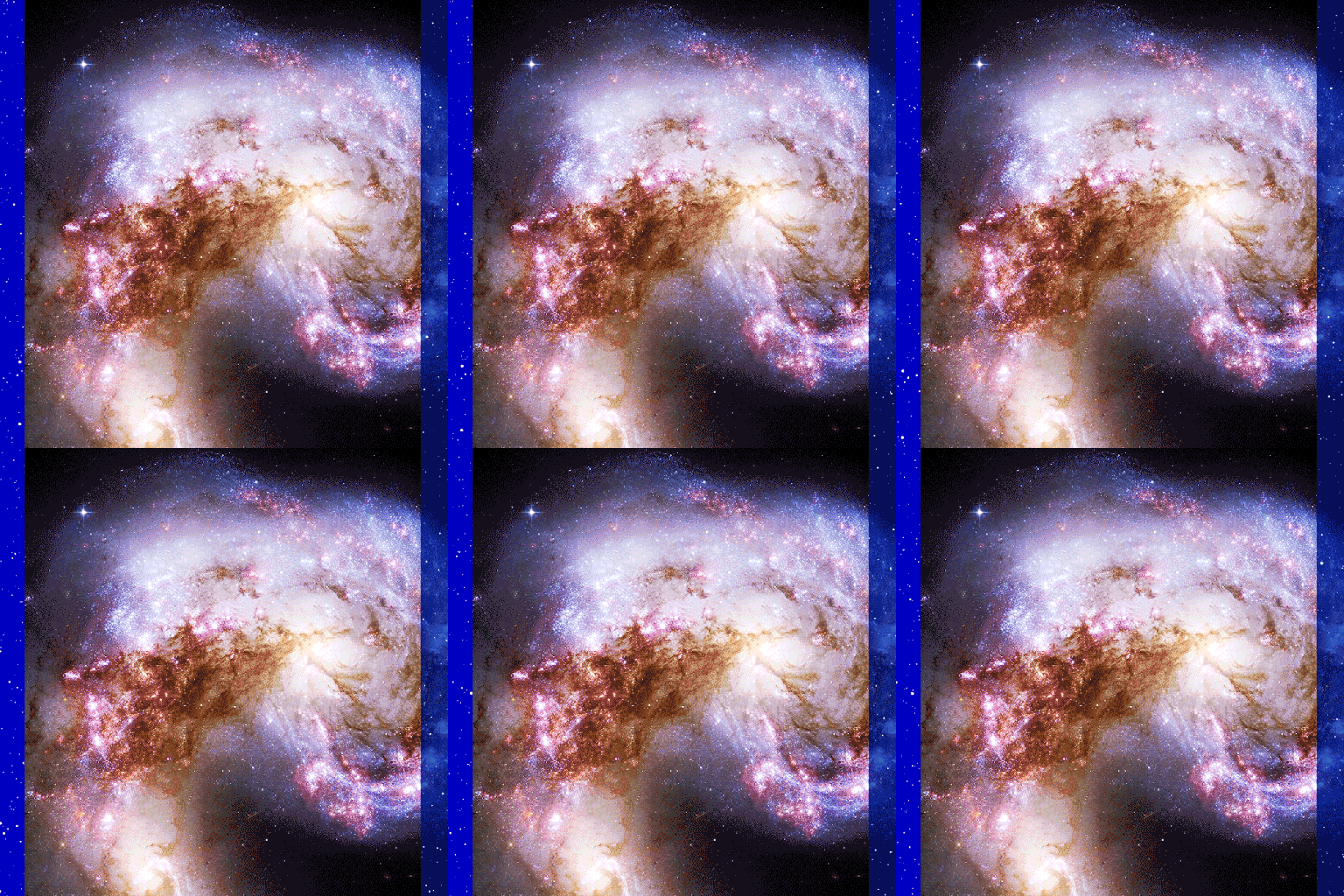
The Universe has been creating stars for nearly all 13.8 billion years of its history. But those photons can't match the Big Bang's light.

Comet A3, also known as Comet Tsuchinshan-ATLAS, has sprung to life since 2024's last equinox. Here's how to catch the show for yourself.

In theory, dark matter is cold, collisionless, and only interacts via gravity. What we see in ultra-diffuse galaxies indicates otherwise.

The Parker Solar Probe is about to undergo its seventh encounter with Venus on its journey toward the Sun. Here's how fast it'll go.

In all directions, at great distances, the Universe looks younger, more uniform, and less evolved. Does that mean Earth must be the center?

Time is relative, not absolute, as gravity and motion both cause time to dilate. Your head and feet, therefore, don't age at the same rate.

Despite many ultra-distant galaxy candidates found with JWST, we still haven't seen anything from the Universe's first 250 million years.

Just 460 light-years away, the closest newborn protostars are forming in the Taurus molecular cloud. Here are JWST's astonishing insights.

It's possible to remove all forms of matter, radiation, and curvature from space. When you do, dark energy still remains. Is this mandatory?

With the discovery of Porphyrion, we've now seen black hole jets spanning 24 million light-years: the scale of the cosmic web.

It would get rid of our hazardous, radioactive, and pollutive waste for good, but physics tells us it's a losing strategy for elimination.

Almost all of the stars, planets, and interesting physics happens in the inner portions of galaxies. Is that conventional wisdom all wrong?

These startups, space agencies, and aerospace giants are building humanity's next off-world homes.

Within our observable Universe, there's only one Earth and one "you." But in a vast multiverse, so much more becomes possible.
Most fundamental constants could be a little larger or smaller, and our Universe would still be similar. But not the mass of the electron.

The existence of another watery world in the outer solar system may offer clues to how such seas form — and hope for another spot to search for life.

In the expanding Universe, different ways of measuring its rate give incompatible answers. Nobel Laureate Adam Riess explains what it means.

3mins
From nothing to everything: How zero changed our understanding of the universe, forever.

The Lyman-α emission line has never been seen earlier than 550 million years after the Big Bang. So why does JADES-GS-z13-1-LA have one?

Galactic activity doesn't just arrive when supermassive black holes feast on matter. Before, during, and after all create fascinating signs.
Although a great many unidentified sights have been seen in the skies, none have conclusively demonstrated the presence of aliens. So far.

Finding life beyond our Solar System requires understanding its host planet.

Taught in every introductory physics class for centuries, the parabola is only an imperfect approximation for the true path of a projectile.

Inflation, dark matter, and string theory are all proposed extensions to the prior consensus picture. But what does the evidence say?

The observation that everything we know is made out of matter and not antimatter is one of nature's greatest puzzles. Will we ever solve it?

The mass that gravitates and the mass that resists motion are, somehow, the same mass. But even Einstein didn't know why this is so.
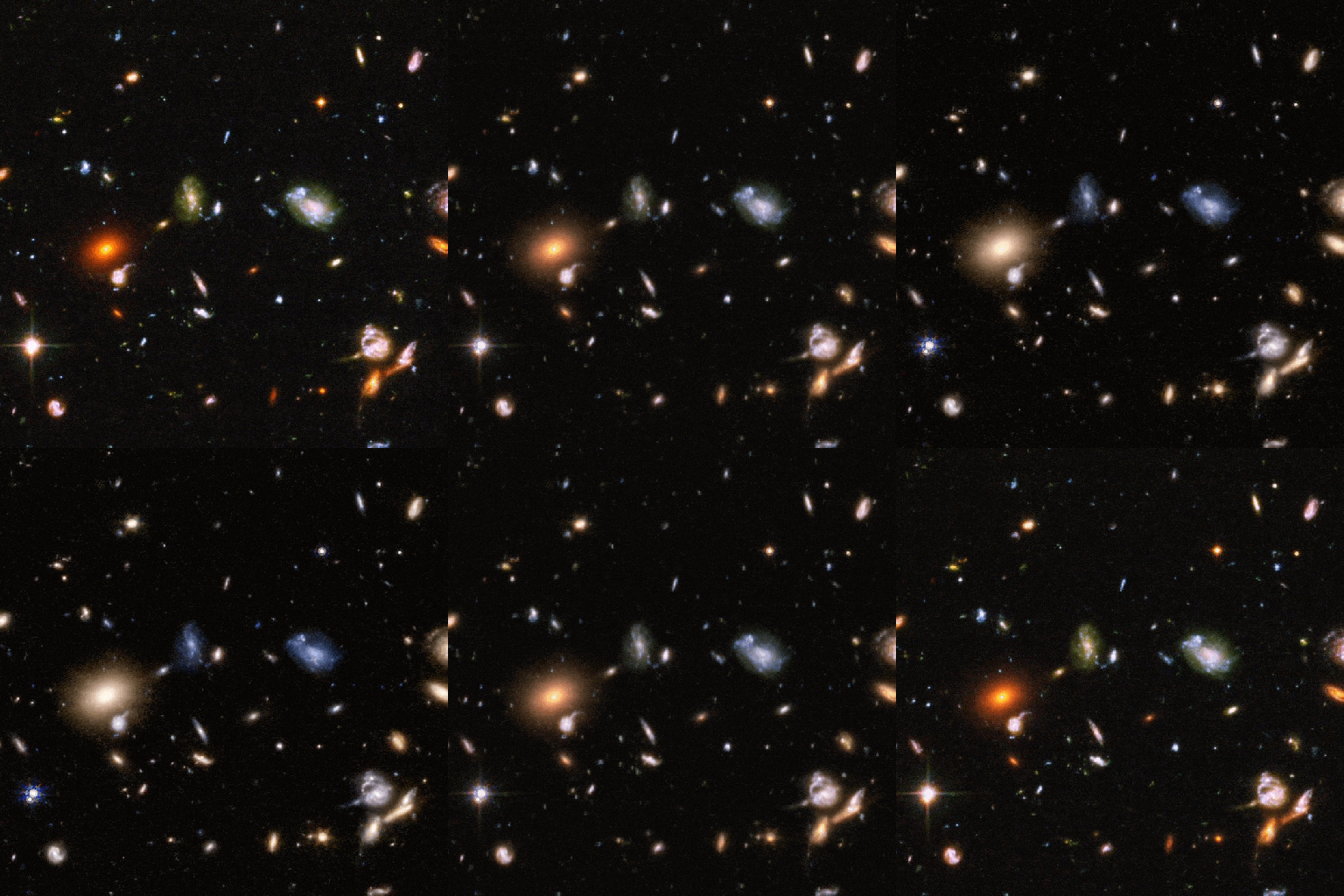
The "little red dots" were touted as being too massive, too early, for cosmology to explain. With new knowledge, everything adds up.

Here on Earth, we commonly use terms like weight (in pounds) and mass (in kilograms) as though they're interchangeable. They're not.

In "Life As No One Knows It," Sara Imari Walker explains why the key distinction between life and other kinds of "things" is how life uses information.

So far, Earth is the only planet that we're certain possesses active life processes. Here's what we shouldn't assume about life elsewhere.