




















Search
Astrophysics

The stars circle each other every 51 minutes, confirming a decades-old prediction.

Most exoplanets have been found around single stars via the transit method. But binary star systems might contain even more of them.

Early relics and late-time objects give incompatible results for the expanding Universe. This independent anomaly intensifies the problem.

The DART mission tested whether it's possible to deflect an asteroid by crashing something into it.

"Even with my training, I still got insights from the book’s descriptions. That’s how good Carroll is at explaining physics."

Are you unhappy with how various events in your life turned out? Perhaps, in a parallel Universe, things worked out very differently.

The Universe gravitates so that normal matter and General Relativity alone can't explain it. Here's why dark matter beats modified gravity.

Unfortunately, the Lunar Ark project is an idea more at home in science fiction than science fact.

1.9 billion years ago, a star's explosive death created a black hole. Its light just arrived at Earth. But did it set a cosmic record?

Holograms preserve all of an object's 3D information, but on a 2D surface. Could the holographic Universe idea lead us to higher dimensions?


NASA is creating a planet habitability index, and Earth may not be at the top. With our current data, ranking habitability is guesswork.

Over the past 50 years, 27 leap seconds have been added to our time.

With its first view of a protoplanetary disk around a newly forming star, the JWST reveals how alone individual stellar systems truly are.
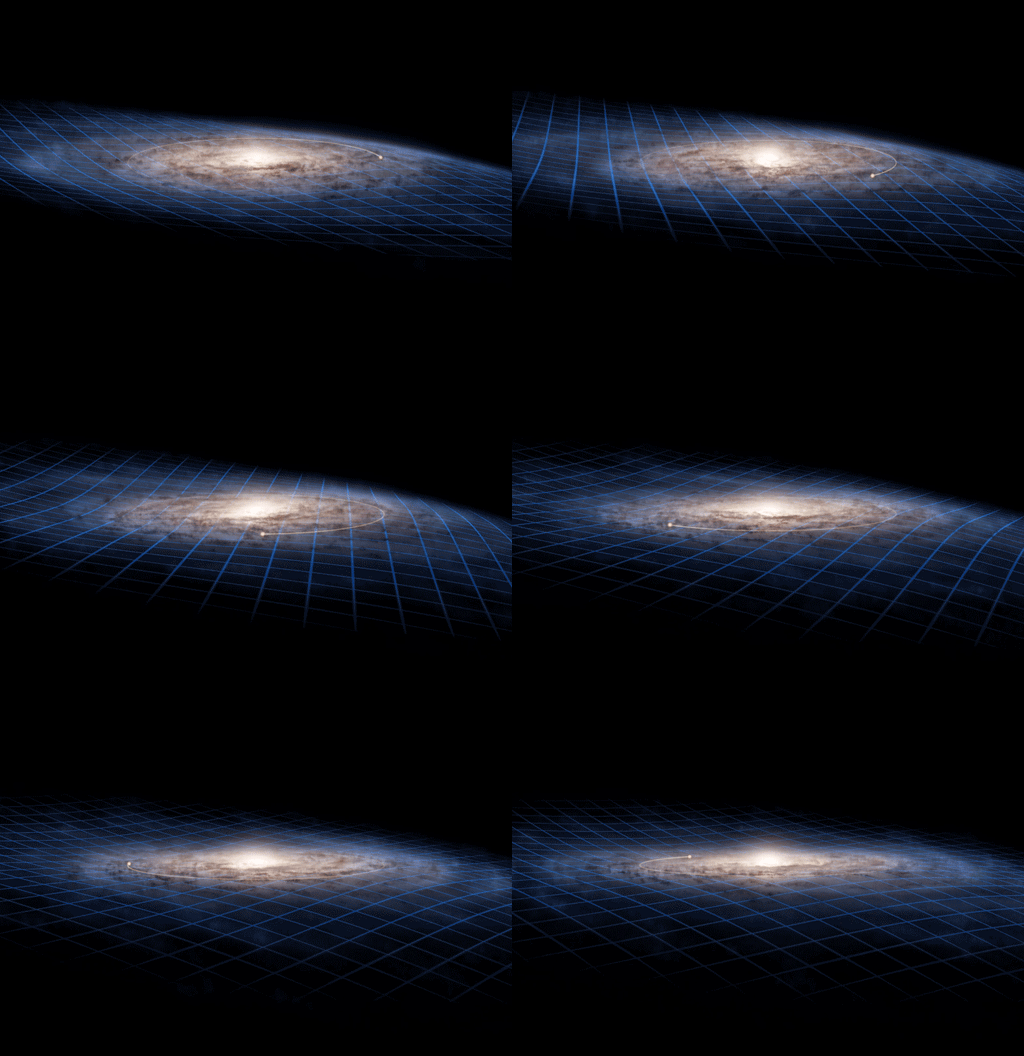
The Universe begins with negligible amounts of angular momentum, which is always conserved. So why do planets, stars, and galaxies all spin?

Venerated astrophysicist Carl Sagan entertained the possibility.

Before we discovered gravitational waves, multi-messenger astronomy got its start with light and particles arriving from the same event.

Uncertainty is inherent to our Universe.

From the tiniest subatomic scales to the grandest cosmic ones, solving any of these puzzles could unlock our understanding of the Universe.

It's the very closest stars to us that hold the key to unlocking the possibilities for life in star systems all throughout the Universe.

In the 20th century, many options abounded as to our cosmic origins. Today, only the Big Bang survives, thanks to this critical evidence.

This technological feat changes our cosmic history.

The Big Bang is commonly misunderstood, warping our understanding about the Universe's size and shape.

The theory is accurate within at least one part in a quadrillion.

The James Webb Space Telescope viewed Neptune, our Solar System's final planet, for the first time. Here's what we saw, and what it means.
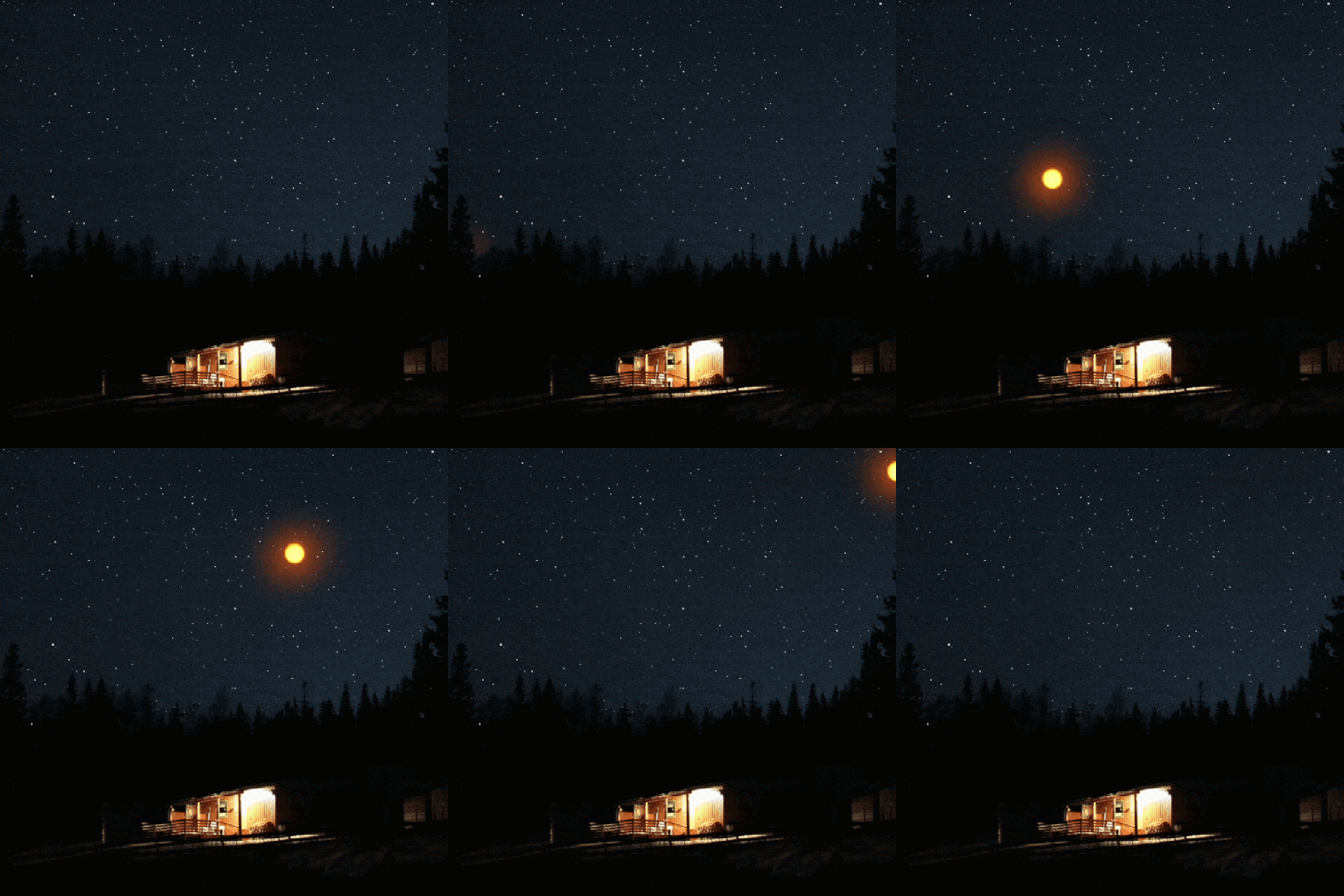
UAP are no laughing matter anymore.

When people pick the greatest scientist of all-time, Newton and Einstein always come up. Perhaps they should name Johannes Kepler, instead.

Recent research suggests that Earth’s magnetic field bounced back just as complex life was starting to emerge on our planet.

You would think that with all our technology, like the James Webb Space Telescope, we would know how big the Universe is. But we don't.

Black holes aren't just the densest masses in the Universe, but they also spin the fastest of all massive objects. Here's why it must be so.