




















Search
Astrophysics

On the morning of June 30, 1908, an explosion of more than 10 megatons occurred above the sparsely populated Siberian Taiga. What caused the so-called Tunguska event?

In our common experience, you can't get something for nothing. In the quantum realm, something really can emerge from nothing.
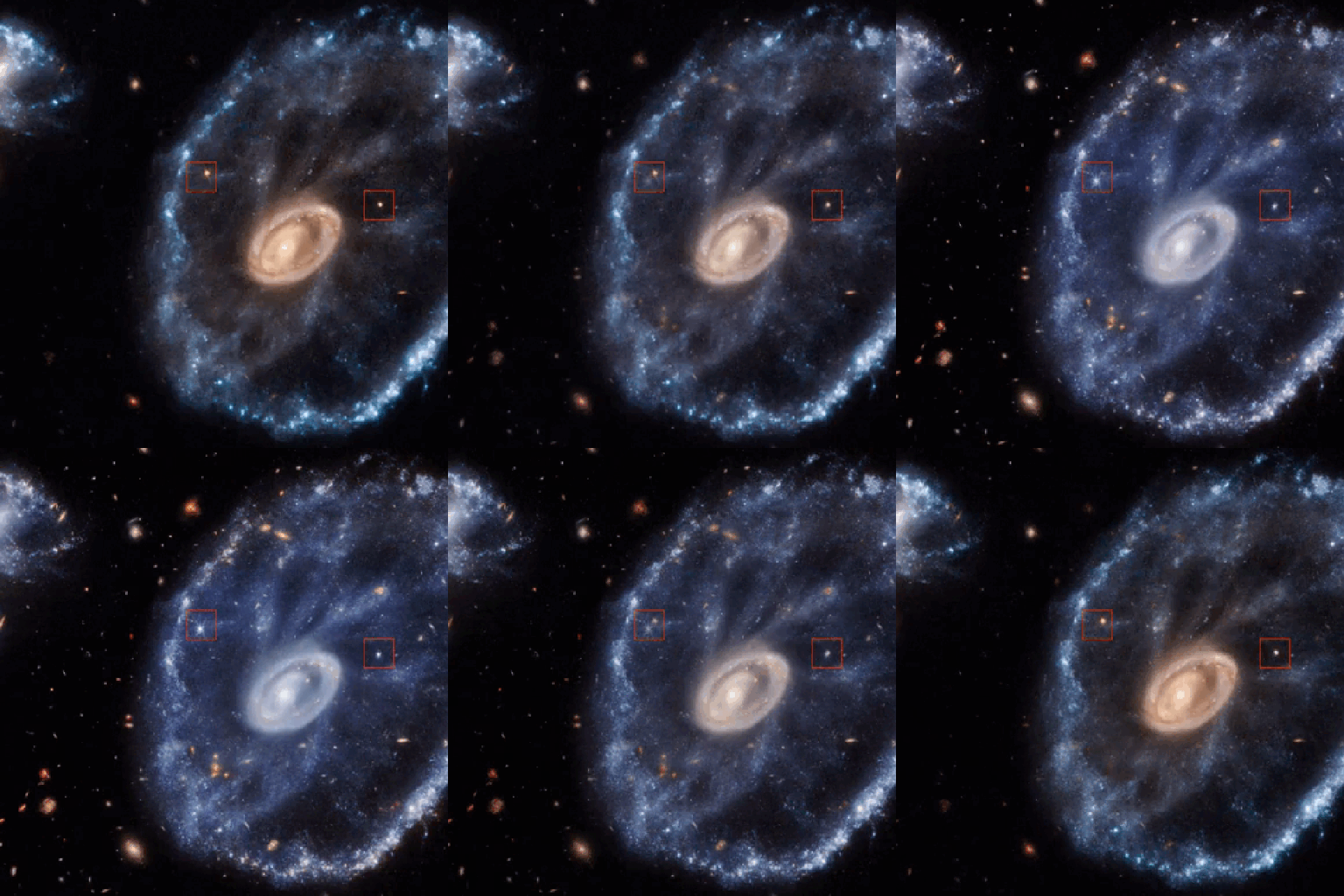
The first set of James Webb's images blew us all away. In just 2 mere months, it's seen highlights that no one could have predicted.

As recently as 1990, we didn't know of any planets beyond our Solar System. Today, with 5000+, we're deep into the weeds of how they form.

Each of us carries our own version of the Multiverse in our heads.


No planet enters retrograde more frequently than Mercury, which does so 3-4 times each year. Here’s the scientific explanation for why.

Asteroid collisions aren't always bad.

Spaceguard shows that we can manage risks to the extinction of humanity — if only we put our mind to it.

Remembering Frank Drake, who transformed the search for alien life & extraterrestrial intelligence into a full-fledged scientific endeavor.

Einstein's relativity teaches us that time isn't absolute, but passes relatively for everyone. So how do telescopes see back through time?

Oxygen isn't strictly necessary for combustion, but it is ideal. Any advanced (alien) civilization probably uses oxygen to burn things.

The last 70 years have taken us farther than the previous 70,000. But can we accomplish more than creating a record saying, "We were here?"

If your computer crashes, it might be due to a star that exploded somewhere in the Universe millions of years ago.

From black holes to dark energy to chances for life in the Universe, our cosmic journey to understand it all is just getting started.

No. No no no. Just... no. The JWST has truly blown our scientific minds, but it's a pure crackpot idea that the Big Bang is now disproven.

Unexpected images of galaxies from the James Webb Space Telescope do not disprove the Big Bang. There are other likelier explanations.

Hubble revolutionized astronomy more than once. Here's what we can expect from the James Webb Space Telescope.

Einstein's "happiest thought" led to General Relativity's formulation. Would a different profound insight have led us forever astray?

Our model of the Universe, dominated by dark matter and dark energy, explains almost everything we see. Almost. Here's what remains.

In special relativity, the statement that two events happened at the same time is meaningless.


The anthropic principle has fascinating scientific uses, where the simple fact of our existence holds deep physical lessons. Don't abuse it!

The false assumption the Multiverse relies on is that something which exists requires an explanation.

At their cores, stars can reach many millions or even billions of degrees. But even that doesn't touch the hottest of all.

The key problem with the dark matter hypothesis is that nobody knows what form dark matter might take.

There's an extra source of massive "stuff" in our Universe beyond what gravitation and normal matter can explain. Could light be the answer?

If you have an old TV set with the "rabbit ear" antennae, and you set it to channel 03, that snowy static can reveal the Big Bang itself.

Unless you have a critical mass of heavy elements when your star first forms, planets, including rocky ones, are practically impossible.

There's an extremely good chance that there is, or at least was, life on Mars. But is it native to Mars, or did it originate from Earth?