




















Search
Astrophysics

As technology advances, the use of laser weapons in space becomes more likely.

Not too hot, not too cold...
In all the Universe, only a few particles are eternally stable. The photon, the quantum of light, has an infinite lifetime. Or does it?

With a telescope at just the right distance from the Sun, we could use its gravity to enhance and magnify a potentially inhabited planet.

"You develop an instant global consciousness, a people orientation, an intense dissatisfaction with the state of the world, and a compulsion to do something about it."

We only detected our very first gravitational wave in 2015. Over the next two decades, we'll have thousands more.

We knew we'd find galaxies unlike any seen before in its first deep-field image. But the other images hold secrets even more profound.

The emergence of life in the universe is as certain as the emergence of matter, gravity, and the stars. Life is the universe developing a memory, and our chemical detection system could find it.
John Templeton Foundation

Ever since the start of the hot Big Bang, time ticks forward as the Universe expands. But could time ever run backward, instead?

"The surface is no longer a record of every impact the moon has ever had, because at some point, impacts were erasing previous impacts."

Quantum communication offers a surer path to sending an interstellar message, as well as receiving one. But can we do it?

Even though the leftover glow from the Big Bang creates a bath of radiation at only 2.725 K, some places in the Universe get even colder.

We live in a four-dimensional Universe, where matter and energy curve the fabric of spacetime. But time sure is different from space!

The costs of such an endeavor would be extremely high, while the potential payoffs would be uncertain.

Take a peek at the pre-release images used to calibrate and commission JWST's coldest instrument, now ready for full science operations.

The psychology of alien contact largely revolves around the concept of "otherness." We need to learn to be comfortable around strange things.

It started with a bang, but won't end with one. Instead, it will "rage against the dying of the light" like nothing you've ever imagined.

Like humans, stars die. The James Webb Space Telescope's early images already give us a lot of information about how this happens.

Even with only 12.5 hours of exposure time, James Webb's first deep-field image taught us lessons we've never realized before.

Astronomy's roots rest in the very origins of humanity. We have always looked to the skies for answers. We are starting to get them.

Now that it's fully commissioned, the James Webb Space Telescope begins its exploration of the Universe. Here are its first science images!

With its very first deep-field view of the Universe now released, the James Webb Space Telescope has shown us our cosmos as never before.

Some ozone experts seriously doubt the findings.
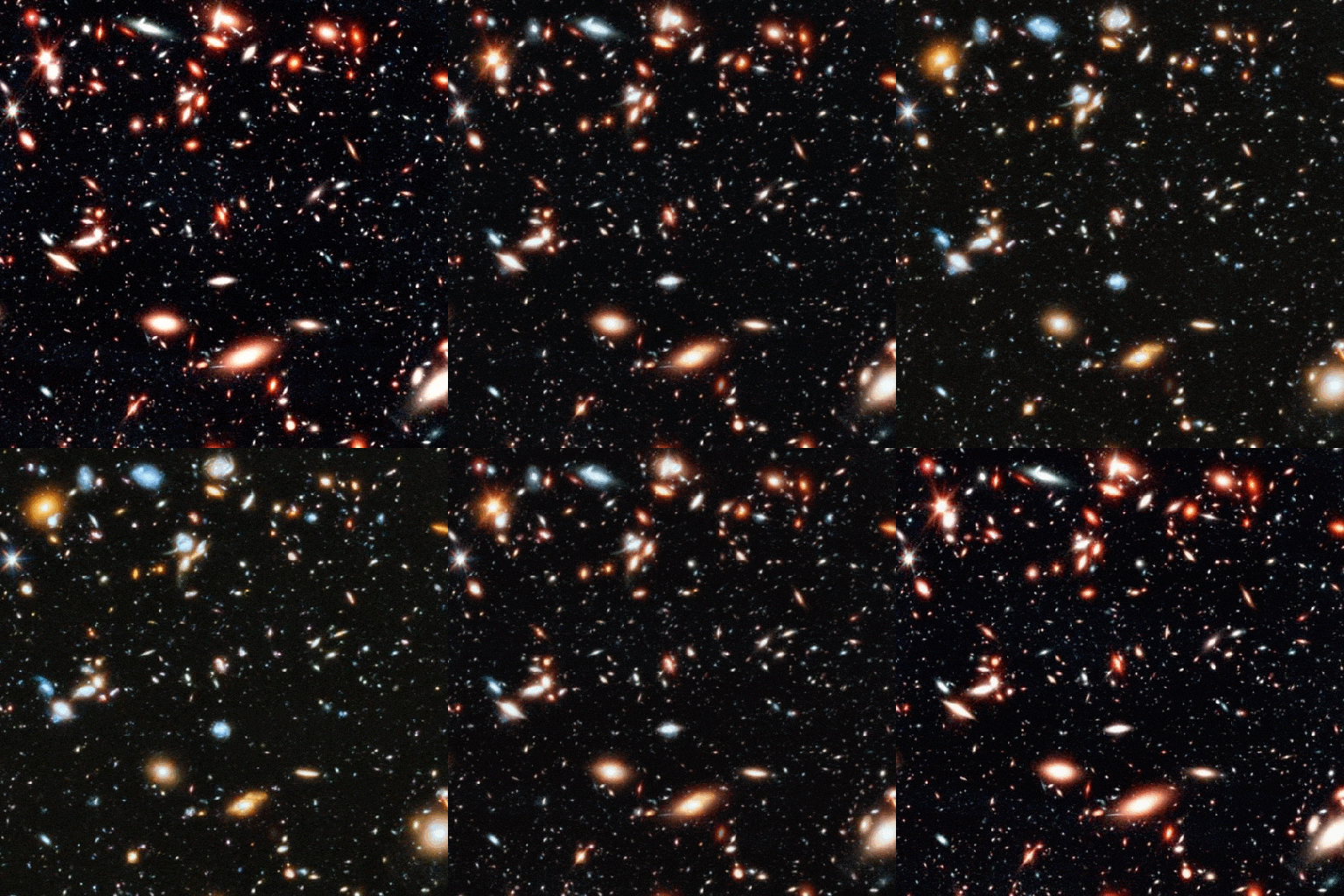
The James Webb Space Telescope has chosen 5 targets for its first science release. Here's what we know on the eve of JWST's big reveal!

It might seem like science and faith are at war, but the two have a historical synergy that extends back in time for centuries.
John Templeton Foundation

LIGO can detect the inspirals and mergers of the lowest-mass black holes, but not the biggest ones. Here's how pulsars can help.

On Earth, carbon can form millions of compounds, while silicon is largely stuck inside rocks. But elsewhere, silicon could form the basis of life.

At all distances, the Universe expands along our line-of-sight. But we can't measure side-to-side motions; could it be rotating as well?


1859's Carrington event gave us a preview of how catastrophic the Sun could be for humanity. But it could get even worse than we imagined.