




















Search
Astrophysics

Your eyes are playing tricks on you.

The idea of gravitational redshift crossed Einstein's mind years before General Relativity was complete. Here's why it had to be there.

No matter how beautiful, elegant, or compelling your idea is, if it disagrees with observation and experiment, it's wrong.

Experts believe they could cut the time it takes a rocket to reach Mars by up to 25%, shaving about two months off the trip.

The Universe is expanding, and the Hubble constant tells us how fast. But how can it be a constant if the expansion is accelerating?

Quite a lot, actually, even though it has no identifiable value as a scientific concept.

The discovery calls into question the few things scientists know about these powerful astronomical phenomena.
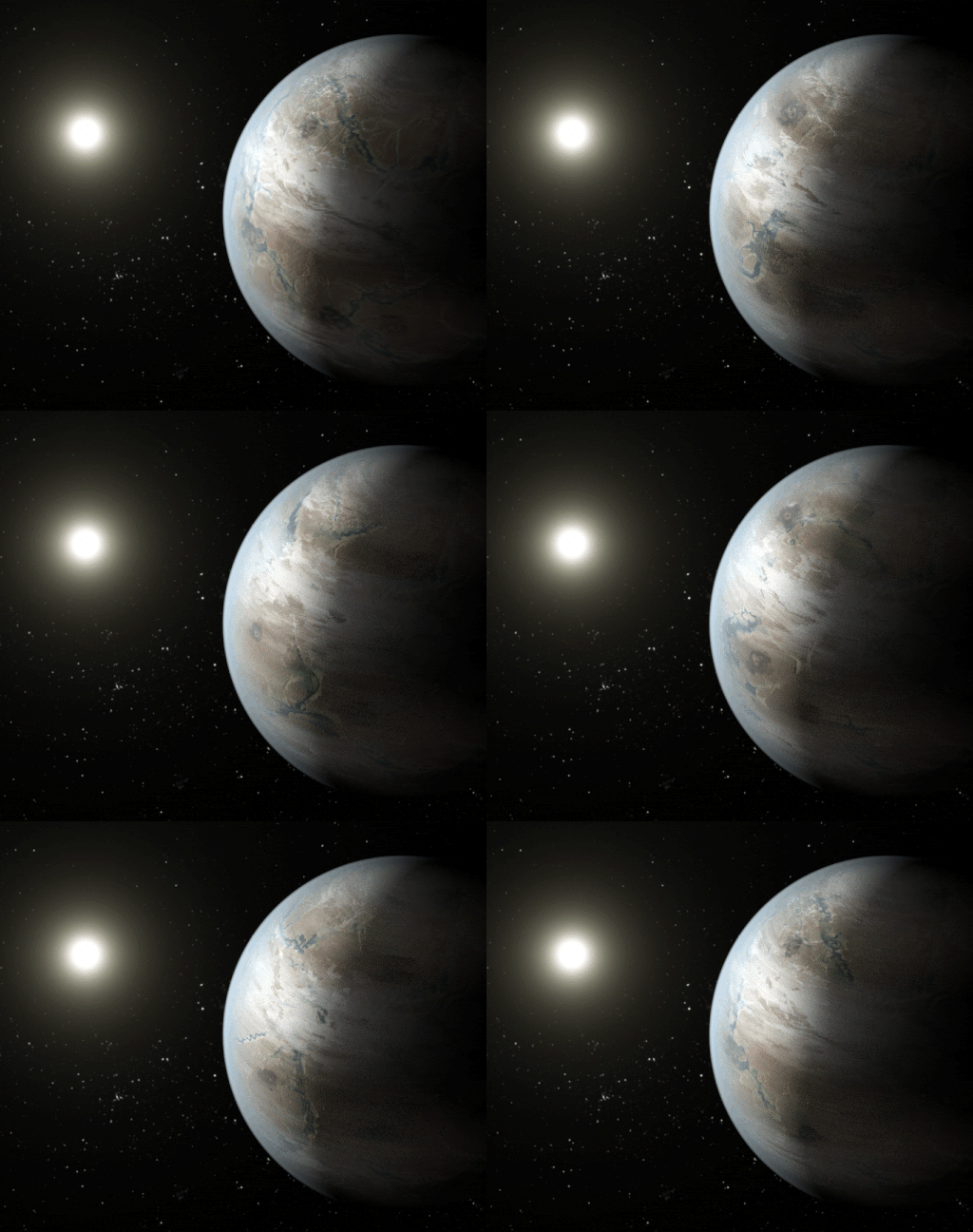
There are billions of potentially inhabited planets in the Milky Way alone. Here's how NASA will at last discover and measure them.

Do you think you know the Solar System? Here's a fact about each planet that might surprise you when you see it!
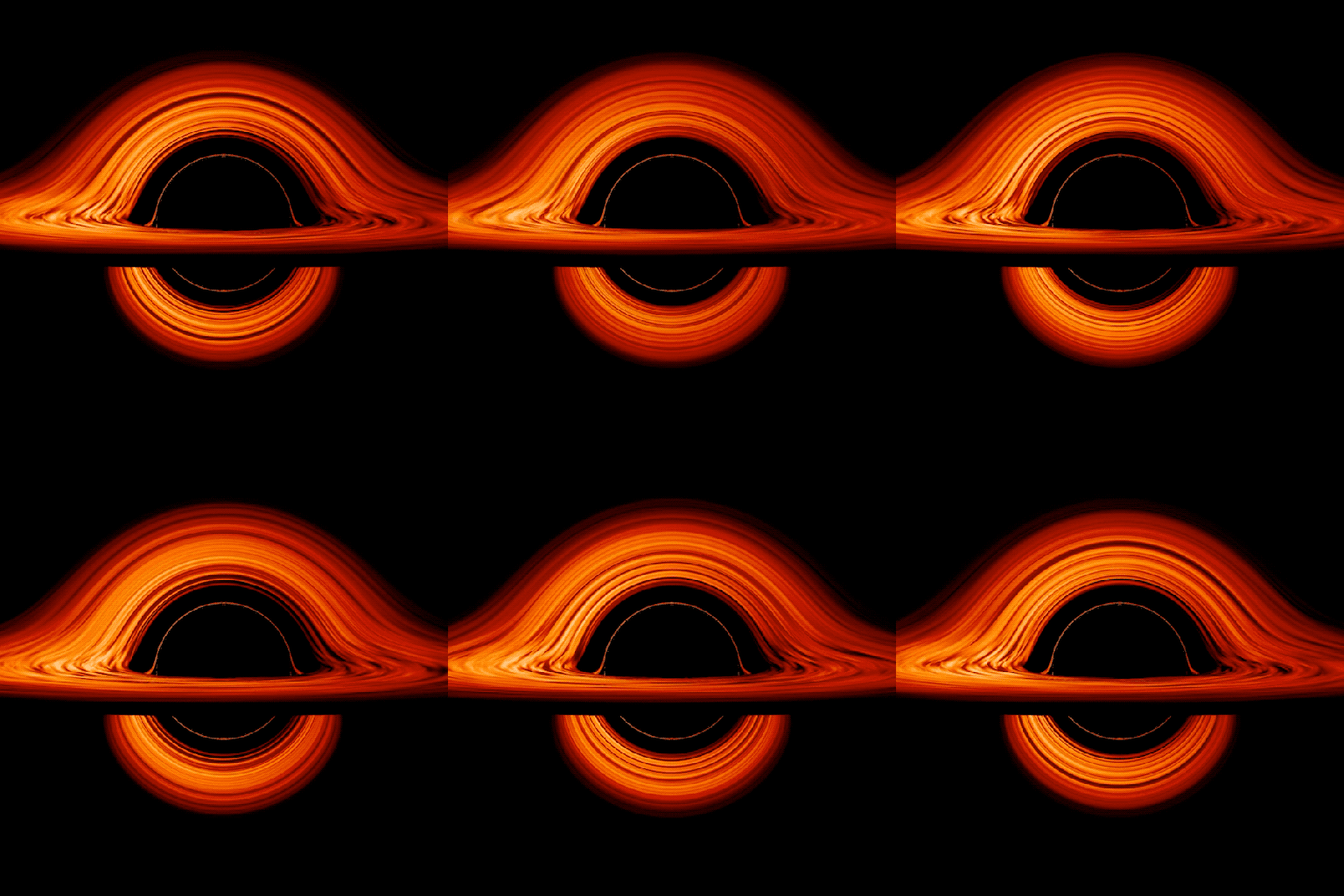
With two different black hole event horizons now directly imaged, we can see that they are, in fact, rings, not disks. But why?

When stars form, they emit energetic radiation that boils gas away. But it can't stop gravitational collapse from making even newer stars.

The James Webb Space Telescope (JWST) will study many dangerous cosmic phenomena, knowledge of which may help save humanity.

If you think you know how an astronomical nova works, buckle up. You're in for a ride like you never expected.

Earth is the Solar System's only known inhabited planet. Could Venus, if its phosphine signal is real, be our second world with life?

On July 12, 2022, NASA will release the first science images taken with the James Webb Space Telescope. Here's what to hope for.

The James Webb Space Telescope is about to begin science operations. Here's what astronomers are excited about.

Where did the “seed” magnetic field come from in the first place?

There's a whole lotta shakin' goin' on beneath the single plate of Mars.

In all of science, no figures have changed the world more than Einstein and Newton. Will anyone ever be as revolutionary again?

Preventing scurvy is not just a problem in the Antarctic.


We've only seen Uranus up close once: from Voyager 2, back in 1986. The next time we do it, its features will look entirely different.

On July 12, 2022, JWST will release its first science images. Here are 5 ways the telescope's findings could change science forever.

Researchers have discovered 830-million-year-old microbes living inside a salt rock on Earth. Could the same occur on Mars?

There is nothing more important to science than its ability to prove ideas wrong.

Over time, the Universe becomes less dominated by dark matter and more dominated by dark energy. Is one transforming into the other?


13.8 billion years ago, the hot Big Bang gave rise to the Universe we know. Here's why the reverse, a Big Crunch, isn't how it will end.

Atomic clocks keep time accurately to within 1 second every 33 billion years. Nuclear clocks could blow them all away.

In all of human history, only 5 spacecraft have had the right trajectory to exit the Solar System. Will they ever catch Voyager 1?