




















Search
Astrophysics

In ~7 billion years, our Sun will run out of fuel and die. So will every star, eventually. Here are the different fates they'll encounter.

In 2023, data from the James Webb Space Telescope soured hopes that TRAPPIST-1 c had an atmosphere. That disappointment might have been premature.

The mutual distance between well-separated galaxies increases with time as the Universe expands. What else expands, and what doesn't?

The number of planets that could support life may be far greater than previously thought, a recent discovery suggests.

It’s not a gambit. It’s not fraud. It’s not driven by opinion, prejudice, or bias. It's not unchallengeable. And it's more than facts alone.

The most iconic, longest-lived space telescope of all, NASA's Hubble, is experiencing orbital decay as the solar cycle peaks. Here's why.

We normally think of dark matter as the "glue" that holds galaxies and larger structures together. But it's so much more than that.

There are many theories of gravity out there, and many interpretations of wide binary star data. What have we really learned from it all?

The evidence that the Universe is expanding is overwhelming. But how? By stretching the existing space, or by creating new space itself?

IceCube scientists have detected high-energy tau neutrinos from deep space, suggesting that neutrino transformations occur not only in lab experiments but also over cosmic distances.

In 2017, we detected gold being forged in a neutron star-neutron star merger. Now, in 2024, the amounts created simply don't add up.

Learning to decode complex communication on Earth may give us a leg up if intelligent life from space makes contact.

The most iconic "dark nebula" of all lights up under JWST's infrared gaze. Here's what's newly discovered inside.

If the past is any guide, things are going to take off quickly.

Holograms preserve all of an object's 3D information, but on a 2D surface. Could the holographic Universe idea lead us to higher dimensions?

In general relativity, white holes are just as mathematically plausible as black holes. Black holes are real; what about white holes?

An interview with Lisa Kaltenegger, the founding director of the Carl Sagan Institute, about the modern quest to answer an age-old question: "Are we alone in the cosmos?"

This first-of-its-kind image offers a detailed look at the magnetic fields within the Central Molecular Zone.

Astranis is on a mission to help everyone in the world get online.

In the 20th century, many options abounded as to our cosmic origins. Today, only the Big Bang survives, thanks to this critical evidence.

For some reason, when we talk about the age of stars, galaxies, and the Universe, we use "years" to measure time. Can we do better?

The JWST's observations of well-developed galaxies early in universal history may coincide with accepted astronomical theory after all.

The most common element in the Universe, vital for forming new stars, is hydrogen. But there's a finite amount of it; what if we run out?

Life arose on Earth very early on. After a few billion years, here we are: intelligent and technologically advanced. Where's everyone else?

Total eclipses are a product of a strange and almost eerie cosmic coincidence — one that makes Earth an even rarer world in the galaxy and, by proxy, in the Universe.

Our Universe requires dark matter in order to make sense of things, astrophysically. Could massive photons do the trick?

Explore how the study of exoplanets is transforming our understanding of ocean formation.

The Universe is expanding, and the Hubble constant tells us how fast. But how can it be a constant if the expansion is accelerating?

Here's what recent DESI measurements suggest — and why it's too early to update conventional predictions about the Universe's distant future.
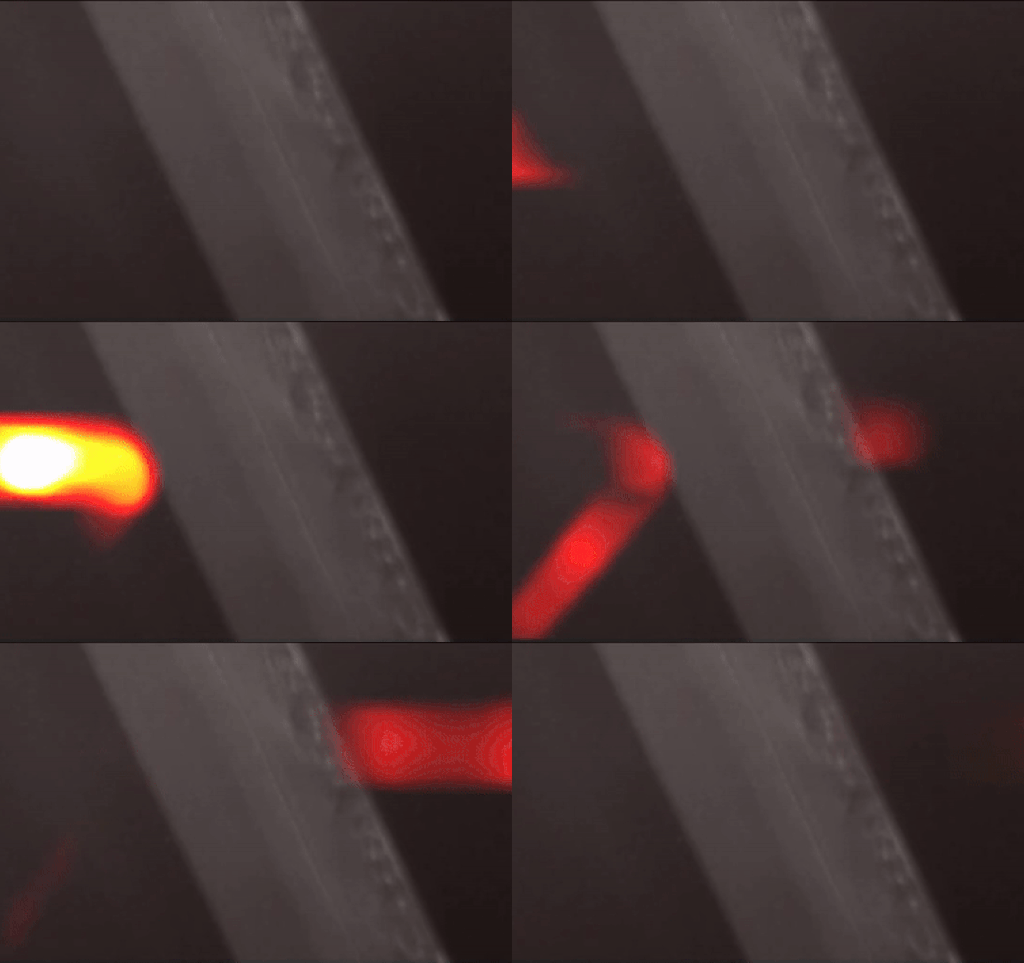
In all the Universe, only a few particles are eternally stable. The photon, the quantum of light, has an infinite lifetime. Or does it?