




















Search
Astrophysics

Some 13.8 billion years ago, the Universe became hot, dense, and filled with high-energy quanta all at once. Here's what it was like.

Two of the answers add a dimension to physics that doesn’t belong there. Maybe we could call it "astrotheology."

With LEDs bringing brighter nighttime lighting than ever before, and thousands of new satellites polluting the skies, astronomy needs help.

Bang bang all over the Universe.

Finding alien technology on the seafloor would be truly incredible. This extraordinary claim, however, is debunked by the actual evidence.

In 1667, a core-collapse supernova happened right here in the Milky Way, invisible to all humans. ~350 years later, here's what JWST sees.

When we look at our Sun, its properties are incredibly constant, varying by merely ~0.1% over time. But all stars don't play by those rules.

Light can be turned into heat, which can then be turned into motion, and the effect of that motion can be turned into a big squeeze.

All matter particles can act as waves, and massless light waves show particle-like behavior. Can gravitational waves also be particle-like?

We need a hypothesis that accounts for both the fine-tuning of physics for life but also the arbitrariness and gratuitous suffering we find in the world.

With JWST, Chandra, and gravitational lensing combined, evidence has emerged for the earliest black hole ever. And wow, is it a surprise!

What do ghosts and anomalous galaxy rotation rates have in common? Some sci-fi enthusiasts believe the answer involves "parallel universes."

Sometimes, going "deeper" doesn't reveal the answers you seek. By viewing more Universe with better precision, ESA's Euclid mission shines.

The TRAPPIST-1 system is a treasure trove of possibilities and questions. Observations by JWST have just begun.

If the Universe is expanding, and the expansion is accelerating, what does that tell us about the cause of the expanding Universe?

Everything we observe beyond our Local Group is speeding away from us, omnidirectionally. If the Universe is expanding, where is the center?

In 1054, a core-collapse supernova occurred 6500 light-years away. In 2023, JWST imaged the remnant, and might solve a massive mystery.

Out of the four rocky planets in our Solar System, only Earth presently has plate tectonics. But billions of years ago, Venus had them, too.

For the first time, astronomers have created a data-driven estimate for how many black holes are in our Universe: more than anyone expected.
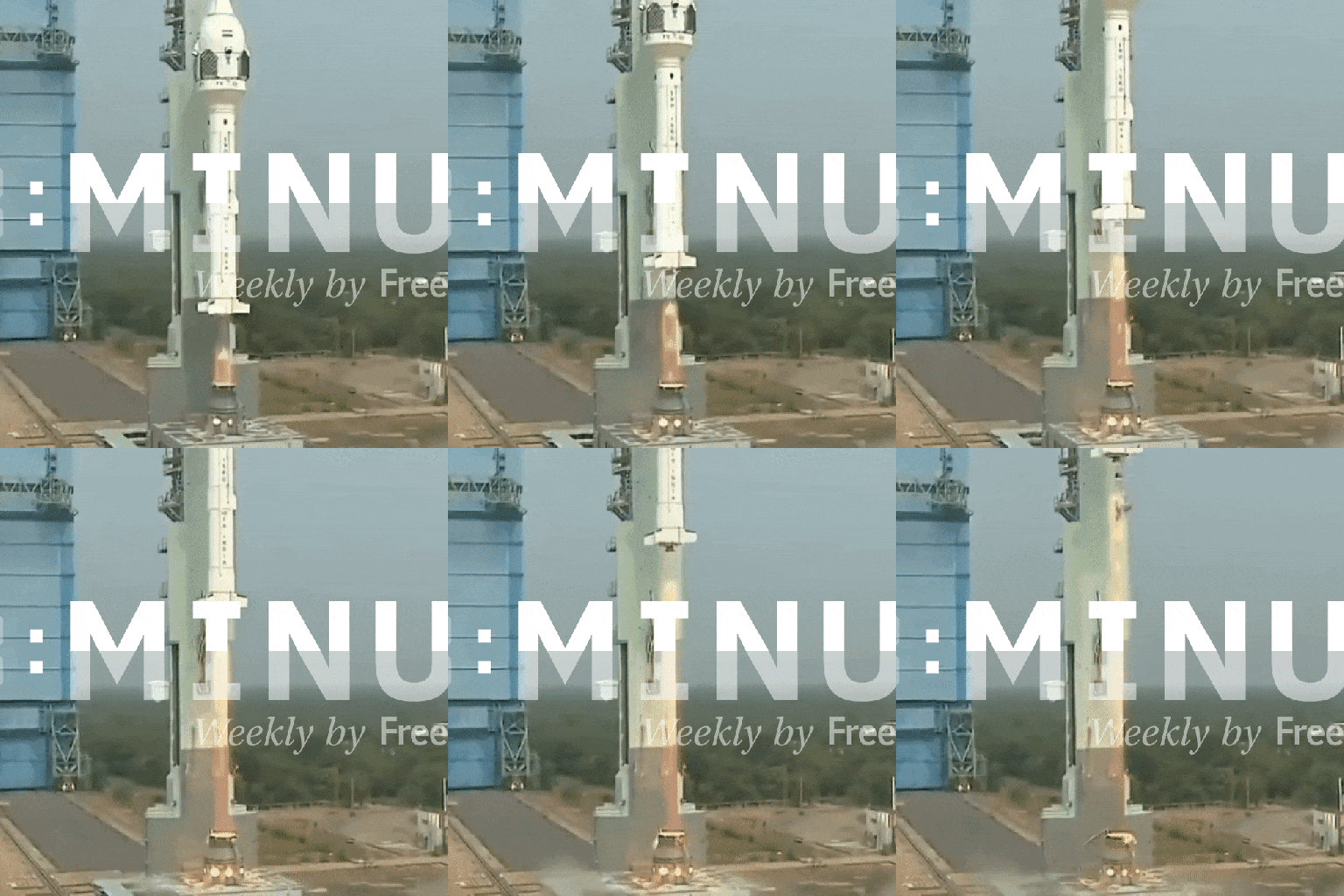
See the 3 biggest space stories from October 16-22, 2023.

Sophisticated rovers have found the conditions for Martian life, as well as the building blocks of life, but never life itself. AI can help.

If you said "with the Big Bang," congratulations: that was our best answer as of ~1979. Here's what we've learned in all the time since.

Einstein's theory of general relativity introduced the concept of space having a shape. So, what is the shape of space?

"If we find just one other example of biology out there, then life is not an accident."

There's a quantum limit to how precisely anything can be measured. By squeezing light, LIGO has now surpassed all previous limitations.

A true scientific view of if, where, and when extraterrestrial life exists is within our grasp thanks to biosignatures and technosignatures.

A woman’s name would undermine the credibility of the mission. Names of former Nazis, however, were no problem.

“To take this in, you need to ride inside the mathematical symbols.”

JWST has already broken many of Hubble's cosmic records. Perhaps additional record-breakers already exist within this data-rich image?

Back during the hot Big Bang, it wasn't just charged particles and photons that were created, but also neutrinos. Where are they now?