




















Search
Astrophysics


Each year in mid-August, Earth plows through the debris stream of an enormous comet, creating the Perseids. 2023's show will be magnificent!

Even with the quantum rules governing the Universe, there are limits to what matter can withstand. Beyond that, black holes are unavoidable.

There are two types of missing, or "dark" matter: baryonic (made of normal matter) and non-baryonic. Have we finally found the normal stuff?

Nothing can escape from a black hole. So where do Hawking radiation, relativistic jets, and X-ray emissions around black holes come from?

Ultracold gases in the lab could help scientists better understand the universe.

Back in the 1930s, Fritz Zwicky postulated the existence of dark matter. No one took it seriously until Vera Rubin's work: 40 years later.

Can two planets stably share the same orbit? Conventional wisdom says no, but a look at Saturn's moons might tell a different story.

All stars, eventually, run out of fuel and die. Given all the stars we can see and the vast distance to them, are any of them already dead?

Over 50 years since humans last walked on the Moon, astronaut footprints and rover tracks are still visible. But they won't last forever.

Today, our observable Universe extends for 46 billion light-years in all directions. But early on in our history, things were much smaller.

The concept of the warp drive is currently at odds with everything we know to be true about physics.

The giant impact theory suggests our Moon was formed from proto-Earth getting a Mars-sized strike. An exoplanet system shows it's plausible.

For many years, cosmologists have claimed the Universe is 13.8 billion years old. A new paper says no, it's 26.7 billion. How do we decide?

If you've found yourself befuddled by extraordinary scientific-sounding claims, you're not alone. But this centuries-old lesson can help.

What are supermassive black holes, how common are they, and how do they grow up throughout cosmic history? Listen and find out!

The separation of pleasure from procreation may occur throughout the cosmos, providing an explanation for the Fermi Paradox.

A Harvard astronomer went to the bottom of the ocean, claiming he recovered alien technology. But what does the science actually indicate?

The space telescope's findings challenge the notion of a galaxy brimming with life.

From the present day all the way to less than 400 million years after the Big Bang, we're seeing how the Universe grew up like never before.

Get ready for the most peculiar road trip that will help you understand the vastness and emptiness of the solar system — and Sweden.

Some 55 million light-years away lies the giant galaxy Messier 87. Its supermassive black hole, inside and out, looks better than ever.

Headlines have blared that quasar ticking confirms that time passed more slowly in the early Universe. That's not how any of this works.

For thousands of years, we puzzled at how far away the Moon was. Today we know its distance, at any time, to within millimeters.

While Saturn and its moons all appear faint and cloudy to JWST, Saturn's rings are the star of the show. Here's the big scientific reason.
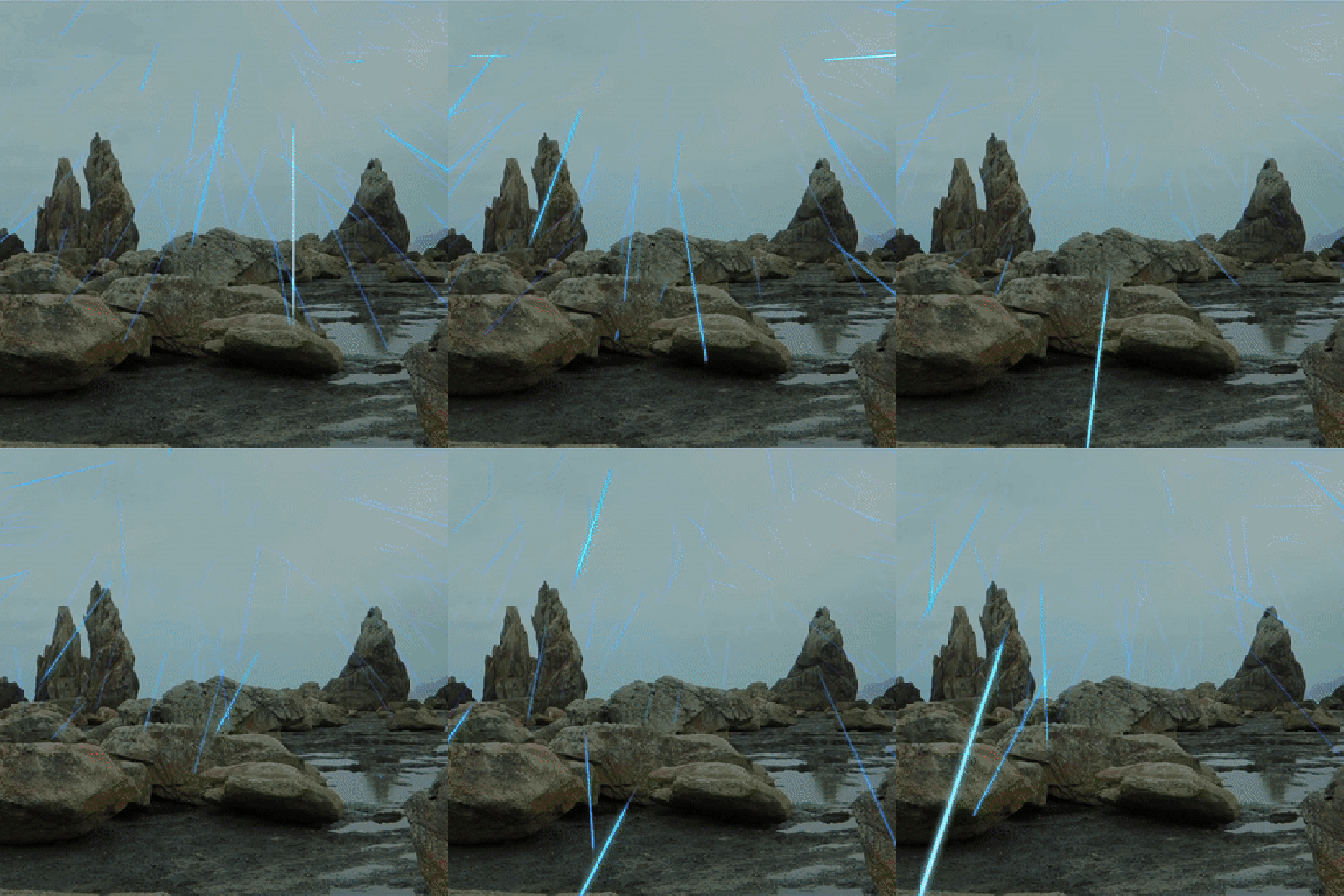
Lost in a building or underwater? A new muon-based navigation system could be your guide.

After 15 years of monitoring 68 objects known as millisecond pulsars, we've found the Universe's background gravitational wave signal!

In one experiment, the Viking landers added water to Martian soil samples. That might have been a very bad idea.

A cute mathematical trick can "rescale" the Universe so that it isn't actually expanding. But can that "trick" survive all our cosmic tests?

In a distant galaxy, a cosmic dance between two supermassive black holes emits periodic flashes of light.