




















Search
Astrophysics

As the Earth spins and wobbles on its axis and revolves elliptically around the Sun, each day changes from the last. "24 hours" isn't right.
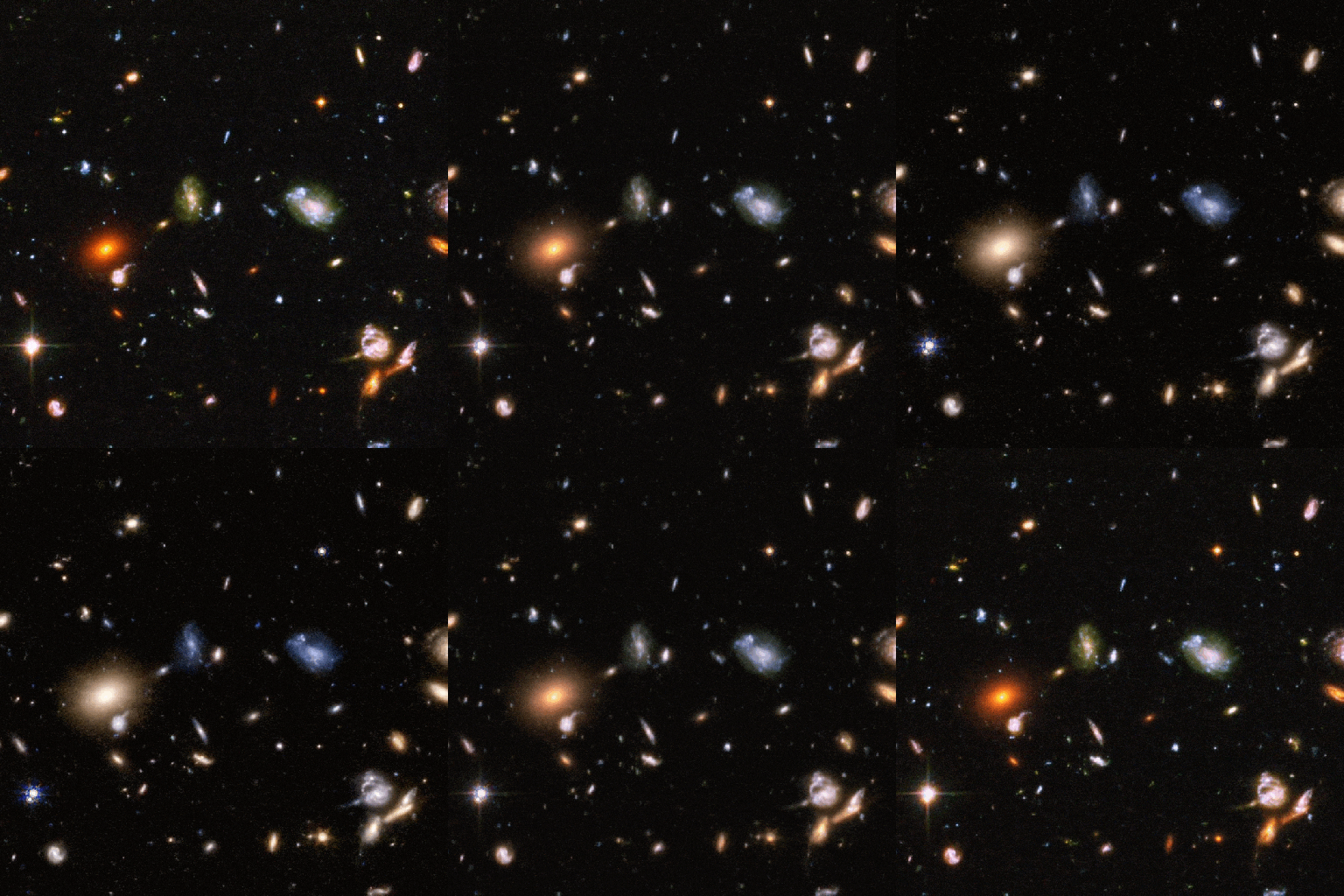
The farther away they get, the smaller distant galaxies look. But only up to a point, and beyond that, they appear larger again. Here’s how.

From a photon's viewpoint, the Universe is timeless and dimensionless.

The multiverse pushes beyond the limits of the scientific method. From our vantage point in the Universe, we cannot know if it's real.

The familiar terrain of solids, liquids, and gases gives way to the exotic realms of plasmas and degenerate matter.

In many ways, we are still novices playing with toy models seeking to understand the stars.

Despite the enormous mass of the Earth, simply depleting our groundwater is changing our axial tilt. Simple Newtonian physics explains why.

In physics, we reduce things to their elementary, fundamental components, and build emergent things out of them. That's not the full story.

In a far-reaching discovery with astrophysicist Karolina Garcia, we discuss what's in the Universe and how it grew up.

What do the dark recesses of the early Universe and Zelda: Tears of the Kingdom have in common? More than you could have ever hoped for.

How are we to deal with the quantization of spacetime and gravity?

The brightest gamma-ray burst ever observed, GRB 221009A behaved in unexpected ways that might help us understand how they occur.

Sun-like stars live for around 10 billion years, but our Universe is only 13.8 billion years old. So what's the maximum lifetime for a star?

Neuroscientist and author Bobby Azarian explores the idea that the Universe is a self-organizing system that evolves and learns.

With hundreds of billions of stars burning bright, some galaxies are already dead. Their inhabitants might not know it, but we're certain.

There are 40 billion billion black holes in the universe. Here’s how our Solar System stacks up against ten of them.

We don't know what causes Miyake events, but these great surges of energy can help us understand the past — while posing a threat to our future.

Exoplanet LP 791-18d is likely to have an atmosphere and liquid water.

Just by observing the tiny amount of deuterium left over from the Big Bang, we can determine that dark matter and dark energy must exist.

There is no such thing as a void in the Universe.

Gamma-ray bursts are so powerful they could vaporize the Earth from 200 light-years away. Recreating them in the lab is not easy.

Hubble showed us what our modern day Universe looks like. JWST's big goal was to teach us how the Universe grew up. Here's where we are now.

With no other galaxies in its vicinity for ~100 million light-years in all directions, it's as isolated and lonely as a galaxy can be.

The outer planets' clouds hide the weirdness within.

There are two methods to measure the expansion rate of the Universe. The results do not agree with each other, and this is a big problem.

In 1974, Hawking showed that black holes aren't stable, but emit radiation and decay. Nearly 50 years later, it isn't just for black holes.
The concept of ‘relativistic mass’ has been around almost as long as relativity has. But is it a reasonable way to make sense of things?

Memorial day is a time to remember veterans killed in the line of service. These spaceflight heroes deserve to be remembered, too.

Particle physicists use gigantic accelerators to investigate the infinitesimal.

It's been 100 years since we discovered that the Universe was expanding. But if it's expanding, then what is it expanding into?