




















Search
Astrophysics

Time gets a little strange as you approach the speed of light.

That scary swirling void from which nothing can escape is our perfect universal translation tool.

Many galaxies really are ultra-distant, but some are just intrinsically red or dusty. Only with spectroscopy can JWST tell which is which.

Mercury, Venus, and Mars are all uni-plate planets, and may always have been. Here's what's known about why Earth, uniquely, has plate tectonics.

We are about to learn a lot more about the most elusive of cosmic particles.
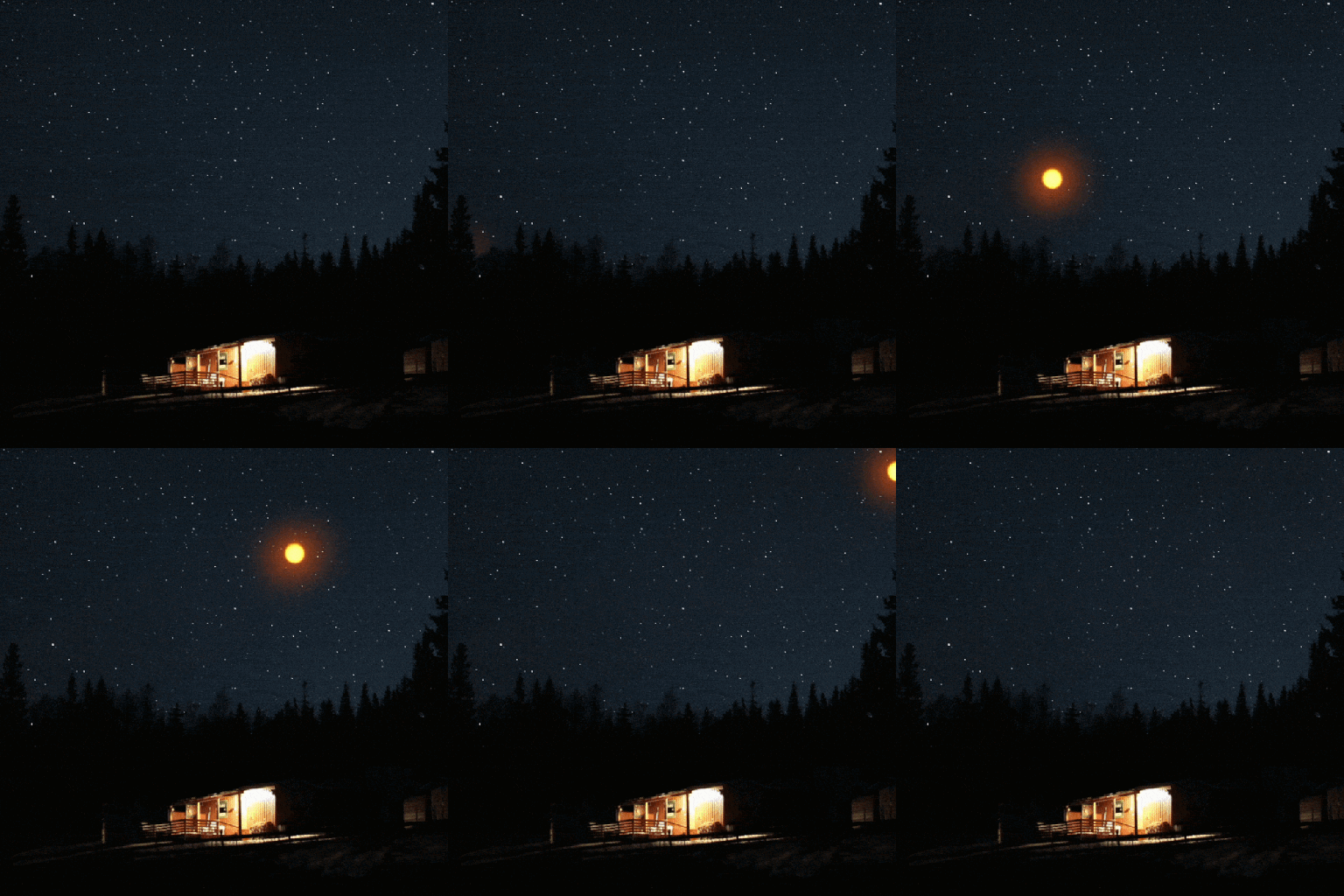
Lots of people have seen lots of bizarre events and phenomena that defy our conventional experience. But is there a scientific explanation?

Temperatures in the Sun's core exceed 10 million degrees Celsius. But how on Earth did we actually come to know that?

With a bigger, better, and more sensitive detector, the XENON collaboration joins LZ and PANDA-X in constraining WIMP dark matter.

What do we mean by a black hole's size? A photon sphere? The minimal stable orbit? The event horizon? The singularity? Which one is right?

Speeding through the Universe and leaving a wake of new stars, this runaway supermassive black hole is likely the first among thousands.

This beautiful JWST image of Wolf-Rayet star WR 124 has been called a "prelude to a supernova" by NASA. That might be entirely wrong.

2023 is an exciting time for the study of quark-gluon plasmas.

Everything everywhere all at once.

How scientists found out that we live in a cosmic aquarium.

When supermassive black holes merge, they emit more energy than anything else to occur in our Universe except the Big Bang.

We can't go back to the Big Bang, nor ahead to the heat death of the Universe. Nevertheless, here are today's natural temperature extremes.

Somewhere out there in the Universe is the heaviest neutron star, and elsewhere lies the lightest black hole. Where's the line between them?

Two very different ideas, wormholes and quantum entanglement, might be fundamentally related. What would "ER = EPR" mean for our Universe?


Even with quantum teleportation and the existence of entangled quantum states, faster-than-light communication still remains impossible.

Not even Einstein immediately knew the power of the equations he gave us.

The zero-point energy of empty space is not zero. Even with all the physics we know, we have no idea how to calculate what it ought to be.

What kind of object will you form? What will its fate be? How long will a star live? Almost everything is determined by mass alone.

A non-invasive method for looking inside structures is solving mysteries about the ancient pyramid.

If stars don't go supernova at first, they can get a second chance after becoming a white dwarf. But can their companions survive?

In our Solar System, even the two brightest planets frequently align in our skies. But only rarely is it spectacularly visible from Earth.

All human development, from large cities to small towns, shines light into the night sky.

If you're a massless particle, you must always move at light speed. If you have mass, you must go slower. So why aren't any neutrinos slow?

Unless you confront your theory with what's actually out there in the Universe, you're playing in the sandbox, not engaging in science.

JWST's revolutionary views arrive in high-resolution at infrared wavelengths. Without NASA's Spitzer first, it wouldn't have been possible.