




















Search
Astrophysics

Was there ever life on Mars? Is there life on Mars now? Did it originate there or here, on Earth? All possibilities are fascinating.

Look out at a distant object, and you're not seeing it as it is today. It's size, brightness, and actual distance are all different.

It was supposed to have a 5.5-10 year lifetime, and take 6 months to calibrate. It's performing better than anyone anticipated.
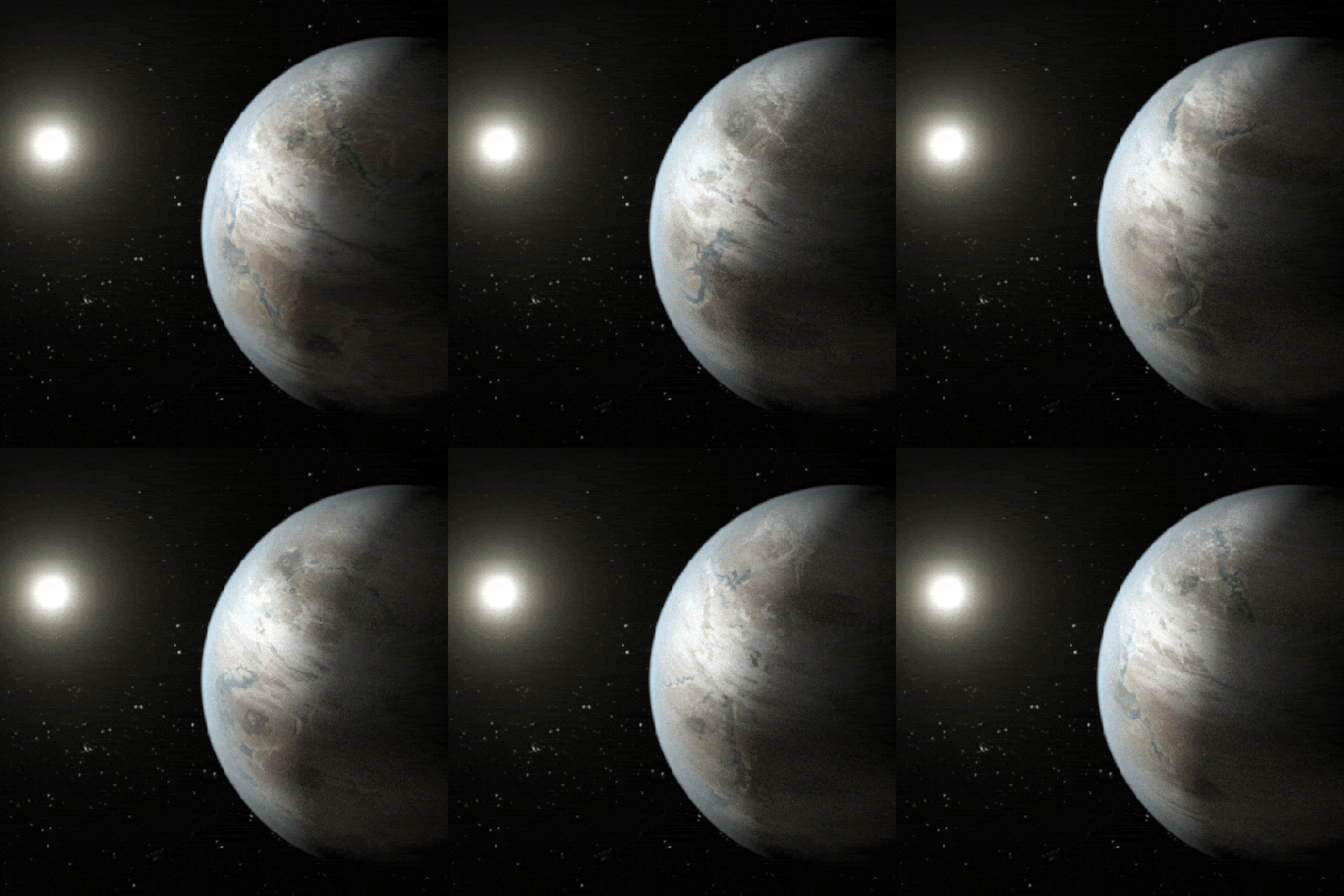
If there are human-sized creatures walking around on other planets, would we be able to view them directly?

Singularities frustrate our understanding. But behind every singularity in physics hides a secret door to a new understanding of the world.

It didn't look like anything I'd seen before, but I'd be a great fool to consider "aliens" as a reasonable possibility.

We take for granted that time is real. But what if it's only an illusion, and a relative illusion at that? Does time even exist?

Spin, spin, spin — fire! The startup’s radical system could make satellite launches cheaper and cleaner.

Ancient helium-3 from the dawn of time leaks from the Earth, offering clues to our planet’s formation. A key question is where it leaks from.

Pluto failed to meet the definition of a planet, but some astronomers think there might be a legitimate Planet 9 out there.

The recently discovered Oort cloud comet, Bernardinelli–Bernstein, has the largest known nucleus: 119 km. Here's what it could do to Earth.

The European Space Agency’s Solar Orbiter recently captured images that could help scientists better under the mysterious physics of our Sun.

Dr. Tyson explains where we might find aliens, why "dark matter" is a misleading term, and why you can blame physics for your favorite team's loss.

Single objects rarely change the course of an entire scientific field. Distant object GNz7q, a galaxy-quasar hybrid, might do exactly that.

For some reason, the charges on the electron and proton are equal and opposite, and their numbers are equal, too. But why?

A new paper combines two concepts from the edges of astrophysics: Dyson Spheres and black holes. A Type III civilization could combine them.

We should not expect aliens to look anything like us. Creatures that resemble octopuses or birds or even robots are legitimate possibilities.

As far as we can tell, there's no limit to how far it goes on; only a limit to how far we can see. Could the Universe truly be infinite?

We've fooled ourselves before with galaxies that look just like this one. The evidence we have simply isn't strong enough.

In the latest edition of the Starts With A Bang podcast, we talk with soon-to-be Dr. Arianna Long about galaxies, from birth to today.

An optical telescope with a massive 20-foot (6-meter) mirror has an eye-popping price tag of $11 billion.

Our Universe requires dark matter in order to make sense of things, astrophysically. Could massive photons do the trick?

The idea of "absolute time" was our default for millennia. But time is relative, as gravity and motion both cause time to dilate.

The Hubble Space Telescope, 32 years after its launch, broke the all-time record for most distant star. It won't do better.

The story of how Jupiter, Saturn, Uranus and Neptune were made isn't a universal one. Some gas giants were built different.
The light from Earendel took 12.9 billion years to reach Hubble. The star is millions of times brighter than our Sun and 50 times as massive.

Due to a crust of carbon, the absence of oxygen, and constant bombardment from meteorites, the planet Mercury may be littered with diamonds.

To study the origin of the Universe, we could build a constellation of six expensive spacecraft — or we could just use the Moon.

For some reason, when we talk about the age of stars, galaxies, and the Universe, we use "years" to measure time. Can we do better?

From life on Earth to the planet itself, there are four ways our planet will actually experience "the end," no matter how we define it.