
















Automation

Automation

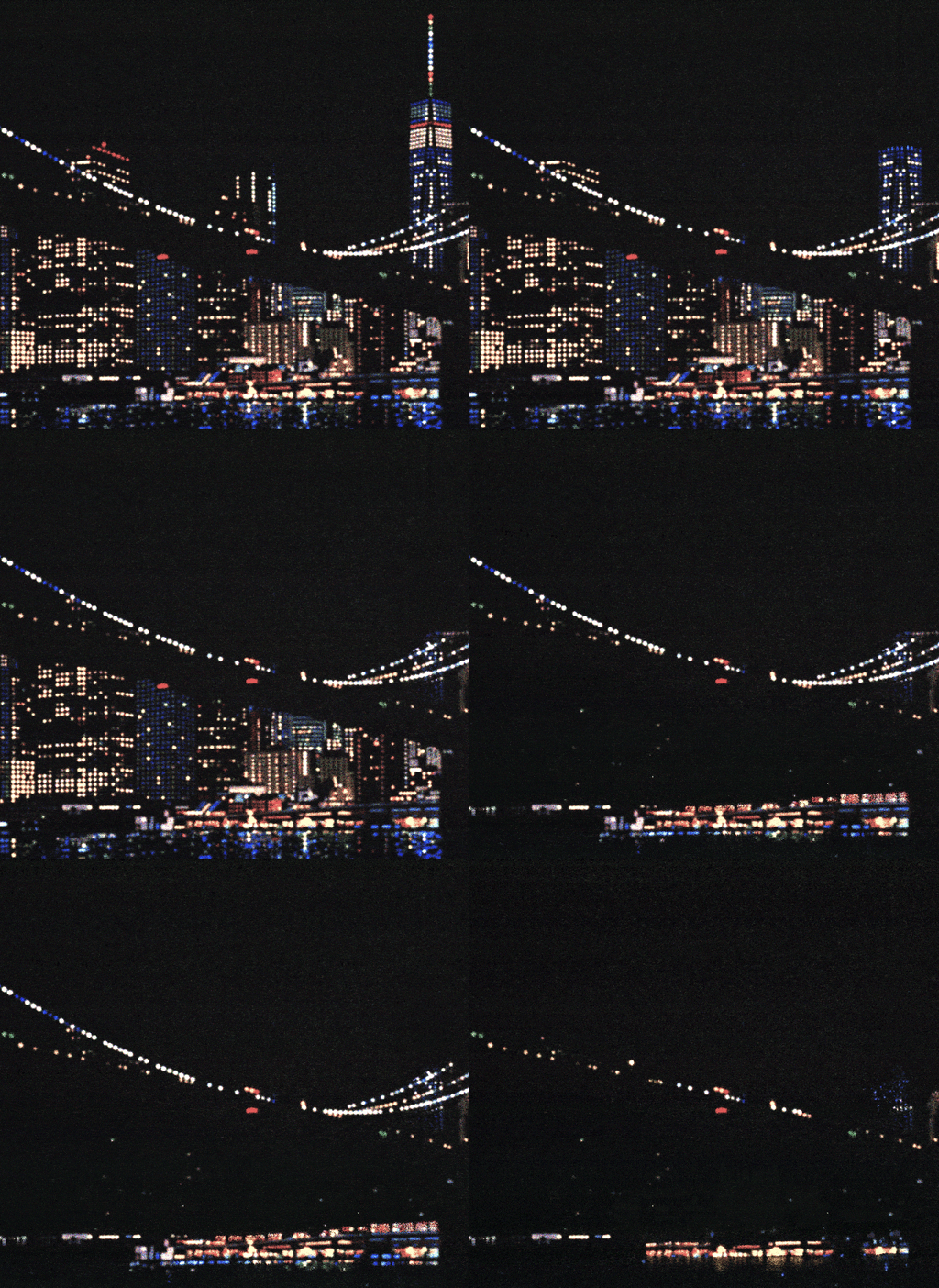
Night view of a city skyline with illuminated skyscrapers and a bridge, home to a self-healing power grid, all reflected in the water below.
A new generation of self-healing tools could make the U.S.'s aging power grid far more resilient against modern threats.
A small human figure stands at the base of a very tall tree, emphasizing the tree’s large size against a background with faint grid lines.
Every generation has faced a version of this moment — the question has never been what our tools can do, but what we choose to do with them.
A person in a suit with a vintage computer monitor as a head carries a large, orange computer tower against a blue background with faint code text.
The quiet transfer of human agency in the age of artificial intelligence.
A robotic hand places a black stone on a Go board, surrounded by scattered black and white stones.
Philosopher Sven Nyholm on reclaiming achievement from the machines.
A laptop made of a rough, brown, stone-like material with green squiggly lines emerging from its screen, set against a black background.
AI is not a rupture in history, but a continuation of intelligence emerging where information becomes systematically arranged.
Book cover titled "Friction: A Biography" by Jennifer R. Vail, featuring an image of a matchstick angled on a matchbox striker—capturing the spark of friction—set against a light blue background.
The deep study of friction and surfaces — so crucial to industrial manufacture — emerged from a mid-century engineering conference.
A colorful silhouette of a person sits at a desk, using a computer with a monitor displaying horizontal static lines—an image inspired by the innovative creativity of Jeff DeGraff.
AI may be rewriting “how” we work — but not “why” we work. And this has profound implications for leadership.
Book cover titled "The End of Driving: Automated Cars, Robotaxis, Sharing vs Owning, and the Future of Mobility" by Bern Grush, John S. Niles, and Andrew Miller, Second Edition.
Robotaxis can transform cities by improving mobile efficiency, equity, and safety — if cities adopt policies that prioritize the public good.
Two people discuss information on a digital tablet, with abstract yellow and white geometric patterns overlaid as they consider the implications of AI reckoning.
AI has brought a reckoning to the consulting industry — and the death knell will quickly sound for those who fail to adapt.
An illustration of a Roman-style ruin labeled "Common Law" is overlaid with concentric semicircles labeled Industrial Revolution, Machine Learning, Artificial Intelligence, and Generative Models.
Common law has long balanced innovation and accountability. Can it do the same for AI?
Split image showing a vintage sailing ship with an American flag on the left and a modern electric boat labeled "Navier" on the right, both on the water with blueprint sketches in the background.
Rivals may try to outnumber us with fleets of cheap vessels. Our path is to out-innovate them.
A yellow bird silhouette reveals a woman sitting on steps using her laptop, symbolizing the watchful presence of AI canaries, set against a dark, patterned background.
Early warning signs show AI is eating into the entry-level job market — a potential harbinger of things to come.
Green circuit board lines form three dollar signs on a dark background with faint circuitry patterns.
Behind the plateau in corporate AI lies a surge in personal and agentic use.
Book cover of "The Intelligence Explosion: When AI Beats Humans at Everything" by James Barrat, featuring a robot hand symbolizing AI, holding Earth against a white background.
The predictions of evolutionary theorists and current advances in “multimodal AI” offer strong clues to the future of employment.
A bright green book cover titled "Me, my Customer & AI: The New Rules of Entrepreneurship" by Henrik Werdelin and Nicholas Thorne, featuring bold white and black text, explores topics like headless agents in modern business.
In the post-AI startup landscape, the role of the entrepreneur will evolve from operator to orchestrator. Are you ready?
A graphic titled "The Night Crawler" features grayscale and red-tinted images of two men, one writing and one smiling—possibly Brad Feld—overlaid on a grid background with abstract shapes.
Welcome to The Nightcrawler — a weekly newsletter from Eric Markowitz covering tech, innovation, and long-term thinking.
A hand holding several U.S. dollar bills, digitally altered with a green color scheme and glitch effects, represents the future of income in a rapidly changing digital economy.
Agentic AI pioneer Chetan Dube considers ways that everyone can be lifted by the tide of AI, not just those with the capital to leverage it.
Two men in suits stand in front of a graphic collage featuring technical drawings and a building with solar panels, overlaid with the text "The Nightcrawler," evoking innovation that stands the test of stellar age.
Welcome to The Nightcrawler — a weekly newsletter from Eric Markowitz covering tech, innovation, and long-term thinking.
A collage with “The Nightcrawler” text, a grayscale photo of a tractor in a field, and a blue-tinted portrait of a man in a suit, layered on blue backgrounds with chart graphics that hint at long-term investing trends.
Welcome to The Nightcrawler — a weekly newsletter from Eric Markowitz covering tech, innovation, and long-term thinking.
A stylized image showcases poker chips and a green Swiss army knife, intricately overlaid with circuit patterns, hinting subtly at AI risk. The word "Nightcrawler" graces the top, adding an enigmatic touch.
Welcome to The Nightcrawler — a weekly newsletter from Eric Markowitz covering tech, innovation, and long-term thinking.
A weaver's resilient hand skillfully crafts vibrant, geometric patterns into the woven fabric.
Many expect AI to follow a familiar pattern — technological disruption followed by adaptation — but what are we losing in return?
Hexagonal map showing Europe, parts of Asia, and North Africa in varying shades of green and gray, with clusters of red and purple indicating specific regions.
"Gyroscope-on-a-chip" technology could soon enable us to navigate over long distances without GPS.
A pencil eraser gently rubs away a detailed sketch of a human brain on graph paper, subtly symbolizing the fine balance needed in critical thinking.
"Ultimately, the choice rests with each individual: whether to take the convenient route of allowing AI to handle our critical thinking, or to preserve this essential cognitive process for ourselves."
An open magazine displays a snapshot of AI efficiency: on the left page, a person types diligently on a laptop, while the right page showcases an abstract blue and white digital design, symbolizing the seamless integration of technology and human creativity.
Philosopher and author Christopher DiCarlo outlines the key areas where AI continues to reshape the labor landscape.
A superintelligent robot stands against a striking backdrop of red and gray financial graphs and a globe, with the text "The Nightcrawler" boldly emblazoned above.
Welcome to The Nightcrawler — a weekly newsletter from Eric Markowitz covering tech, innovation, and long-term thinking.
Wind turbines on grassy hills under a clear blue sky.
And can we run the grid of the future without AI?
Digital illustration of a DNA double helix in red and blue, set against a black background.
“We can build AI scientists that are better than we are… these systems can be superhuman,” says the FutureHouse co-founder.
Gloved hands holding a computer processor chip, viewed from an angled perspective against a black background.
AI software is rapidly accelerating chip design, potentially leveling up the speed of innovation across the economy.