




















Search
Big Bang Theory

Known as the "past hypothesis" problem, the Universe's initially low entropy has long puzzled scientists. Now, cosmic inflation solves it.

Looking up at the night sky gives us a glimpse of the Universe beyond our terrestrial concerns. Here's the science of what's out there.

Over billions of years, fewer stars form, galaxies mutually recede, and the Universe becomes ever darker. Here's how fast it all happens.

Not everyone accepts the scientific consensus; some even make careers out of challenging it. But only a select few do it the right way.

1hr 19mins
Theoretical physicist Jim Al-Khalili explores why our sense of time may be incredibly misleading, including the idea that past, present, and future might all exist at once.

Before we formed stars, atoms, elements, or even got rid of our antimatter, the Big Bang made neutrinos. And we finally found them.

The Universe formed stars, galaxies, and even galaxy clusters extremely early on in our cosmos. This new marvel is one more JWST surprise.

The seeds of cosmic structure that were planted back during the Big Bang grew into the cosmic web we see today. What is it telling us?

Even the youngest galaxies are often dust-rich, even with very low levels of heavy elements. Nearby dwarf galaxy Sextans A explains why.

In a galaxy less than 300 million years after the Big Bang, oxygen's presence abounds. That's expected; its absence would truly be profound.

Perhaps the most remarkable fact about the Universe is simply that it, and everything in it, exists. But what's the reason why?

While humanity has been skywatching since ancient times, much of our cosmic understanding has come about only recently. Very recently.

Our Universe doesn't just expand and cool, but the expansion itself is accelerating. Can stars form under such structure-erasing conditions?

The method you use to measure the expanding Universe determines which of two answers you'll get. Lensed supernovae can't resolve that issue.

Science has assembled an incredible story outlining our Universe's whole history. Despite its unrivaled success, 9 profound gaps remain.

Although American Thanksgiving only comes once a year, the scientific rules that make our Universe possible are always worth appreciating.

13mins
Everything ever seen — every star, mountain, and face — makes up less than 5 percent of the universe. Astrophysicist Janna Levin reminds us that the rest — dark matter and dark energy — is invisible, mysterious, and everywhere. We are the luminous exception in a universe of darkness.

Such massive, early supermassive black holes have puzzled astronomers for decades. At last, we've finally figured out how they form.

From white holes to dark stars and multiverses, James Riordon explores the bizarre exhibits of general relativity's "cryptozoo."

For over 10 billion years, the cosmic star-formation rate has been dropping and dropping. Someday, the final star in the Universe will die.

Dark matter has never been directly detected, but the astronomical evidence for its existence is overwhelming. Here's what to know.

We've long known we can't go back to infinite temperatures and densities. But the hottest part of the hot Big Bang remains a cosmic mystery.

Inflation's two main criticisms, that it can predict anything and that the "measure problem" remains unsolved, can't erase its successes.

Our Sun only arose after 9.2 billion years of cosmic history: with many stars living and dying first. How many prior generations were there?
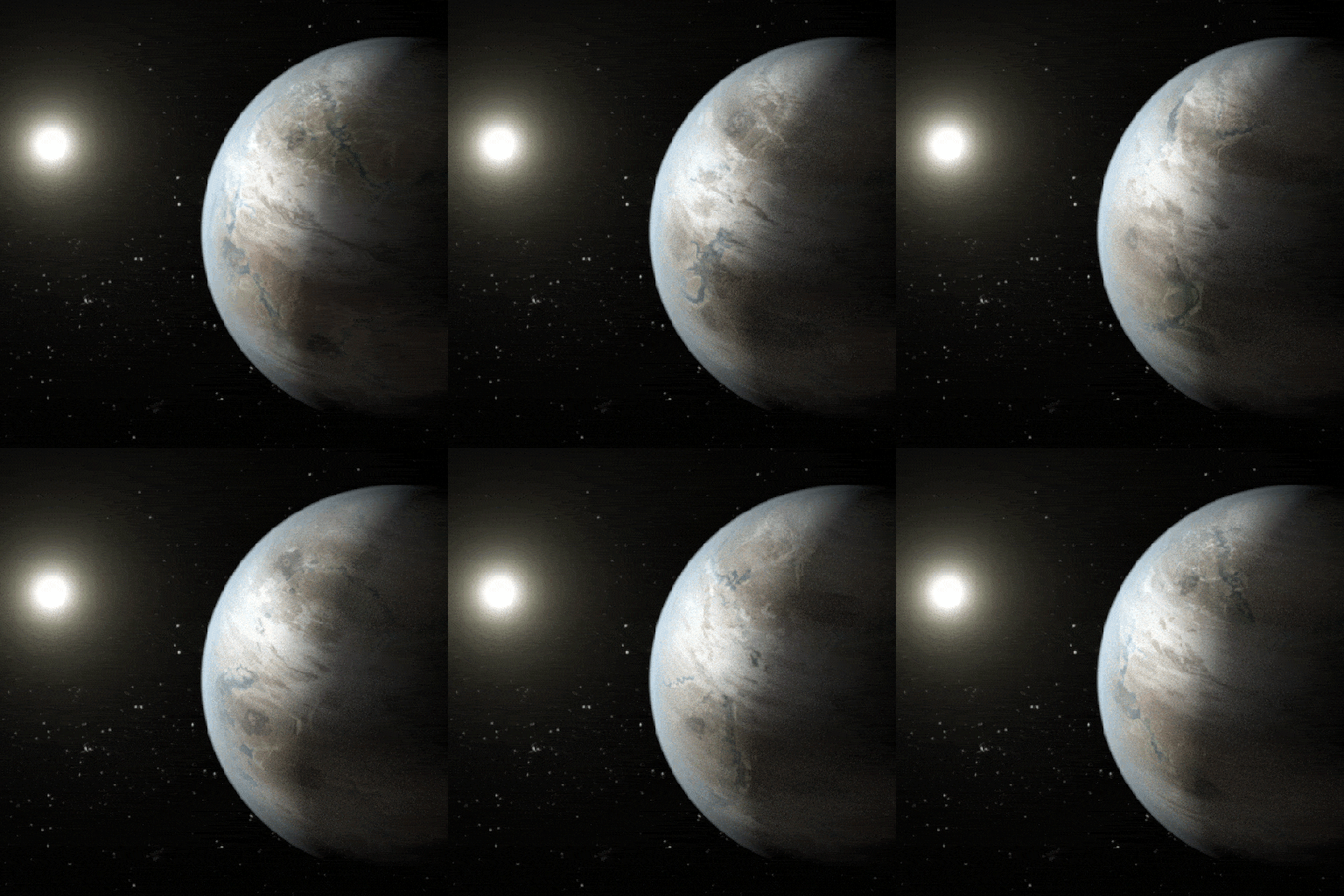
From here on Earth, looking farther away in space means looking farther back in time. So what are distant Earth-watchers seeing right now?

If you think of the Big Bang as an explosion, we can trace it back to a single point-of-origin. But what if it happened everywhere at once?

All of the matter that we measure today originated in the hot Big Bang. But even before that, and far into the future, it'll never be empty.

The hot Big Bang is often touted as the beginning of the Universe. But there's one piece of evidence we can't ignore that shows otherwise.
As we gain new knowledge, our scientific picture of how the Universe works must evolve. This is a feature of the Big Bang, not a bug.

Questions about our origins, biologically, chemically, and cosmically, are the most profound ones we can ask. Here are today's best answers.