




















Search
Big Bang Theory

Many people out there, including scientists, claim to have discovered a series of game-changing revolutions. Here's why we don't buy it.

The Universe isn't as "clumpy" as we think it should be.

The Universe certainly formed stars, at one point, for the very first time. But we haven't found them yet. Here's what everyone should know.

7mins
How the Big Bang gave us time, explained by theoretical physicist.

The information we have in the Universe is finite and limited, but our curiosity and wonder is forever insatiable. And always will be.

JWST has seen more distant galaxies than any other observatory, ever. But many candidates for "most distant of all" are likely impostors.

As time goes on, dark energy makes distant galaxies recede from us ever faster in our expanding Universe. But nothing truly disappears.

All the things that surround and compose us didn't always exist. But describing their origin depends on what 'nothing' means.

You can lead an overconfident chatbot to expert knowledge, but can it actually learn and assimilate new information?

Leaving Hubble in the dust, JWST has officially seen a galaxy from just 320 million years after the Big Bang: at just 2.3% its current age.

The most common element in the Universe, vital for forming new stars, is hydrogen. But there's a finite amount of it; what if we run out?

We thought the Big Bang started it all. Then we realized that something else came before, and it erased everything that existed prior.

The answer to this question is key to understanding why anything exists.

We confidently state that the Universe is known to be 13.8 billion years old, with an uncertainty of just 1%. Here's how we know.

Every time our Universe cools below a critical threshold, we fall out of equilibrium. That's the best thing that ever happened to us.

The Universe is 13.8 billion years old, going back to the hot Big Bang. But was that truly the beginning, and is that truly its age?

Science is for everyone, even those possessing strongly held beliefs that seem to conflict with the best available evidence.

We know the Universe is expanding, but scientists don't agree on the rate. This is a legitimate problem.

Early relics and late-time objects give incompatible results for the expanding Universe. This independent anomaly intensifies the problem.

Are you unhappy with how various events in your life turned out? Perhaps, in a parallel Universe, things worked out very differently.
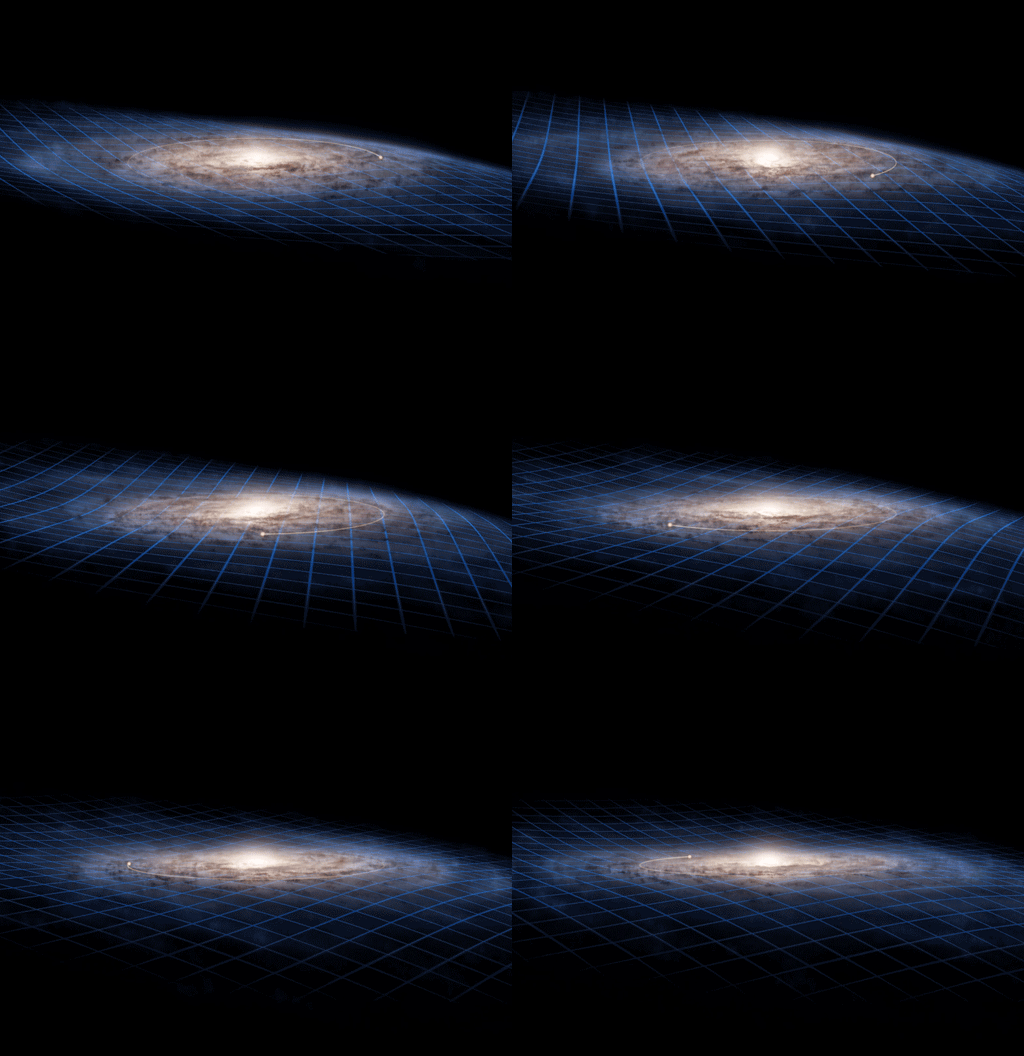
The Universe begins with negligible amounts of angular momentum, which is always conserved. So why do planets, stars, and galaxies all spin?

From the tiniest subatomic scales to the grandest cosmic ones, solving any of these puzzles could unlock our understanding of the Universe.

In the 20th century, many options abounded as to our cosmic origins. Today, only the Big Bang survives, thanks to this critical evidence.

The Big Bang is commonly misunderstood, warping our understanding about the Universe's size and shape.

You would think that with all our technology, like the James Webb Space Telescope, we would know how big the Universe is. But we don't.


Einstein's relativity teaches us that time isn't absolute, but passes relatively for everyone. So how do telescopes see back through time?
No. No no no. Just... no. The JWST has truly blown our scientific minds, but it's a pure crackpot idea that the Big Bang is now disproven.

Unexpected images of galaxies from the James Webb Space Telescope do not disprove the Big Bang. There are other likelier explanations.

Hubble revolutionized astronomy more than once. Here's what we can expect from the James Webb Space Telescope.