




















Search
Black Hole

The James Webb Space Telescope (JWST) will study many dangerous cosmic phenomena, knowledge of which may help save humanity.

The James Webb Space Telescope is about to begin science operations. Here's what astronomers are excited about.

On July 12, 2022, JWST will release its first science images. Here are 5 ways the telescope's findings could change science forever.

Everything is made of matter, not antimatter, including black holes. If antimatter black holes existed, what would they do?

At four million solar masses, the Milky Way's supermassive black hole is quite small for a galaxy its size. Did we lose the original?

The idea of black holes has been around for over 200 years. Today, we're seeing them in previously unimaginable ways.

Astronomers in 2017 caught an image of a supermassive black hole in a galaxy far, far away. Doing it in our own galaxy is a huge milestone.

After years of analysis, the Event Horizon Telescope team has finally revealed what the Milky Way's central black hole looks like.

Everything that gets heated up has to, somehow, radiate that energy away. Here's what we see when that happens in the Universe.

Singularities frustrate our understanding. But behind every singularity in physics hides a secret door to a new understanding of the world.

Single objects rarely change the course of an entire scientific field. Distant object GNz7q, a galaxy-quasar hybrid, might do exactly that.

A new paper combines two concepts from the edges of astrophysics: Dyson Spheres and black holes. A Type III civilization could combine them.

Astronomers used supercomputers and an international network of antennas to create the stunning map.

The odds are slim, but the consequences would be devastating. Here's what would happen, plus how to avoid it.

As viewed by the MeerKAT telescope, this radio view of the Milky Way blows away every other way we've ever seen our home galaxy.

Shooting star or piece of space dust?

If you want to understand what the Universe is, how it began, evolved, and will eventually end, astrophysics is the only way to go.

Some stars burn through their fuel as expected, and die of natural causes. But others, instead, get murdered. Here's their story.

Known as primordial black holes, they could thoroughly change our Universe's history. But the evidence is strongly against them.

Although most of the Universe's mass is dark matter, which gravitates just as well as normal matter, it still can't make black holes.

The latest gravitational wave data from LIGO and Virgo finally shows us the truth: there are no "gaps" in the masses of black holes.

It could evolve, strengthen, decay, or not be alone. Our known Universe contains matter, radiation, and dark energy. While matter (both normal and dark) and radiation become less dense as […]
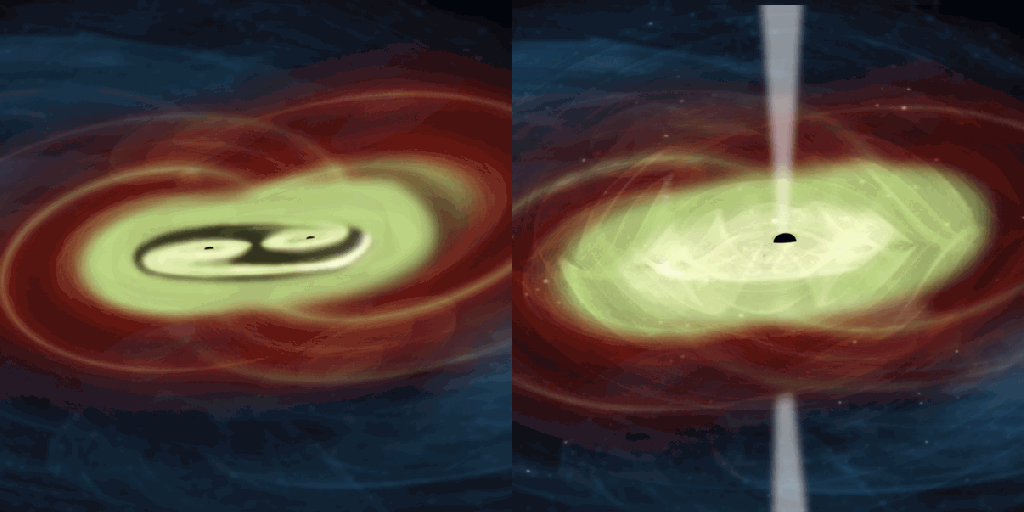
The ‘final parsec problem’ is still a mystery for astronomers. When it comes to black holes in the Universe, we know there are at least two major types. There are […]

Even a small merger can trigger so much more than we realize. Practically every galaxy in the Universe has a supermassive black hole at their core. Ranging from millions to many […]
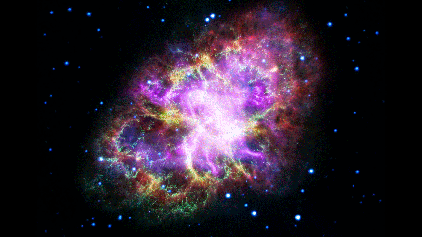
Despite Betelgeuse’s recent faintening and brightening, I’d bet on these stars instead. Betelgeuse, a nearby red supergiant, will someday explode. The black hole at the center of the Milky Way should […]
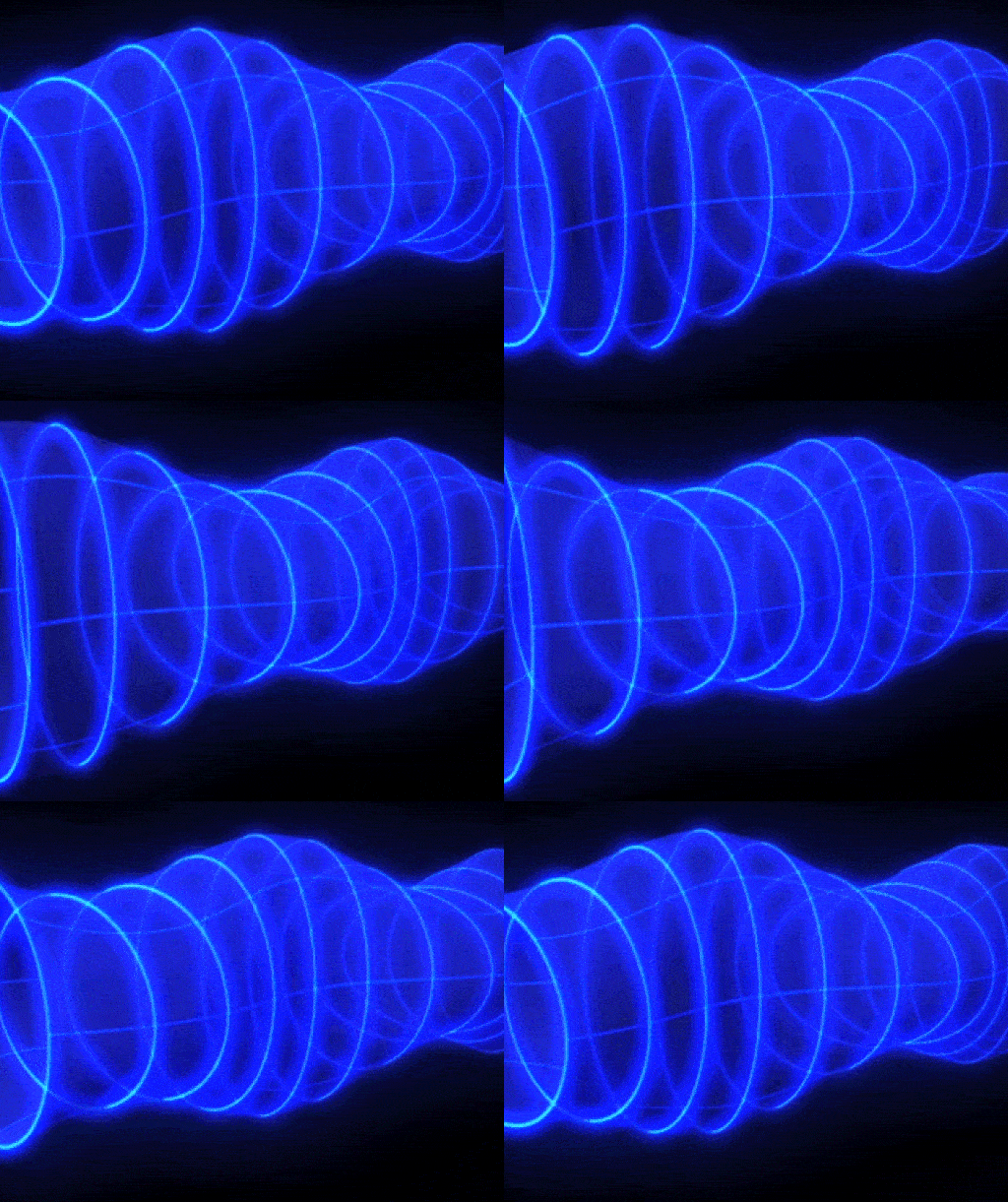
And either way, is energy or information conserved? When two things in the Universe that “always” occur meet one another, how do you know which one will win? Gravitational waves, […]

If you want to find life in the Universe, this is how you do it. When it comes to uncovering the ultimate truths about reality, we can only reap what we […]

An artist’s impression of what the fully-deployed James Webb Space telescope will look like from the perspective of an observer on the ‘dark’ (non-Sun-facing) side of the observatory. (NORTHRUP GRUMMAN) […]

Or is ‘new space’ created in between the gaps of the ‘old’ space? It’s been almost 100 years since humanity first reached a revolutionary conclusion about our Universe: space itself doesn’t […]

The last image puts it all in perspective. Compared to what we find in our Solar System, galaxies are truly enormous. The Sun may be 109 times the diameter of […]