




















Search
Cosmology

Here's why the answer may forever elude scientists.
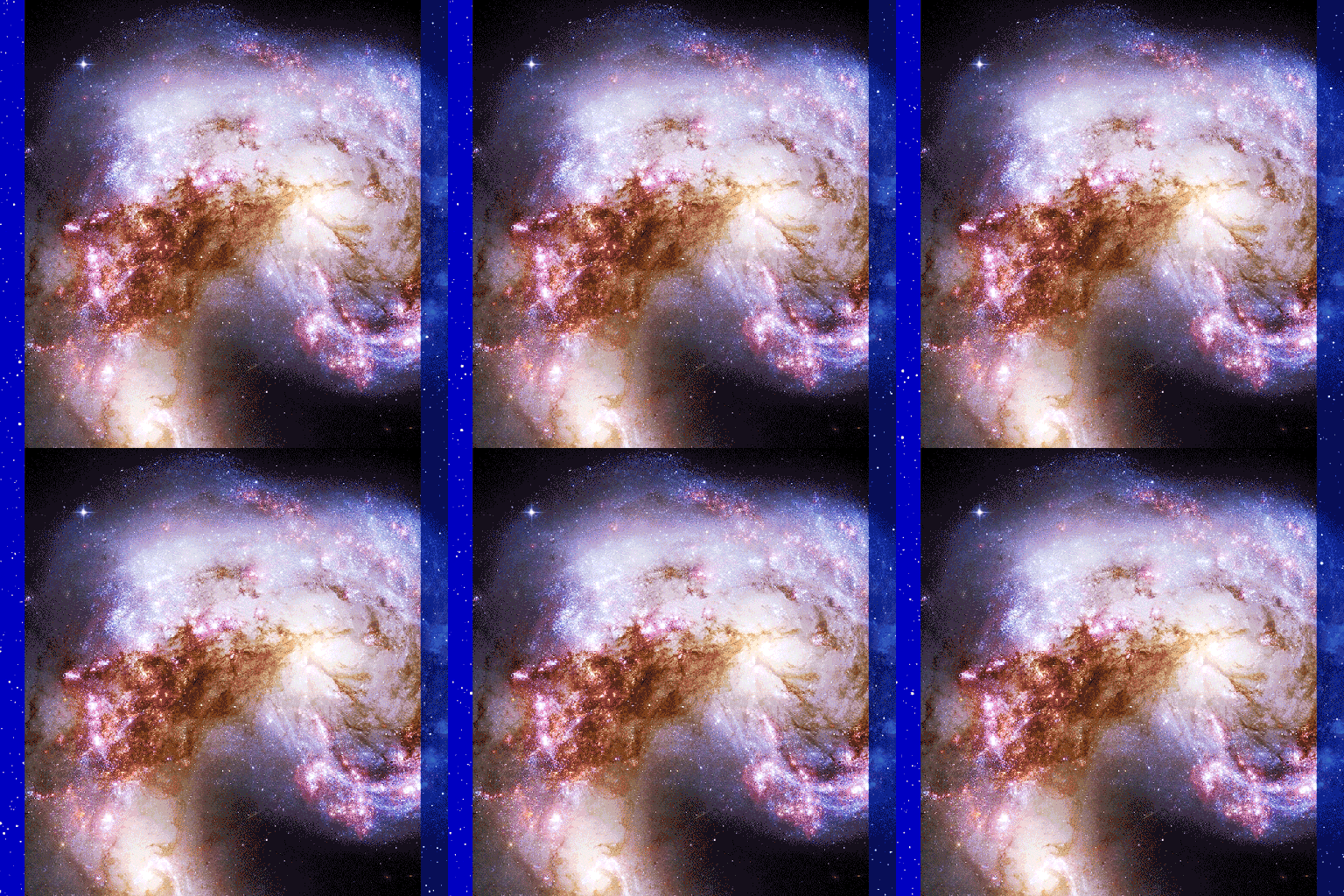
Today, the star-formation rate across the Universe is a mere trickle: just 3% of what it was at its peak. Here's what it was like back then.

As early as we've been able to identify them, the youngest galaxies seem to have large supermassive black holes. Here's how they were made.
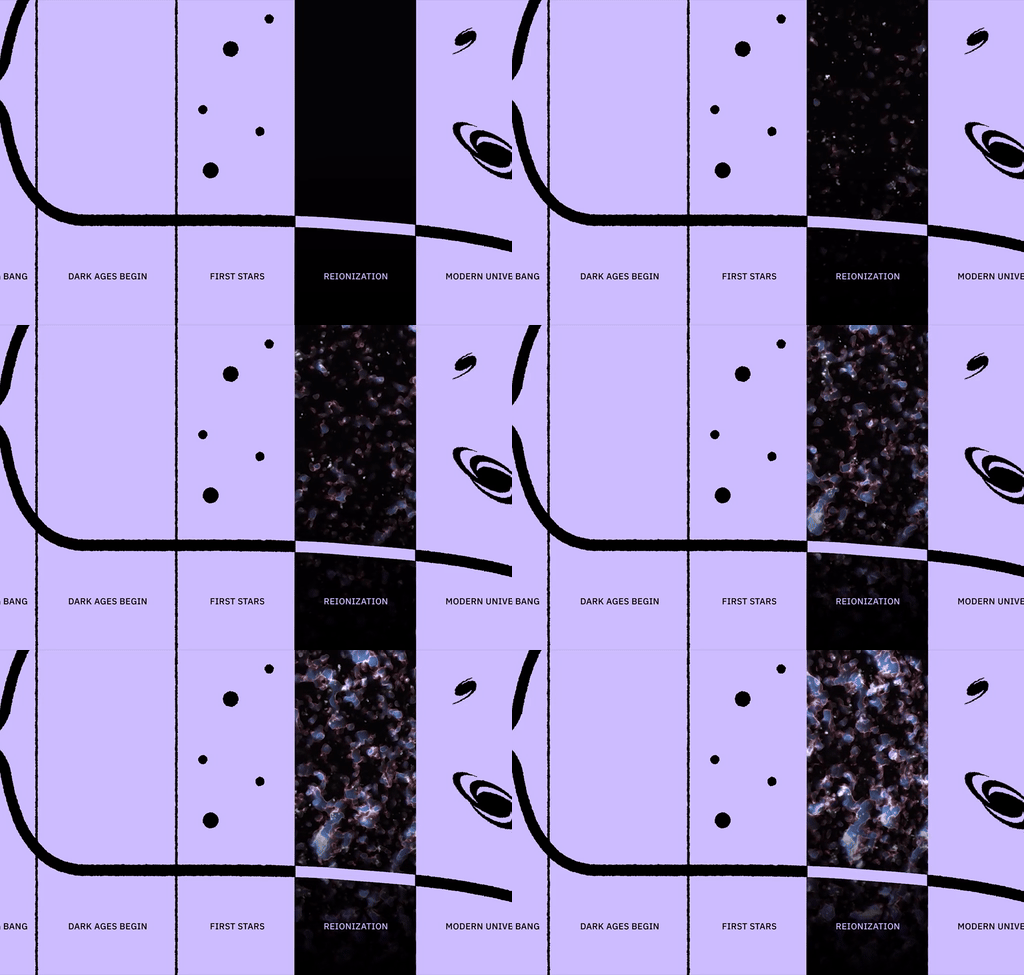
For 550 million years, neutral atoms blocked the light made in stars from traveling freely through the Universe. Here's how it then changed.

Even after the first stars form, those overdense regions gravitationally attract matter and also merge. Here's how they grow into galaxies.

The first stars took tens or even hundreds of millions of years to form, and then died in the cosmic blink of an eye. Here's how.

The Big Bang's hot glow faded away after only a few million years, leaving the Universe dark until the first stars formed. Oh, the changes!

The Universe is an amazing place. Under the incredible, infrared gaze of JWST, it's coming into focus better than ever before.

Physicists have yet to pinpoint the hypothetical matter that keeps galaxies from flying apart. Now they have a new focus.

Misinformation was extremely popular in 2023, as bad science often made global headlines. Learn the truth behind these 10 dubious stories.

In our Universe, matter is made of particles, while antimatter is made of antiparticles. But sometimes, the physical lines get real blurry.

Atomic nuclei form in minutes. Atoms form in hundreds of thousands of years. But the "dark ages" rule thereafter, until stars finally form.

Contrary to conventional wisdom, matter can escape the center of the Earth.
35mins
Kmele talked with a planetary scientist, a physicist, and a futurist, to understand how visionaries across disciplines are thinking about the future of our planet and humankind.

Since JWST first glimpsed the Universe, we've entered a new era in understanding the earliest objects in the Universe. What have we learned?

The first elements in the Universe formed just minutes after the Big Bang, but it took hundreds of thousands of years before atoms formed.

Each December, the Geminid meteor shower puts on a show for skywatchers across Earth. With a new Moon at 2023's peak, it'll be outstanding!

The brilliant mind who discovered the spacetime solution for rotating black holes claims singularities don't physically exist. Is he right?

The Big Bang theory is not threatened, but astrophysicists have some explaining to do.

The paper does not prove the existence of dark matter, but it mostly eliminates a rival theory called Modified Newtonian Dynamics.

In the early stages of the hot Big Bang, there were only free protons and neutrons: no atomic nuclei. How did the first elements form from them?

In the early stages of the hot Big Bang, matter and antimatter were (almost) balanced. After a brief while, matter won out. Here's how.

In 2022, Hubble owned the record for most distant galaxy. Today, that galaxy is down to the 9th most distant object. Thanks, JWST.

For a substantial fraction of a second after the Big Bang, there was only a quark-gluon plasma. Here's how protons and neutrons arose.

In the very early Universe, practically all particles were massless. Then the Higgs symmetry broke, and suddenly everything was different.

In the earliest stages of the hot Big Bang, equal amounts of matter and antimatter should have existed. Why aren't they equal today?

When the hot Big Bang first occurred, the Universe reached a maximum temperature never recreated since. What was it like back then?

Some 13.8 billion years ago, the Universe became hot, dense, and filled with high-energy quanta all at once. Here's what it was like.

Cosmic inflation is the state that preceded and set up the hot Big Bang. Here's what the Universe was like during that time period.

Two of the answers add a dimension to physics that doesn’t belong there. Maybe we could call it "astrotheology."