




















Search
Cosmology


Einstein's relativity teaches us that time isn't absolute, but passes relatively for everyone. So how do telescopes see back through time?

No. No no no. Just... no. The JWST has truly blown our scientific minds, but it's a pure crackpot idea that the Big Bang is now disproven.

Einstein's "happiest thought" led to General Relativity's formulation. Would a different profound insight have led us forever astray?

Our model of the Universe, dominated by dark matter and dark energy, explains almost everything we see. Almost. Here's what remains.

In special relativity, the statement that two events happened at the same time is meaningless.

Magnetic monopoles began as a mere theoretical curiosity. They might hold the key to understanding so much more.

The false assumption the Multiverse relies on is that something which exists requires an explanation.

There's an extra source of massive "stuff" in our Universe beyond what gravitation and normal matter can explain. Could light be the answer?

If you have an old TV set with the "rabbit ear" antennae, and you set it to channel 03, that snowy static can reveal the Big Bang itself.
In all the Universe, only a few particles are eternally stable. The photon, the quantum of light, has an infinite lifetime. Or does it?

We knew we'd find galaxies unlike any seen before in its first deep-field image. But the other images hold secrets even more profound.

The emergence of life in the universe is as certain as the emergence of matter, gravity, and the stars. Life is the universe developing a memory, and our chemical detection system could find it.
John Templeton Foundation

Ever since the start of the hot Big Bang, time ticks forward as the Universe expands. But could time ever run backward, instead?

Searching for dark matter, the XENON collaboration found absolutely nothing out of the ordinary. Here's why that's an extraordinary feat.

Scientists have found three new examples of a very exotic form of matter made of quarks. They can yield insights into the early Universe.

It started with a bang, but won't end with one. Instead, it will "rage against the dying of the light" like nothing you've ever imagined.

Like humans, stars die. The James Webb Space Telescope's early images already give us a lot of information about how this happens.
Even with only 12.5 hours of exposure time, James Webb's first deep-field image taught us lessons we've never realized before.

LIGO can detect the inspirals and mergers of the lowest-mass black holes, but not the biggest ones. Here's how pulsars can help.

At all distances, the Universe expands along our line-of-sight. But we can't measure side-to-side motions; could it be rotating as well?

Modern cosmology conjectures different possible fates for the Universe and thus for the end of time. Details depend on which model is right.

Since at least 600 BC, people have been mesmerized by the concept of the infinite.

No matter how beautiful, elegant, or compelling your idea is, if it disagrees with observation and experiment, it's wrong.

Experiments cannot confirm what theory predicts about neutrinos. And particle physicists have no idea why.

The Universe is expanding, and the Hubble constant tells us how fast. But how can it be a constant if the expansion is accelerating?

Quite a lot, actually, even though it has no identifiable value as a scientific concept.
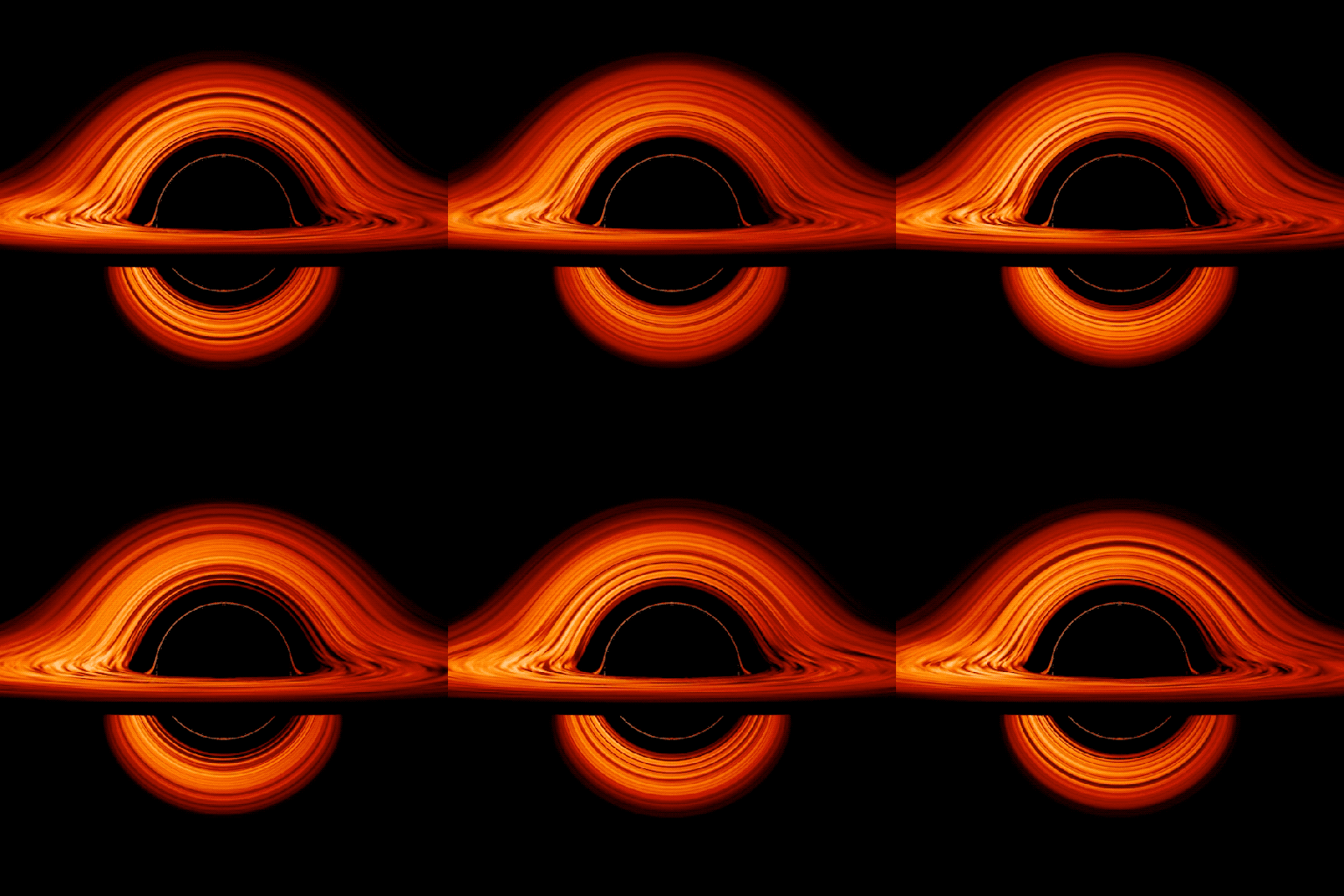
With two different black hole event horizons now directly imaged, we can see that they are, in fact, rings, not disks. But why?

The James Webb Space Telescope is about to begin science operations. Here's what astronomers are excited about.

Where did the “seed” magnetic field come from in the first place?