




















Search
Cosmology

When the Universe was first born, the ingredients necessary for life were nowhere to be found. Only our "lucky stars" enabled our existence.

We can reasonably say that we understand the history of the Universe within one-trillionth of a second after the Big Bang. That's not good enough.

Archaeologists can learn how societies lived by studying what they left behind when they died. Astronomers are doing much the same thing.

The problem of the electroweak horizon haunts the standard model of cosmology and beckons us to ask how deep a rethink the model may need.

Before there were planets, stars, and galaxies, before even neutral atoms or stable protons, there was the Big Bang. How did we prove it?

The standard model of cosmology has a big new problem: Some galaxies seem to be too old.

Einstein's relativity overthrew the notion of absolute space and time, replacing them with a spacetime fabric. But is spacetime truly real?

What began as an annoyance ended as a Nobel Prize-winning discovery about the Big Bang and the origin of the Universe.

The conservation of energy is one of the most fundamental laws governing our reality. But in the expanding Universe, that's just not true.

These high-mass, rapidly star-forming galaxies have called modern cosmology into question. But hi-res simulations show no tension at all.

All forms of energy affect the expanding Universe. But if matter and radiation slow the expansion down, how does dark energy speed it up?

How do physicists solve a problem like entropy?

The best evidence for dark matter is astrophysical and indirect. Do new lensing observations point to ultra-light, wave-like dark matter?

Once the initial blaze of heat dissipated, the constituent particles of atoms were free to bind.

Quantum uncertainty and wave-particle duality are big features of quantum physics. But without Pauli's rule, our Universe wouldn't exist.

The cosmic microwave background offers clues.

Finding out how the Universe grew up was the biggest science goal of JWST. This ultra-early proto-galaxy cluster is one amazing discovery.
From quarks and gluons to giant galaxy clusters, everything that exists in our Universe is determined by what is (and isn't) bound together.

The LHC has a long, productive life ahead of it. An upgraded version, called the “High Luminosity LHC,” will be available in 2028.

The acceptance of our cosmic loneliness and the rarity of our planet is a wakeup call.
John Templeton Foundation
JWST has brought us more distant views of the early Universe than ever before. Is the Big Bang, and all of modern cosmology, in trouble?

Cosmologists are largely still in the dark about the forces that drive the Universe.

What would become the Big Bang model started from a crucial idea: that the young Universe was denser and hotter.

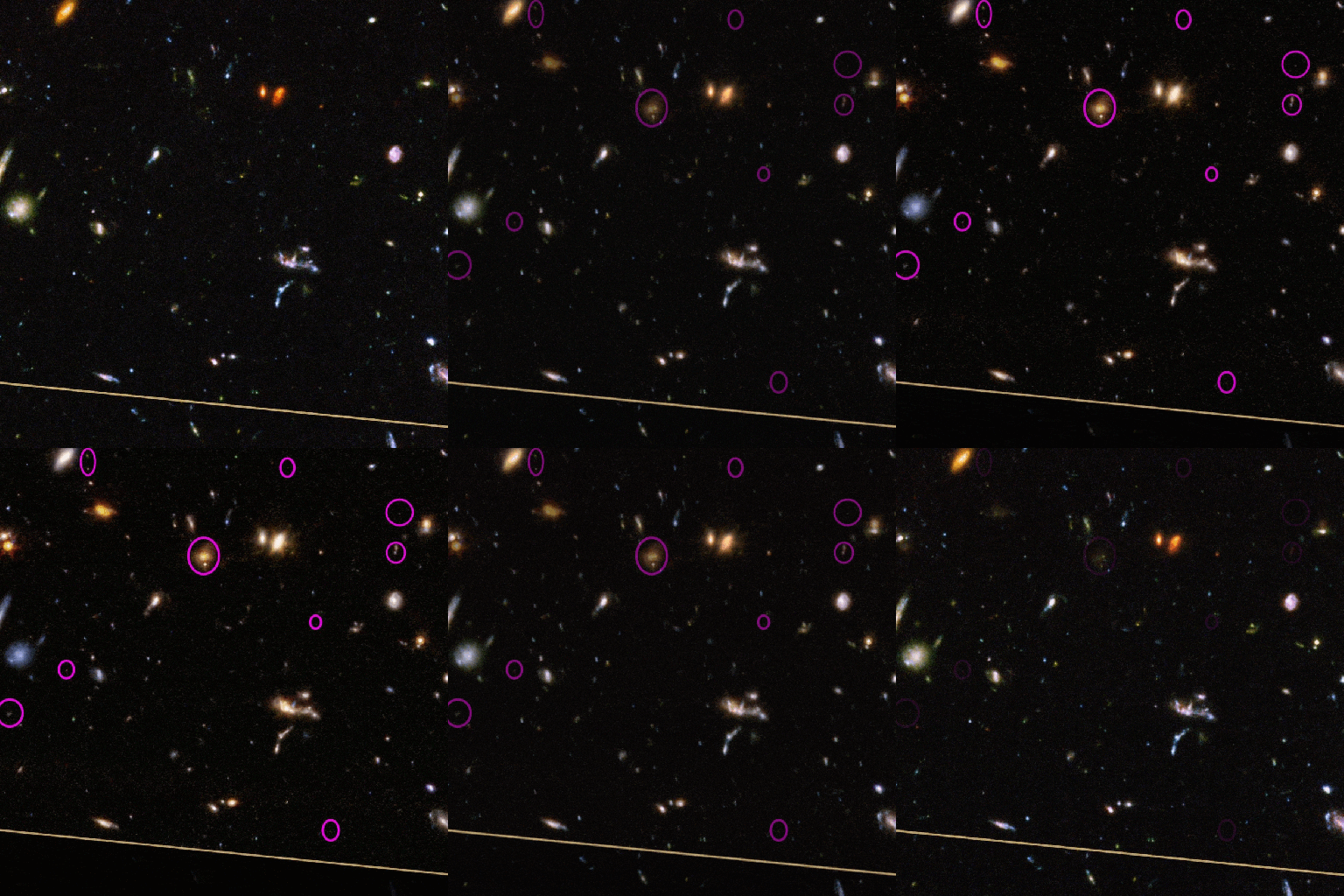
With infrared capabilities and image sharpness far beyond Hubble's limits, JWST looked at Hubble's deepest field, revealing so much more.

Though he renounced philosophy, Stephen Hawking's final theory of the universe redraws the basic foundations of cosmology.

The Universe is grand, awe-inspiring, and greater than we likely imagine. Even astrophysicists get anxious thinking about it, but we cope.

It may be time for a cosmological paradigm shift.

For many years, some cosmologists embraced the idea of an eternal, steady state universe. But science triumphed over philosophical prejudice.

With a massive, charged nucleus orbited by tiny electrons, atoms are such simple objects. Miraculously, they make up everything we know.

Stars orbiting black holes were observed to move significantly slower than expected. One explanation centers on dark matter.