




















Search
Cosmology

The laws of physics state that you can't create or destroy matter without also creating or destroying an equal amount of antimatter. So how are we here?

Despite all that we've learned about the Universe, there remain unanswered, and possibly unanswerable, questions. Could "God" be the answer?

Shortly after planet Earth formed, life took a permanent hold on our surface. But just how common is such an outcome?

If dark matter exists in a large halo in our galaxy, made up of particles, then it's passing through us constantly. But how much?

Is the multiverse real? It's one of the hottest questions in all of theoretical physics. We invited two astrophysicists to join the debate.

Out of all the galaxies we know, only a few little ones are missing dark matter. At last, we finally understand why.

If the electromagnetic and weak forces unify to make the electroweak force, maybe, at even higher energies, something even greater happens?

With 1550 distinct type Ia supernovae measured across ~10 billion years of cosmic time, the Pantheon+ data set reveals our Universe.

Yes, the Universe is expanding, but you might wonder, "How fast is it expanding?"

The Universe has asymmetries, but that's a good thing. Imperfections are essential for the existence of stars and even life itself.

In scientific theories, the Multiverse appears as a bug rather than as a feature. We should squash it.

There are ~400 billion stars in the Milky Way, and ~2 trillion galaxies in the visible Universe. But what if we aren't typical?

Just 12 million light-years away, the galaxies Messier 81 and 82 offer a nearby preview of the Milky Way-Andromeda merger.

Is the Universe finite or infinite? Does it go on forever or loop back on itself? Here's what would happen if you traveled forever.

Hubble's deepest views of space revealed fewer than 10% of the Universe's galaxies. James Webb will change that forever.

Shooting star or piece of space dust?

It is time to give the Russian cosmologist the credit he deserves.

If you want to understand what the Universe is, how it began, evolved, and will eventually end, astrophysics is the only way to go.

We frequently say it's 2.725 K: from the light left over all the way from the Big Bang. But that's not all that's in the Universe.

There are two fundamentally different ways of measuring the Universe's expansion. They disagree. "Early dark energy" might save us.

In movies and TV shows, aliens look like pointy-eared humans. Is this realistic? If evolution is predictable, then it very well might be.

From before the Big Bang to the present day, the Universe goes through many eras. Dark energy heralds the final one.

Known as primordial black holes, they could thoroughly change our Universe's history. But the evidence is strongly against them.

A wild, compelling idea without a direct, practical test, the Multiverse is highly controversial. But its supporting pillars sure are stable.

With launch, deployment, calibration, and science operations about to commence, here are 10 facts that are absolutely true.

The boiling new world, which zips around its star at ultraclose range, is among the lightest exoplanets found to date.

Astrophysicists once believed in a static Universe, containing only the Milky Way galaxy. Science definitively proved otherwise.
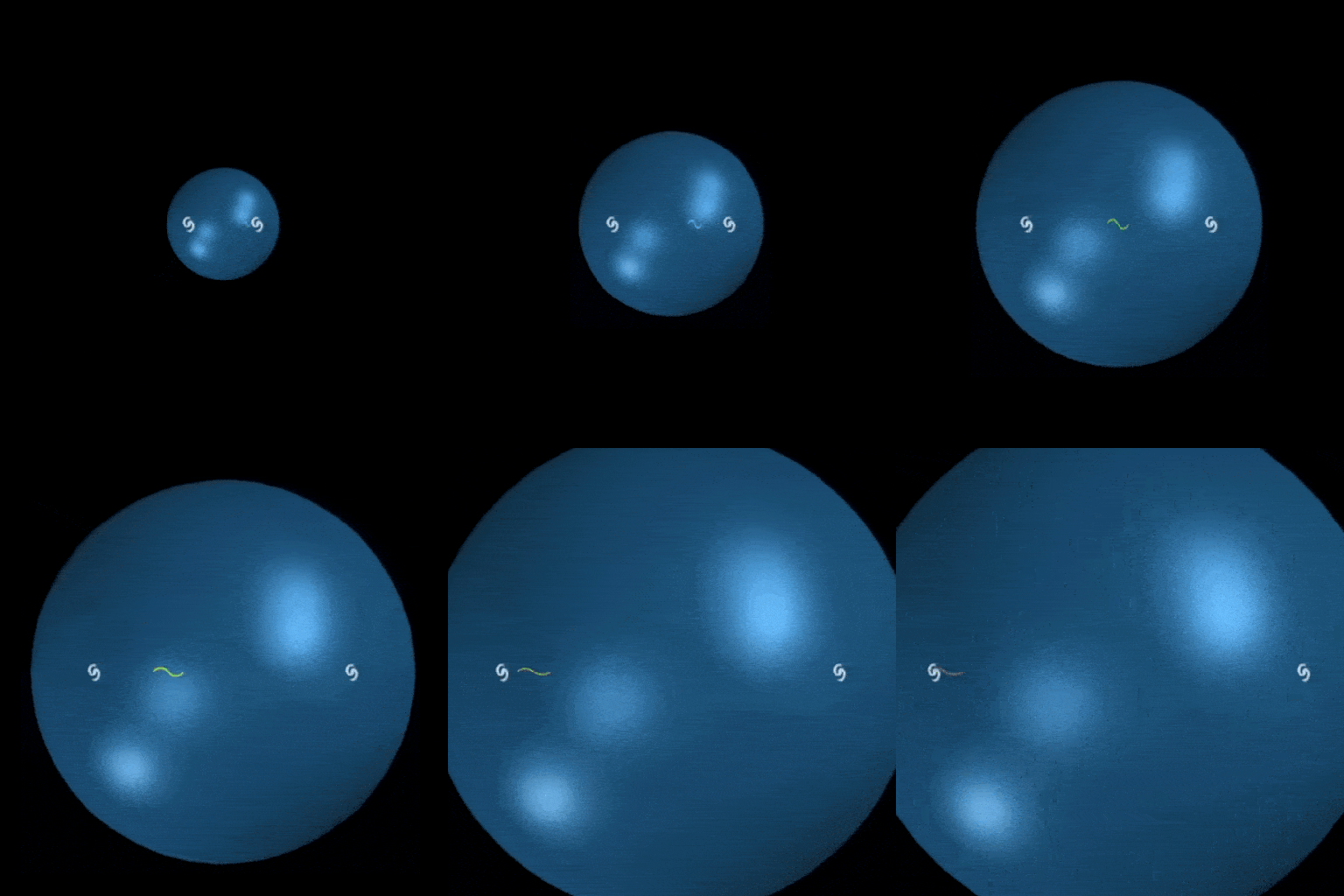
After more than two decades of precision measurements, we've now reached the "gold standard" for how the pieces don't fit.

A few years ago, the first dark matter-free galaxies were announced, and then immediately disputed. Now, there are too many to ignore.

Our Solar System's outer reaches, and what's in them, was predicted long before the first Oort Cloud object was ever discovered.