




















Search
Cosmology

Large, massive, rotating galaxies like the Milky Way are common today. So how could one form a mere ~2 billion years after the Big Bang?

DESI, by mapping galaxies, has claimed they see evidence for dark energy evolving by getting weaker. But that's only one interpretation.

Someday, we'll look back and see a young galaxy forming stars for the first time. JADES-GS-z14-0, the farthest ever, isn't early enough.

Einstein's general relativity has reigned supreme as our theory of gravity for over a century. Could we reduce it back down to Newton's law?

Some nebulae emit their own light, some reflect the light from stars around them, and some only absorb light. But that's just the beginning.

When we see spiral galaxies, some are face-on, others are edge-on, but most are tipped at an angle. But which side is closest to us?

The tiniest galaxies of all are the most susceptible to violence by their larger, bullying siblings. That's why we need them in isolation.

The Universe is expanding, and individual, bound structures are all receding away from one another. How, then, are galaxies still colliding?

Since the dawn of history, humans have pondered our ultimate cosmic origins. Now in the 21st century, science has gone beyond the Big Bang.

There are some 26 fundamental constants in nature, and their values enable our Universe to exist as it does. But where do they come from?

One of the most promising dark matter candidates is light particles, like axions. With JWST, we can rule out many of those options already.

Astronomers see spiral and elliptical nebulae nearly everywhere, except by the Milky Way's plane. We didn't know why until the 20th century.
Perhaps the most well-known equation in all of physics is Einstein's E = mc². Does mass or energy increase, then, near the speed of light?

From the tiniest subatomic scales to the grandest cosmic structures of all, everything that exists depends on two things: charge and mass.

The CMB gives us critical information about our cosmic past. But it doesn't give us everything, and galaxy mapping can fill in a key gap.

Dark matter doesn't absorb or emit light, but it gravitates. Instead of something exotic and novel, could it just be dark, normal matter?

When we divide matter into its fundamental, indivisible components, are those particles truly point-like, or is there a finite minimum size?
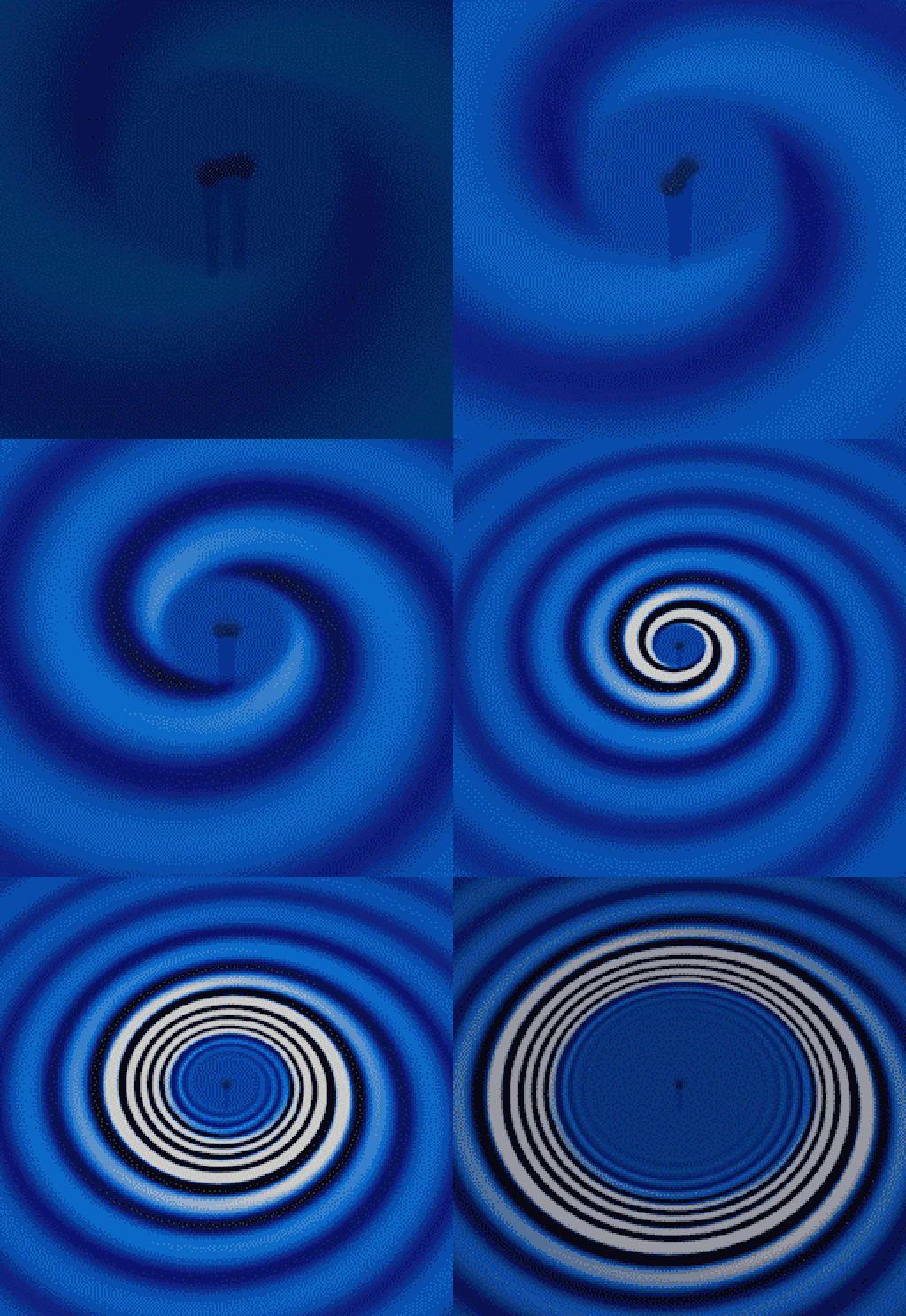
The ultimate multi-messenger astronomy event would have gravitational waves, particles, and light arriving all at once. Did that just occur?

A young, nearby, massive star, whose protoplanetary disk appears perfectly edge-on, was just viewed by JWST, with staggering implications.

If humanity lives in an otherwise barren Universe, we'll have to forge philosophy that fills the void.

Here in our Universe, both normal and dark matter can be measured astrophysically. But only normal matter can collapse. Why is that?

First discovered in the mid-1960s, no cosmic signal has taught us more about the Universe, or spurred more controversy, than the CMB.

It's the ultimate game of cosmic "cover up," as the dimming occurs when a circumbinary disk from a nearby star passes in front of T Tauri North.

Matter is made up largely of atoms, where atomic nuclei can contain up to 100 protons or more. But how were the heaviest elements made?

Cosmic inflation, proposed back in 1980, is a theory that precedes and sets up the hot Big Bang. After thorough testing, is it still valid?

Physicist Don Lincoln explains why mathematics is a powerful tool for scientific modeling, but is not a science itself.

The discovery of ultra-bright, ultra-distant galaxies was JWST's first big surprise. They didn't "break the Universe," and now we know why.

Our Universe isn't just expanding, the expansion is accelerating. Instead of dark energy, could a "lumpy" Universe be at fault?

A recent measurement has simultaneously settled an ongoing scientific debate while puzzling scientists.

On larger and larger scales, many of the same structures we see at small ones repeat themselves. Do we live in a fractal Universe?