




















Search
Cosmology

It's not only the gravity from galaxies in a cluster that reveals dark matter, but the ejected, intracluster stars actually trace it out.

Did the Milky Way form by slowly accreting matter or by devouring its neighboring galaxies? At last, we're uncovering our own history.

Our galactic home in the cosmos — the Milky Way — is only one of trillions of galaxies within our Universe. Is one of them truly our "twin?"

When three wise men gifted baby Jesus with gold, frankincense, and myrrh, they had no idea one was made from colliding neutron stars.

Carl Sagan was far from the first to declare we are the children of ancient stars.

Matt Strassler's journey into fundamental physics culminates in a brilliant explanation of the Higgs field. Enjoy this exclusive interview.

The Firefly Sparkle galaxy was only spotted because of gravitational lensing's effects. Yet galaxies like these brought us a visible cosmos.

From a hot, dense, uniform state in its earliest moments, our entire known Universe arose. These unavoidable steps made it all possible.

50 years ago, Stephen Hawking showed that black holes emit radiation and eventually decay away. That fate may now apply to everything.

The closest known star that will soon undergo a core-collapse supernova is Betelgeuse, just 640 light-years away. Here's what we'll observe.

One of the fundamental constants of nature, the fine-structure constant, determines so much about our Universe. Here's why it matters.

DESI has allowed astronomers to create an unprecedented 3D map of the Universe representing 20% of the entire sky.

For nearly 60 years, the hot Big Bang has been accepted as the best story of our cosmic origin. Could the Steady-State theory be possible?

Two parts of our Universe that seem to be unavoidable are dark matter and dark energy. Could they really be two aspects of the same thing?

"A person’s mass is made not of 'stuff' in the way we normally think about it, but rather our mass is made of energy."

Since the mid-1960s, the CMB has been identified with the Big Bang's leftover glow. Could any alternative explanations still work?

The most massive early galaxies grew up faster, and have more stars, than astronomers expected, according to JWST. What does it all mean?

The last naked-eye Milky Way supernova happened way back in 1604. With today's detectors, the next one could solve the dark matter mystery.
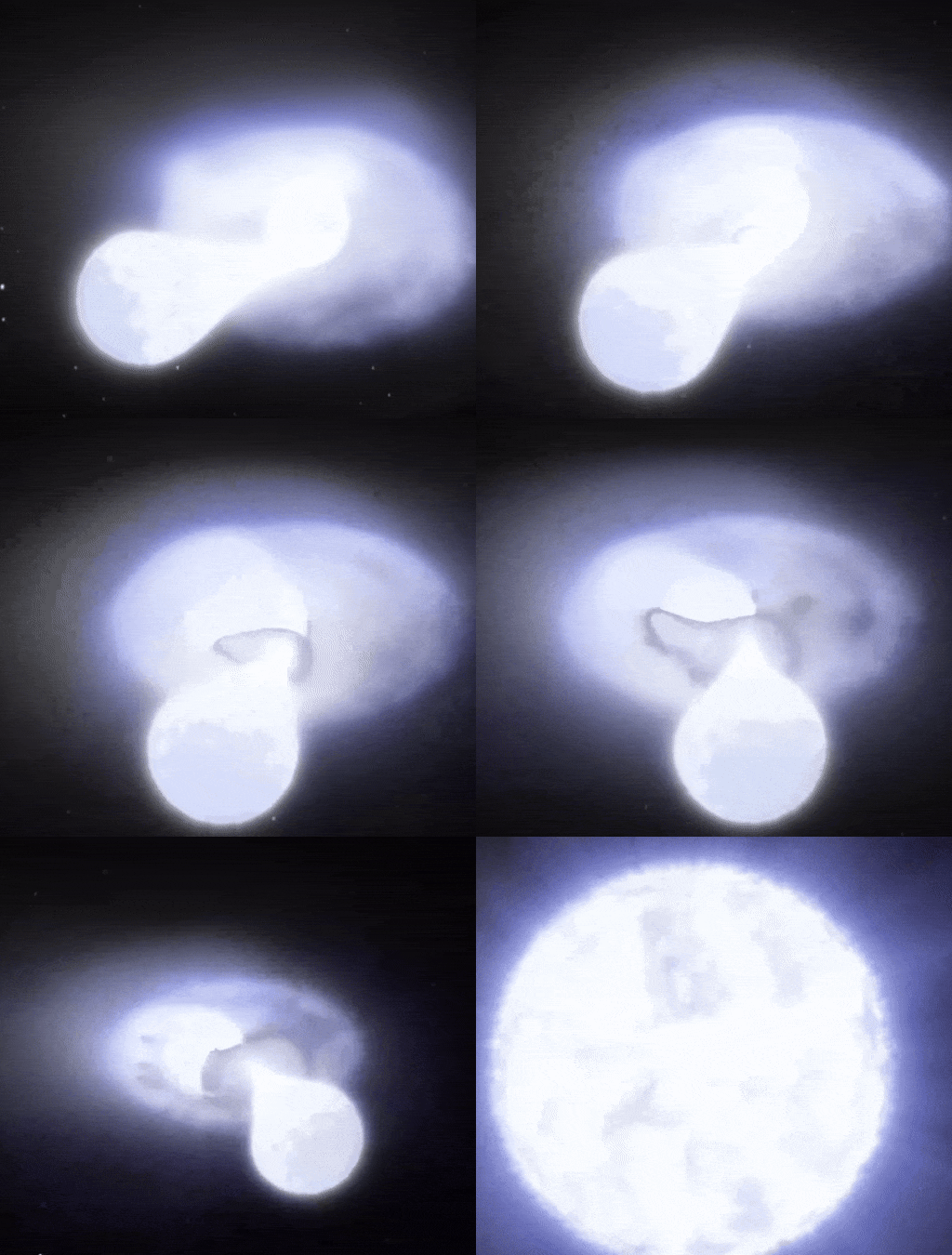
Since 1930, type Ia supernovae have been thought to arise from white dwarfs exceeding the Chandrasekhar mass limit. Here's why that's wrong.

The race to find dark matter could grow more complex with high-energy neutrino interference.

Black holes are the most massive individual objects, spanning up to a light-day across. So how do they make jets that affect the cosmic web?

Humans, when we consider space travel, recognize the need for gravity. Without our planet, is artificial or antigravity even possible?

Why hasn’t matter fallen apart over billions of years? The mystery might start with protons.

The 5th brightest star in our night sky is young, blue, and apparently devoid of massive planets. New JWST observations deepen the mystery.

In the year 1181, a "guest star" was recorded in the constellation of Cassiopeia. Its modern supernova remnant is weirder than we imagined.

Almost everyone asserts that the Big Bang was the beginning of everything, followed by inflation. Has everyone gotten the order wrong?

More than two years after JWST began science operations, our Universe now looks very different. Here are its biggest science contributions.

The fabric of spacetime is four-dimensional, with three for space and only one for time. But wow, time sure is different from space!

An in-depth interview with astronomer Kelsey Johnson, whose new book, Into the Unknown, explores what remains unknown about the Universe.

The Universe changes remarkably over time, with some entities surviving and others simply decaying away. Is this cosmic evolution at work?