




















Search
Earth Science

Wind energy is one of the cleanest, greenest sources of power. But could it have the sneaky side-effect of changing the weather?


The sky is blue. The oceans are blue. While science can explain them both, the reasons for each are entirely different.

The simulation gave researchers some of the first concrete data linking climate change to human evolution and speciation.

Europa may be difficult to access. But if a recent study is correct, its subsurface ocean would be more accessible than previously thought.

Extremely precise atomic clocks are not just of theoretical interest; they could help detect impending volcanic eruptions or melting glaciers.

Volcanic activity caused the end-Triassic mass extinction 200 million years ago. The dinosaurs survived and rose to dominance.

Ancient helium-3 from the dawn of time leaks from the Earth, offering clues to our planet’s formation. A key question is where it leaks from.

A floating platform the size of Rome collapsed off of Antarctica.

Scientists have known blobs existed for a long time, but how they have behaved over Earth’s history has been an open question.

Small spiders use their silk threads to passively fly, a process called ballooning. Learning how could help atmospheric scientists.

Scientists across a range of disciplines have helped solve Darwin's dilemma.

Due to a crust of carbon, the absence of oxygen, and constant bombardment from meteorites, the planet Mercury may be littered with diamonds.

On Nov. 13, 1946, a scientist dropped crushed dry ice from a plane into supercooled stratus clouds.

“I watched closely for the sun or stars to appear, to correct my chronometer, on the accuracy of which our lives and the success of the journey would depend.”

From crocodiles to birds, certain animals managed to survive some of the worst extinction events in world history.

In the Saudi Arabian desert, the Al Naslaa rock formation looks completely unnatural. Its perfectly vertical split remains a mystery.

60% of all potentially dangerous asteroids remain undetected.

Gigantic ranges called "supermountains" formed twice in Earth's history, and they may have had a profound influence on evolutionary history.

From a desert oasis to the Rocky Mountains, being filled with awe makes me a better scientist.

An ancient continent called Balkanatolia rose and fell in the area in and around what is now the eastern Mediterranean.

A new method of extracting rare-earth elements could put us on the track toward a circular economy.

The natural wonders of Mauritius include the spectacular sight of an underwater waterfall. Here's the science of how it works.

Lake Baikal holds nearly one-fourth of Earth's fresh surface water and is the most scientifically interesting lake on our planet.

The pulse took just 35 hours to cover the whole world.

We know more about the universe than what is beneath our feet. But Earth's mantle holds subtle clues about our planet's past.

Impressive but deadly physics underlie catastrophic eruptions.
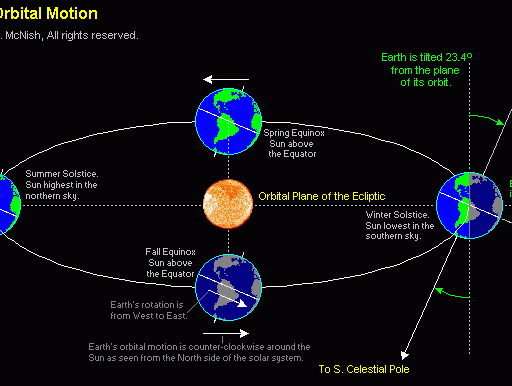
Even with leap years and long-term planning, our calendar won't be good forever. Here's why, and how to fix it.

Driving Teslas and planting trees are nice, but methane reduction, industrial efficiency, carbon removal, and a moderate carbon tax are the most efficient ways to fight climate change.

What was this mammoth tusk doing on the ocean floor 150 miles from land?