




















Search
Exoplanet Research

Looking up at the night sky gives us a glimpse of the Universe beyond our terrestrial concerns. Here's the science of what's out there.

One big goal of science is to find an inhabited, Earth-like planet. But if we find an Earth-like world, will we even recognize it?

Even at its faintest, Venus always outshines every other star and planet that's visible from Earth, and then some!

Astronomer Lisa Kaltenegger spoke with Big Think about how "the colors of life" could leave detectable traces on distant planets.

There will always be "wolf-criers" whose claims wither under scrutiny. But aliens are certainly out there, if science dares to find them.

Finding alien Earths requires seeing Earth-sized planets at Earth-like distances from Sun-like stars. A new discovery completes the roadmap.

Planets grow from protostellar material in disks, leading to full-grown planetary systems in time. At last, the final gap has been filled.

Red dwarfs are the Universe's most common star type. Their flaring now makes potentially Earth-like worlds uninhabitable, but just you wait.

Big Think spoke with astronomer David Kipping about technosignatures, "extragalactic SETI," and being a popular science communicator in the YouTube age.

The most common type of exoplanet is neither Earth-sized nor Neptune-sized, but in between. Could these haze-rich worlds house alien life?

Going back to 1990, we hadn't even found one planet outside of our Solar System. As we close in on 6000, we now see many of them directly.
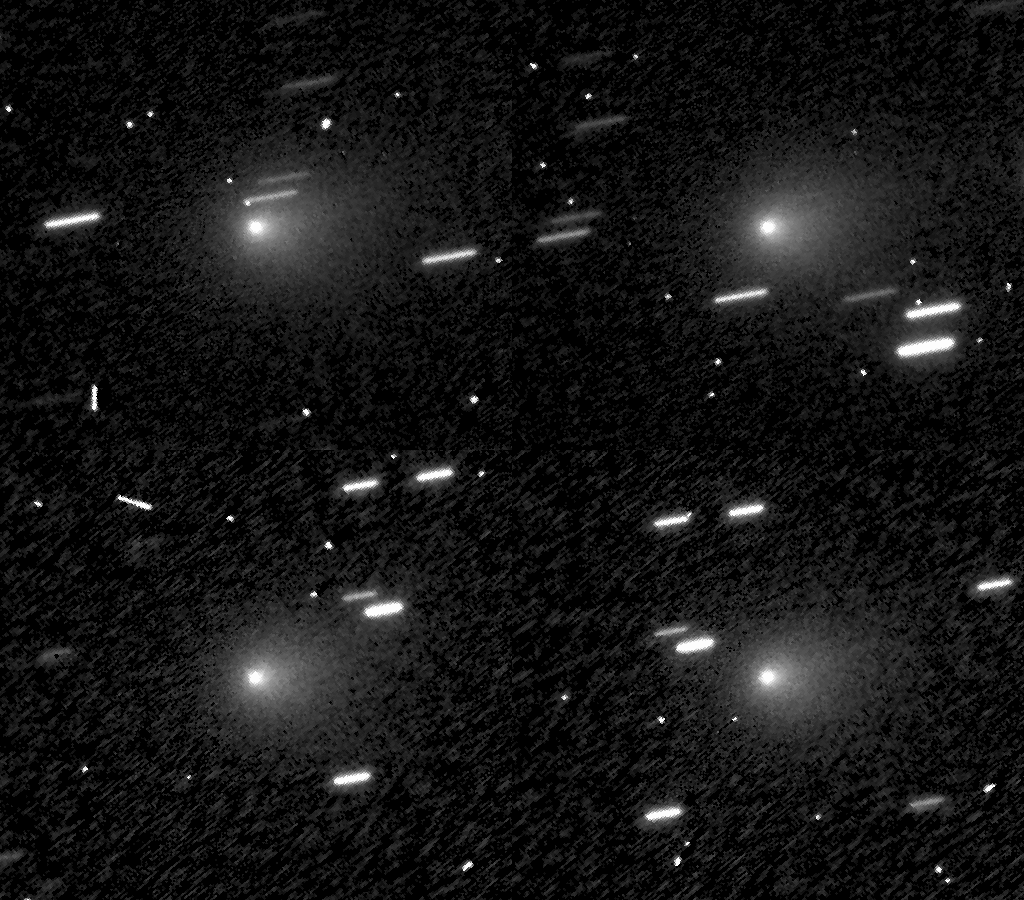
Designed to map galaxies, the SPHEREx mission's first science result is instead about interstellar interloper 3I/ATLAS. No, it's not aliens.
In the search for life in the Universe, the ultimate goal is to find an inhabited planet beyond Earth. How will we know when we've made it?

At the end of July, hundreds of scientists convened to plan NASA's upcoming astrophysics flagship mission. Will the US allow it to happen?

Somewhere, at some point in the history of our Universe, life arose. We're evidence of that here on Earth, but many big puzzles remain.

When the Hubble Space Telescope first launched in 1990, there was so much we didn't know. Here's how far we've come.

Our nearby Ring Nebula, with JWST's eyes, shows evidence for planet formation. Will the Sun eventually destroy, and then replace, the Earth?

Once every 12 years, Earth, Jupiter, Uranus, and Neptune all line up, opening a window for a joint mission. Our next chance arrives in 2034.

The hunt for extraterrestrial life begins with planets like Earth. But our inhabited Earth once looked very different than Earth does today.

The Vera C. Rubin Observatory in Chile will image the southern sky using the largest digital camera ever built.

NASA astrophysics, which gave us Hubble, JWST, and so much more, faces its greatest budget cut in history. All future missions are at risk.

A Cambridge-based team claims to find molecules on an exoplanet that are only produced by life on Earth. Don't fall for the unfounded hype.

Planets can create nuclear power on their own, naturally, without any intelligence or technology. Earth already did: 1.7 billion years ago.

Exoplanets can exist anywhere around their parent stars, even so close that they evaporate or disintegrate. Even the rocky ones.
Even from a single pixel, multiwavelength data taken over time can reveal clouds, icecaps, oceans, continents, and even signs of life.

Barnard's star, the closest singlet star system to ours, has long been a target for planet-hunters. We've finally confirmed it: they exist!

At extremely close distances to their stars, even rocky planets can be completely disintegrated. We've just caught our first one in action.

Here in our Solar System, terrestrial bodies get moons from gravitational capture or collisions. The Pluto-Charon system? It was both.

A young, nearby, massive star, whose protoplanetary disk appears perfectly edge-on, was just viewed by JWST, with staggering implications.

A new SETI study shows how far the field of technosignatures has come.