




















Search
Galaxy Formation

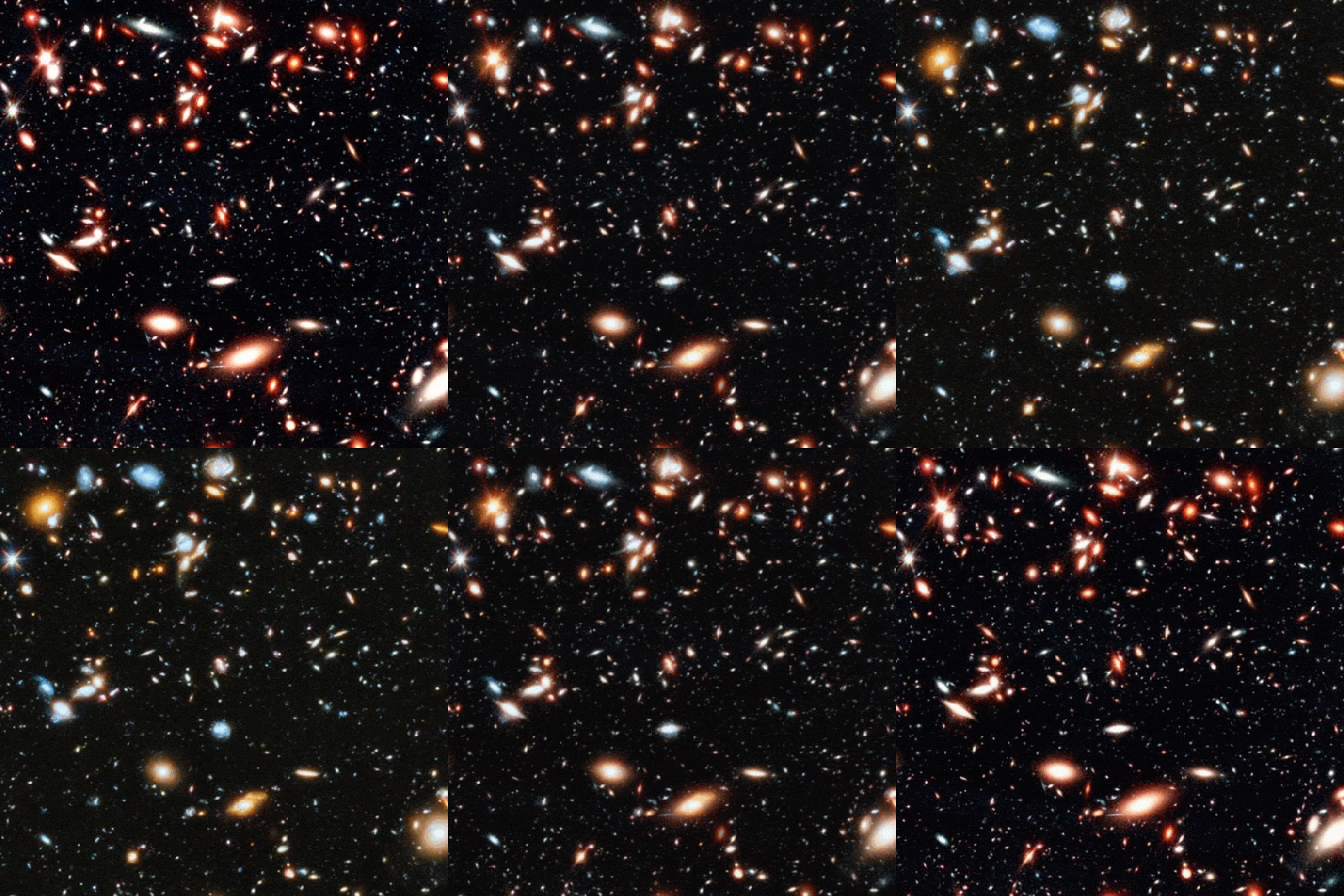
Even with only 12.5 hours of exposure time, James Webb's first deep-field image taught us lessons we've never realized before.
The James Webb Space Telescope has chosen 5 targets for its first science release. Here's what we know on the eve of JWST's big reveal!

LIGO can detect the inspirals and mergers of the lowest-mass black holes, but not the biggest ones. Here's how pulsars can help.

The discovery calls into question the few things scientists know about these powerful astronomical phenomena.

The James Webb Space Telescope is about to begin science operations. Here's what astronomers are excited about.

Where did the “seed” magnetic field come from in the first place?

On July 12, 2022, JWST will release its first science images. Here are 5 ways the telescope's findings could change science forever.

The observable Universe is 92 billion light-years in diameter. These pictures put just how large that is in perspective.

At four million solar masses, the Milky Way's supermassive black hole is quite small for a galaxy its size. Did we lose the original?

For a thousand light-years in all directions, there's a "bubble" that the Sun sits at the center of. Here's the story behind it.

Single objects rarely change the course of an entire scientific field. Distant object GNz7q, a galaxy-quasar hybrid, might do exactly that.

We've fooled ourselves before with galaxies that look just like this one. The evidence we have simply isn't strong enough.

In the latest edition of the Starts With A Bang podcast, we talk with soon-to-be Dr. Arianna Long about galaxies, from birth to today.

The Hubble Space Telescope, 32 years after its launch, broke the all-time record for most distant star. It won't do better.

Galactic archaeology has uncovered a spectacular find: the Milky Way already existed more than 13 billion years ago.

Even a tiny sliver of the Universe can reveal the cosmic story of what's out there and how it came to be the way it is today.

The James Webb Space Telescope could help scientists learn about the cosmic dark ages and how they ended.

When we look out at the Universe, even with Hubble, we're only seeing the closest, biggest, brightest galaxies. Here's where the rest are.

Professional astronomy images are the gold standard. But this Large Magellanic Cloud composite is the amateur community's best image ever.

Out of all the galaxies we know, only a few little ones are missing dark matter. At last, we finally understand why.

Once science operations begin for James Webb, we'll never look at the Universe the same way again. Here's what everyone should know.

Please stop calling our Sun an "average star." It is philosophically dubious and astronomically incorrect.

As viewed by the MeerKAT telescope, this radio view of the Milky Way blows away every other way we've ever seen our home galaxy.

There are ~400 billion stars in the Milky Way, and ~2 trillion galaxies in the visible Universe. But what if we aren't typical?

Just 12 million light-years away, the galaxies Messier 81 and 82 offer a nearby preview of the Milky Way-Andromeda merger.

Hubble's deepest views of space revealed fewer than 10% of the Universe's galaxies. James Webb will change that forever.

Shooting star or piece of space dust?

With a new telescope on the horizon, we reflect on the best pictures of space that came before.

The photometric filters for the Vera Rubin Observatory are complete and showcase why they are indispensable for astronomy.

Astrophysicists once believed in a static Universe, containing only the Milky Way galaxy. Science definitively proved otherwise.