




















Search
General Relativity

There are two fundamentally different ways of measuring the Universe's expansion. They disagree. "Early dark energy" might save us.

New technology is helping physicists move forward in the search for the Theory of Everything.

We know it couldn't have began from a singularity. So how small could it have been at the absolute minimum?

Astrophysicists once believed in a static Universe, containing only the Milky Way galaxy. Science definitively proved otherwise.
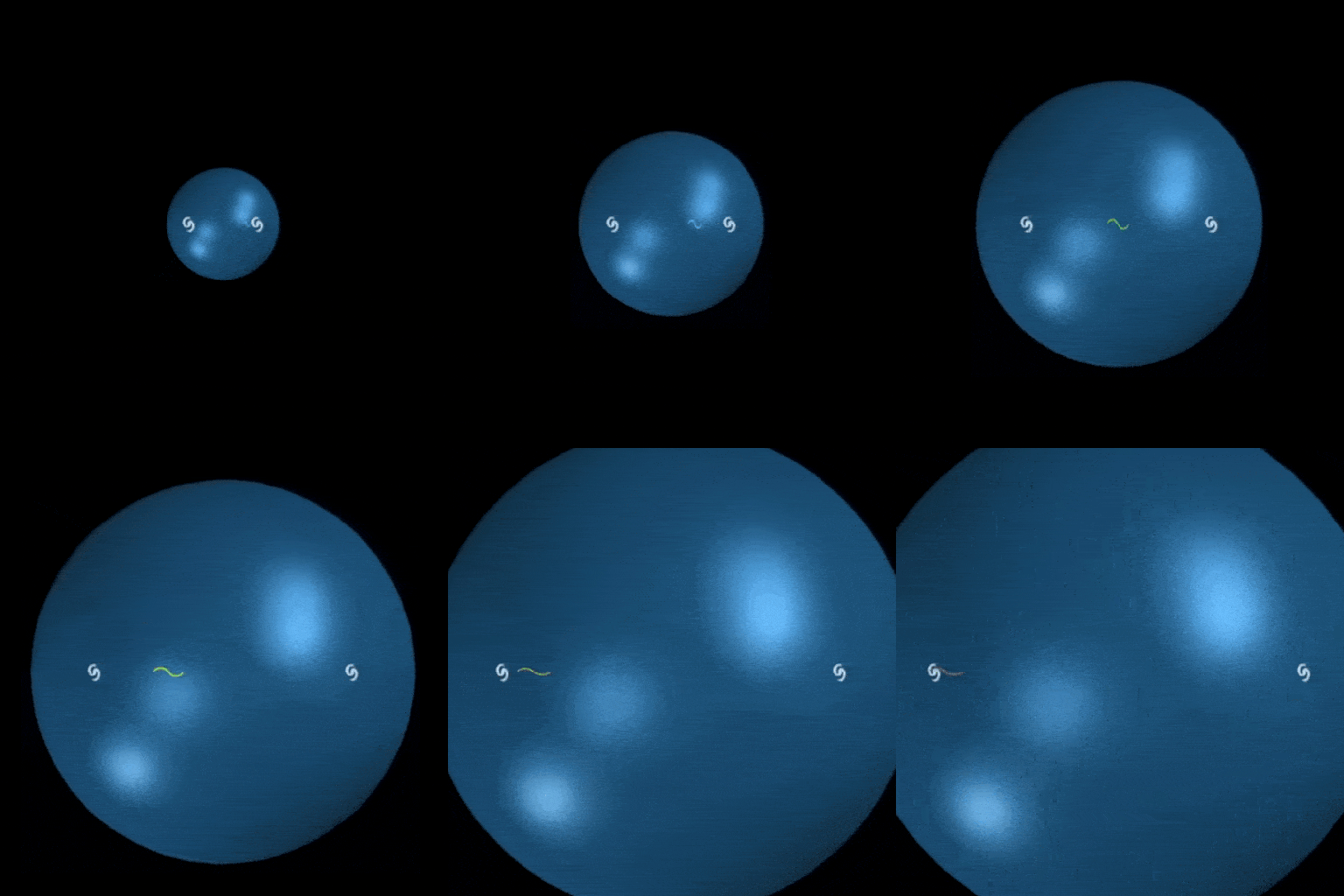
After more than two decades of precision measurements, we've now reached the "gold standard" for how the pieces don't fit.

The same (former) NASA engineer who previously claimed to violate Newton's laws is now claiming to have made a warp bubble. He didn't.

Even without the greatest individual scientist of all, every one of his great scientific advances would still have occurred. Eventually.

There are a few possible solutions to the problem of interstellar travel, but they largely remain within the realm of science fiction.

If it wasn’t a singularity, how small could it have been? Today, when you look out in any direction as far as the laws of physics allow us to see, the […]

When you mix science with speculation, you get speculation. But the underlying science is still real. Whenever you hear the phrase, “it’s just a theory,” it should trigger alarm bells in […]
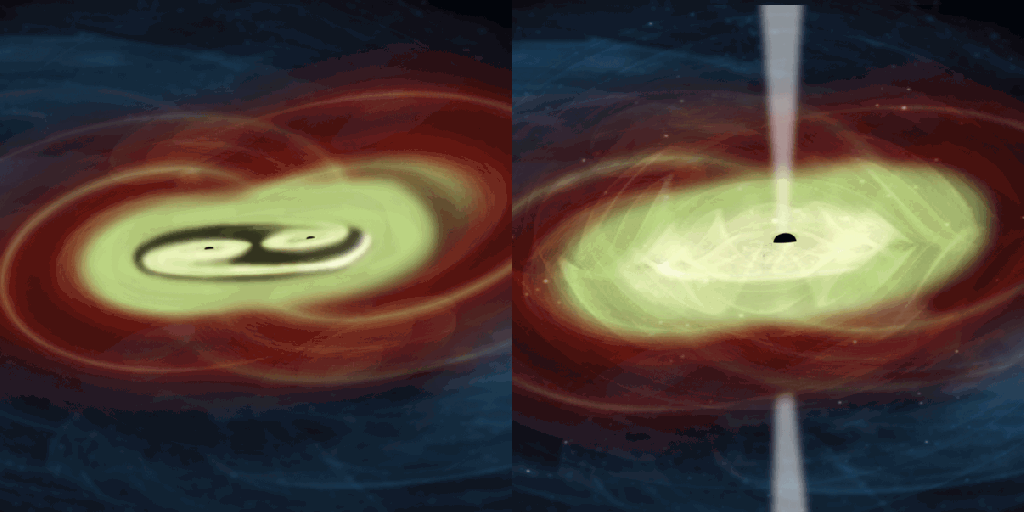
The ‘final parsec problem’ is still a mystery for astronomers. When it comes to black holes in the Universe, we know there are at least two major types. There are […]

Even a small merger can trigger so much more than we realize. Practically every galaxy in the Universe has a supermassive black hole at their core. Ranging from millions to many […]

And, if we have one, how close are we to it? No matter which direction we look in, or how far away our telescopes and instruments are capable of seeing, the […]

And why, even at its faintest, it always outshines every other star and planet. If you’ve been looking to the west after sunset recently, you may have noticed that there’s one […]

All scientific theories, at some level, are wrong. That’s why consensus is so vital. There are two important and common words that, when used scientifically, have a very different meaning than […]
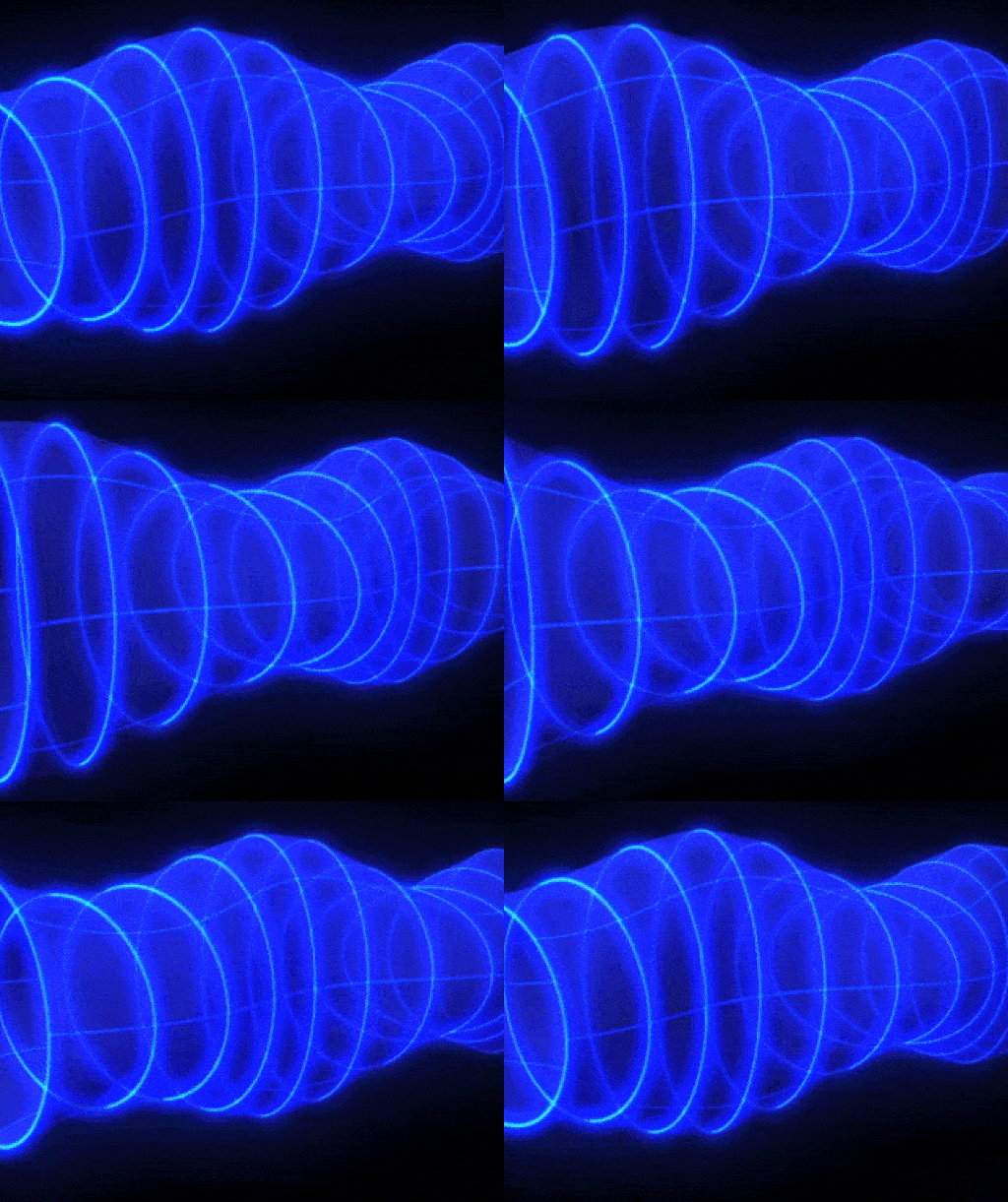
And either way, is energy or information conserved? When two things in the Universe that “always” occur meet one another, how do you know which one will win? Gravitational waves, […]

Three of our dimensions are spatial and one is temporal, but could there be more? From any point in space, you are free to move in any direction you choose. No […]

With 5,000 square degrees of data, the Dark Energy Survey has something important to say. For as long as humans have been studying the Universe, we’ve yearned to know the answers […]

Or is ‘new space’ created in between the gaps of the ‘old’ space? It’s been almost 100 years since humanity first reached a revolutionary conclusion about our Universe: space itself doesn’t […]

Has all this happened before, and will all this happen once again? There are only a few questions, when we ask them, that force us to reckon with the fundamental nature […]

If you can’t surpass it in a vacuum, try doing so in a medium instead. In our Universe, there are a few rules that everything must obey. Energy, momentum, and angular […]

Is it groupthink? Or is there a deeper reason? In the early half of the 20th century, even after the discovery of the expanding Universe, physicists considered a wide variety of […]

Even addition has to play by different rules for black holes. How do you add 28 and 47 together? This simple math question helps us highlight the many different ways that […]

We have to use the right definition for the specific question we’re asking. When it comes to the Universe, we frequently characterize objects by examining and reporting on their physical […]

And which ones are probably examples where we’ve fooled ourselves? Every once in a while — multiple times per year — a new research finding fails to line up with our theoretical expectations. In […]

And, at some point, did the Milky Way lose ours? There are some 400 billion objects flying through the Milky Way galaxy with enough mass that — if they were all made of […]

We can describe what we see happening, but we don’t understand why. Despite our vast cosmic knowledge, enormous unknowns remain. The quantum fluctuations inherent to space, stretched across the Universe […]

At just 3 solar masses, it eliminates the “mass gap.” Searching for black holes is one of the most difficult astronomical games a scientist can play. Emitting no light of their […]

The densest objects that haven’t collapsed to black holes can tell us information about the Universe unlike anything else. Swarming through our own galaxy, we’ve detected quite a few bizarre objects: […]

Enough mass in one location will always create a black hole. But not all masses are possible. If you take enough mass and compress it into a small enough volume […]