




















Search
General Relativity

11mins
"We are all in orbit around the center of the Milky Way galaxy. How big is this collection of stars? Somewhere between 200 and 400 billion suns in the Milky Way galaxy, about 100,000 light years across."

Just 10 years ago, humanity had never directly detected a single gravitational wave. We're closing in on 300 now, with so much more to come!

The fact that our Universe's expansion is accelerating implies that dark energy exists. But could it be even weirder than we've imagined?

Since 1998, we've known our Universe isn't just expanding, but the expansion is accelerating. Could the Big Bang itself be the reason why?
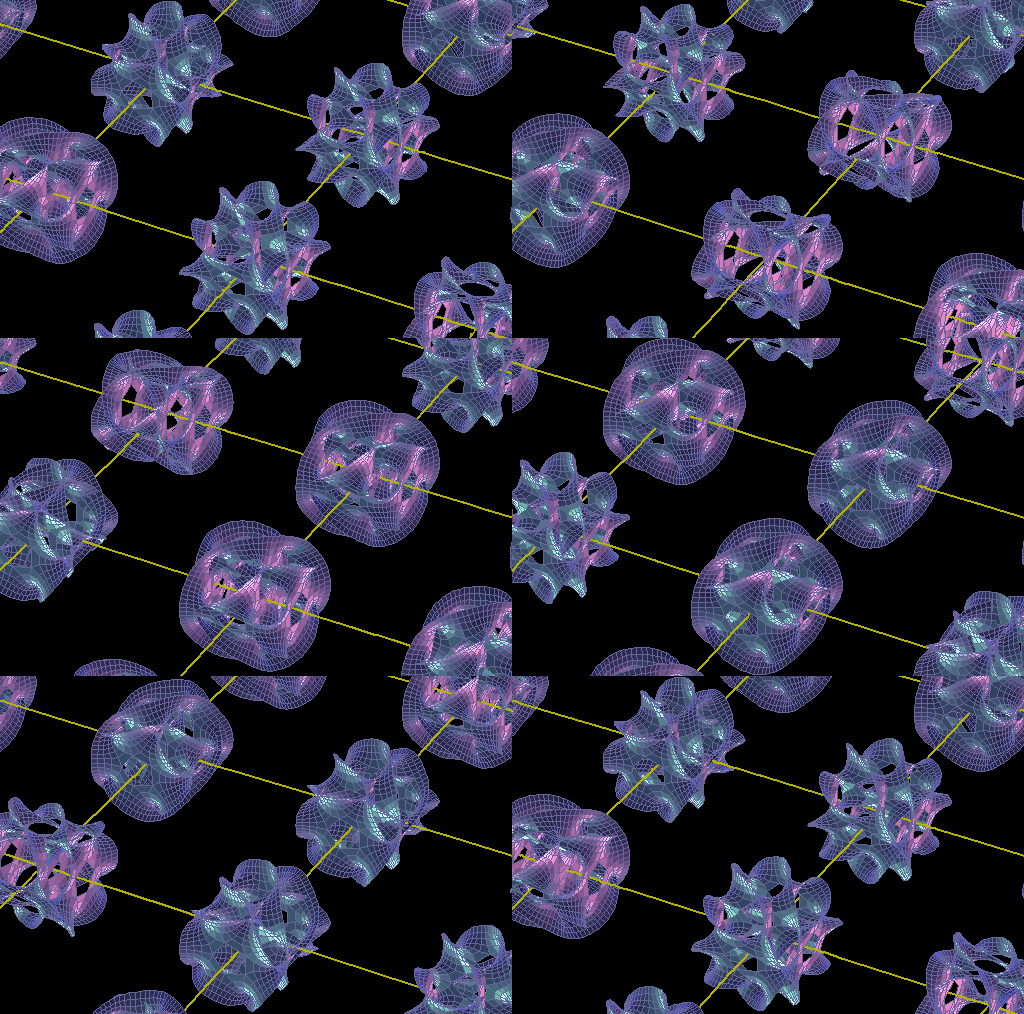
There are limits to where physics makes meaningful predictions: beyond the Planck length, time, or energy. Here's why we can't go further.

According to Stephen Hawking, spontaneously emitted radiation should cause all black holes to decay. But we've never seen it: not even once.

DESI, by mapping galaxies, has claimed they see evidence for dark energy evolving by getting weaker. But that's only one interpretation.

Einstein's general relativity has reigned supreme as our theory of gravity for over a century. Could we reduce it back down to Newton's law?

Since the dawn of history, humans have pondered our ultimate cosmic origins. Now in the 21st century, science has gone beyond the Big Bang.

Despite no experimental evidence showing that gravitons exist, they remain a respectable concept in the world of professional physicists.

Many of us look at black holes as cosmic vacuum cleaners: sucking in everything in their vicinity. But it turns out they don't suck at all.

In the year 2000, physicists created a list of the ten most important unsolved problems in their field. 25 years later, here's where we are.

Electromagnetism, both nuclear forces, and even the Higgs force are mediated by known bosons. What about gravity? Does it require gravitons?

50 years ago, Stephen Hawking showed that black holes emit radiation and eventually decay away. That fate may now apply to everything.

Most waves need a medium to travel through. But the way that light and gravitational waves travel shows that space can't be a medium at all.
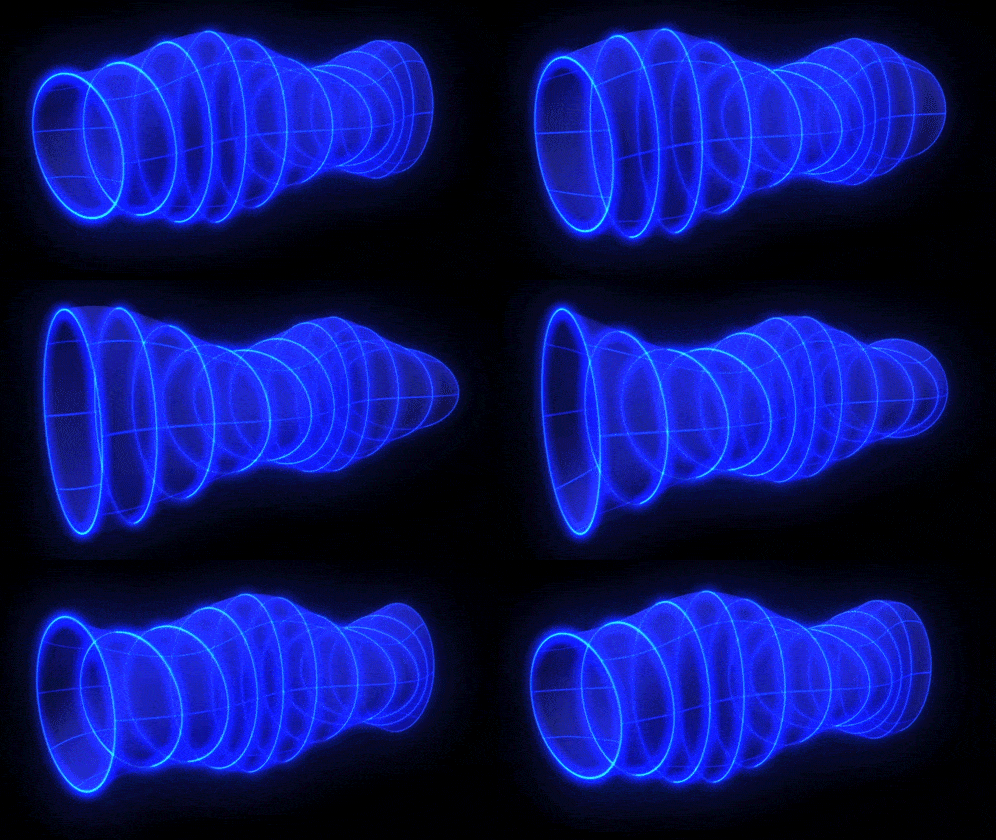
Gravitational waves are the last signatures that are emitted by merging black holes. What happens when these two phenomena meet in space?

DESI has allowed astronomers to create an unprecedented 3D map of the Universe representing 20% of the entire sky.

For nearly 60 years, the hot Big Bang has been accepted as the best story of our cosmic origin. Could the Steady-State theory be possible?

Two parts of our Universe that seem to be unavoidable are dark matter and dark energy. Could they really be two aspects of the same thing?

Since the mid-1960s, the CMB has been identified with the Big Bang's leftover glow. Could any alternative explanations still work?

Humans, when we consider space travel, recognize the need for gravity. Without our planet, is artificial or antigravity even possible?

One of the 20th century's most famous, influential, and successful physicists is lauded the world over. But Feynman is no hero to me.

Almost everyone asserts that the Big Bang was the beginning of everything, followed by inflation. Has everyone gotten the order wrong?

Many mavericks look to Einstein as a unique figure, whose lone genius revolutionized the Universe. The big problem? It isn't true.

The secret sauce is the real world.

The fabric of spacetime is four-dimensional, with three for space and only one for time. But wow, time sure is different from space!

Black holes encode information on their surfaces, but evaporate away into Hawking radiation. Is that information preserved, and if so, how?

Physicists recently created Coordinated Lunar Time, a time zone for our Moon.

In all directions, at great distances, the Universe looks younger, more uniform, and less evolved. Does that mean Earth must be the center?

Time is relative, not absolute, as gravity and motion both cause time to dilate. Your head and feet, therefore, don't age at the same rate.