




















Search
General Relativity

42mins
Sabine Hossenfelder talks about Albert Einstein, dead grandmothers, the physics of aging, and more in this full interview with Big Think.

Yes, "the laws of physics break down" at singularities. But something really weird must have happened for black holes to not possess them.

Contrary to common experience, not everything needs a medium to travel through. Overcoming that assumption removes the need for an aether.

Before there were planets, stars, and galaxies, before even neutral atoms or stable protons, there was the Big Bang. How did we prove it?

The standard model of cosmology has a big new problem: Some galaxies seem to be too old.

Einstein's relativity overthrew the notion of absolute space and time, replacing them with a spacetime fabric. But is spacetime truly real?

The conservation of energy is one of the most fundamental laws governing our reality. But in the expanding Universe, that's just not true.

All forms of energy affect the expanding Universe. But if matter and radiation slow the expansion down, how does dark energy speed it up?

The cosmic microwave background offers clues.
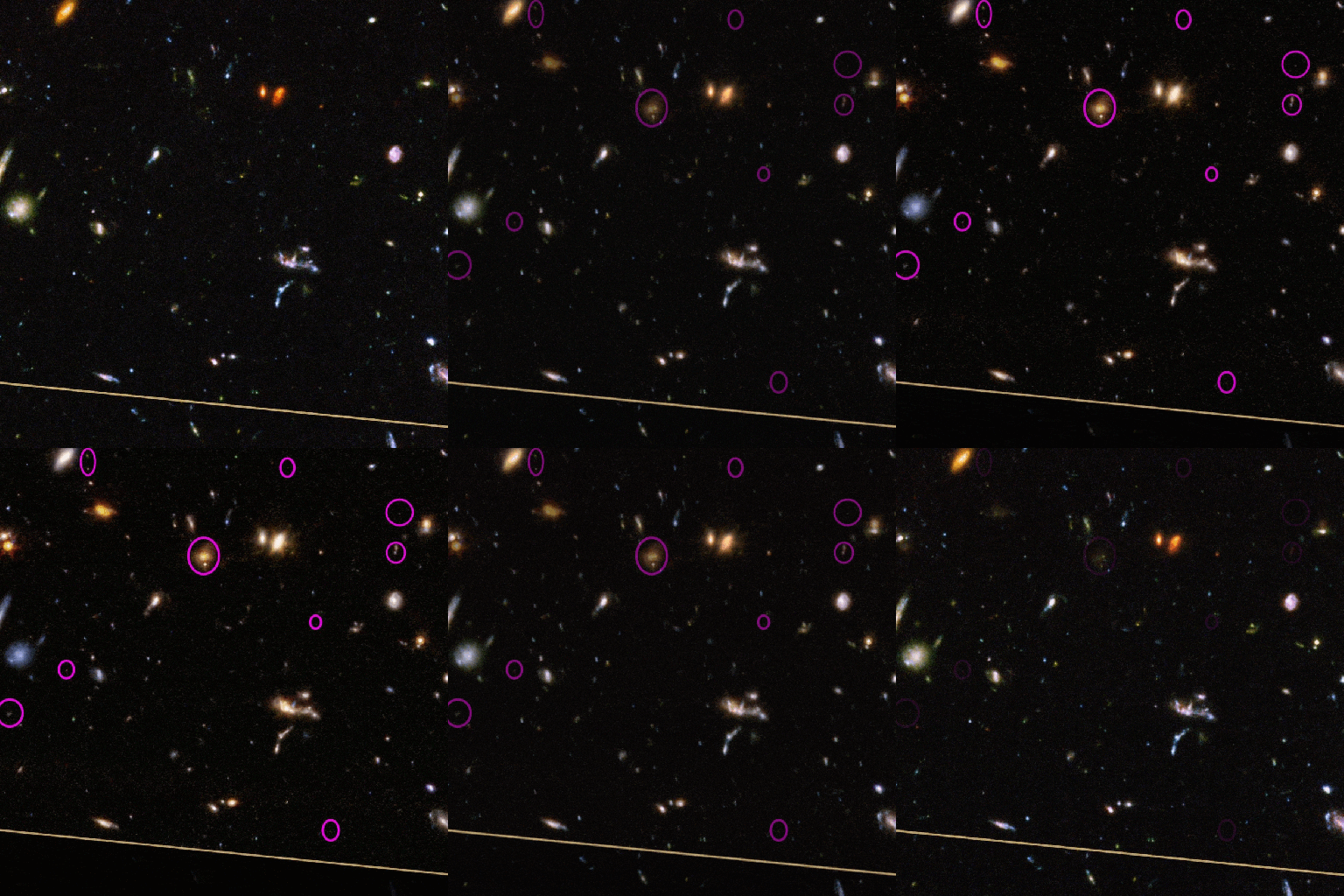
JWST has brought us more distant views of the early Universe than ever before. Is the Big Bang, and all of modern cosmology, in trouble?

Cosmologists are largely still in the dark about the forces that drive the Universe.

Though he renounced philosophy, Stephen Hawking's final theory of the universe redraws the basic foundations of cosmology.

"Imagination is more important than knowledge" is often taken to mean that your conceptions outweigh what's real. That's not what he said.

Stars orbiting black holes were observed to move significantly slower than expected. One explanation centers on dark matter.

Einstein called his idea "abominable," but the world of physics came around to embracing the views of Georges Lemaître.

Leading a scientific revolution is easy: you just have to succeed where the current theory fails while equaling its successes. Good luck!

If the evolution of the Universe is a movie, what happens when we rewind it all the way backward?

Time gets a little strange as you approach the speed of light.

What do we mean by a black hole's size? A photon sphere? The minimal stable orbit? The event horizon? The singularity? Which one is right?

Speeding through the Universe and leaving a wake of new stars, this runaway supermassive black hole is likely the first among thousands.

How scientists found out that we live in a cosmic aquarium.

Two very different ideas, wormholes and quantum entanglement, might be fundamentally related. What would "ER = EPR" mean for our Universe?


Not even Einstein immediately knew the power of the equations he gave us.

The zero-point energy of empty space is not zero. Even with all the physics we know, we have no idea how to calculate what it ought to be.

Unless you confront your theory with what's actually out there in the Universe, you're playing in the sandbox, not engaging in science.

Dark energy is one of the biggest mysteries in all the Universe. Is there some way to avoid "having to live with it?"

From the Big Bang to dark energy, knowledge of the cosmos has sped up in the past century — but big questions linger.

It is a story with nebulous beginnings and no discernible end.

19 years ago, the Bullet Cluster provided an empirical proof for dark matter. Even today, modified gravity still can't explain it.