




















Search
General Relativity
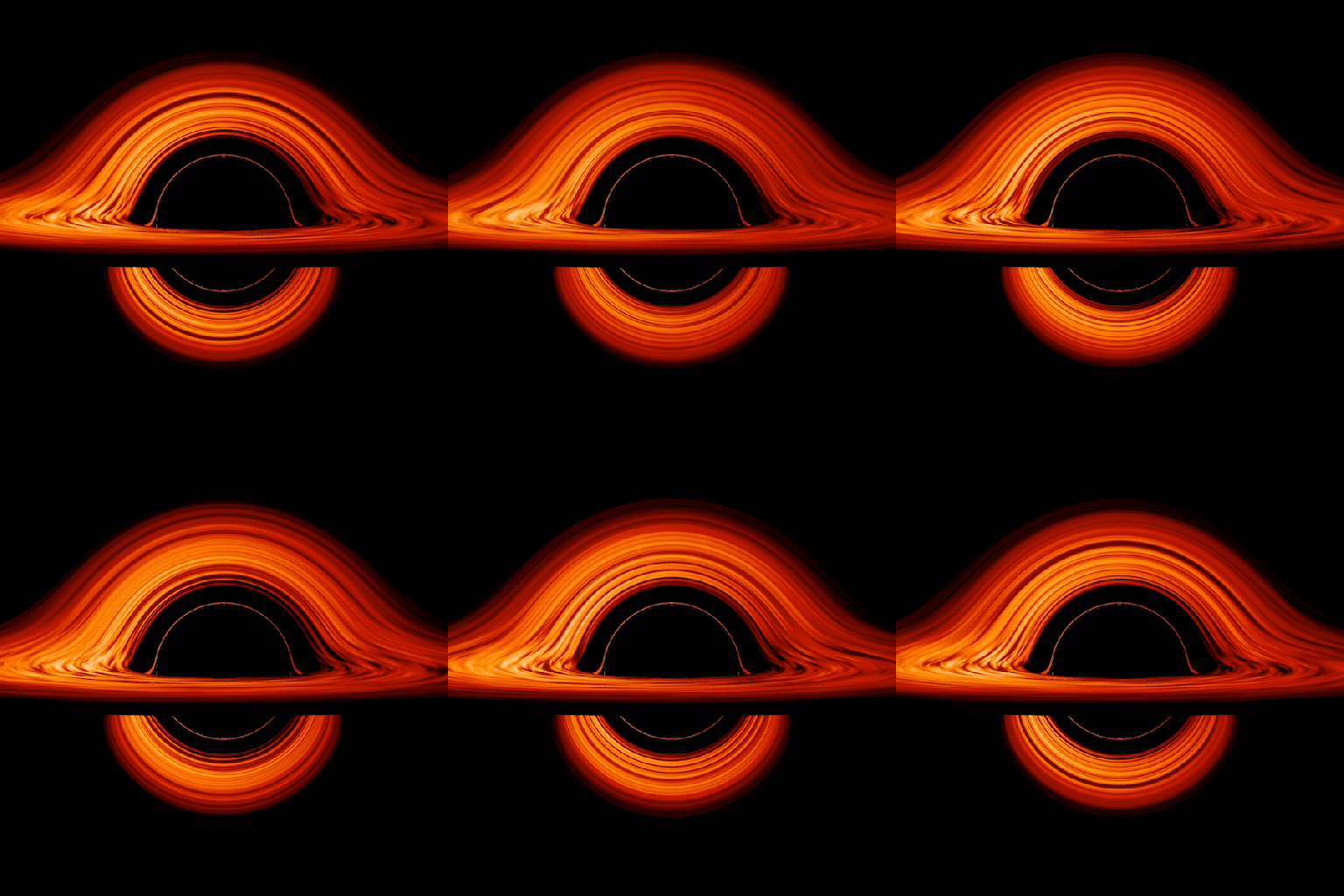
With two different black hole event horizons now directly imaged, we can see that they are, in fact, rings, not disks. But why?

In all of science, no figures have changed the world more than Einstein and Newton. Will anyone ever be as revolutionary again?


13.8 billion years ago, the hot Big Bang gave rise to the Universe we know. Here's why the reverse, a Big Crunch, isn't how it will end.

Atomic clocks keep time accurately to within 1 second every 33 billion years. Nuclear clocks could blow them all away.

Everything is made of matter, not antimatter, including black holes. If antimatter black holes existed, what would they do?

At four million solar masses, the Milky Way's supermassive black hole is quite small for a galaxy its size. Did we lose the original?

Time isn't the same for everyone, even on Earth. Flying around the world gave Einstein the ultimate test. No one is immune from relativity.

Basic and breath-taking – Dr. Frank Wilczek addresses symmetry’s critical role in nature’s laws and what we consider to be beautiful.
John Templeton Foundation

The idea of black holes has been around for over 200 years. Today, we're seeing them in previously unimaginable ways.

Popular media often frame scientists as having a cold, sterile view of the world. That couldn’t be further from the truth.
John Templeton Foundation


Astronomers in 2017 caught an image of a supermassive black hole in a galaxy far, far away. Doing it in our own galaxy is a huge milestone.

After years of analysis, the Event Horizon Telescope team has finally revealed what the Milky Way's central black hole looks like.

Equations that describe time travel are fully compatible and consistent with relativity — but physics is not mathematics.

Extremely precise atomic clocks are not just of theoretical interest; they could help detect impending volcanic eruptions or melting glaciers.

Look out at a distant object, and you're not seeing it as it is today. It's size, brightness, and actual distance are all different.

Singularities frustrate our understanding. But behind every singularity in physics hides a secret door to a new understanding of the world.

For some reason, the charges on the electron and proton are equal and opposite, and their numbers are equal, too. But why?

The idea of "absolute time" was our default for millennia. But time is relative, as gravity and motion both cause time to dilate.

For some reason, when we talk about the age of stars, galaxies, and the Universe, we use "years" to measure time. Can we do better?

To answer any physical question, you must ask the Universe itself. But what happens when the answers aren't around anymore?

To understand the edges of our universe, we’ll need to explore the edges of our own philosophies.
John Templeton Foundation

Despite all that we've learned about the Universe, there remain unanswered, and possibly unanswerable, questions. Could "God" be the answer?

More than any other of Einstein's equations, E = mc² is the most recognizable to people. But what does it all mean?

Is the multiverse real? It's one of the hottest questions in all of theoretical physics. We invited two astrophysicists to join the debate.

Yes, the Universe is expanding, but you might wonder, "How fast is it expanding?"

There are an estimated two trillion galaxies within the observable Universe. Most are already unreachable, and the situation only gets worse.

It is time to give the Russian cosmologist the credit he deserves.

At a fundamental level, nobody knows whether gravity is truly quantum in nature. A novel experiment strongly hints that it is.