




















Search
General Relativity

If you think of the Big Bang as an explosion, we can trace it back to a single point-of-origin. But what if it happened everywhere at once?

The hot Big Bang is often touted as the beginning of the Universe. But there's one piece of evidence we can't ignore that shows otherwise.

As we gain new knowledge, our scientific picture of how the Universe works must evolve. This is a feature of the Big Bang, not a bug.

10 years ago, LIGO first began directly detecting gravitational waves. Now better than ever, it's revealing previously unreachable features.

It's the origin of our entire observable Universe, but it's still not the very beginning of everything.

The Holy Grail of physics is a Theory of Everything: where a single equation describes the whole Universe. But maybe there simply isn't one?

Since even before Einstein, physicists have sought a theory of everything to explain the Universe. Can positive geometry lead us there?
The Universe isn't just expanding; the expansion is accelerating. If different methods yield incompatible results, is dark energy evolving?

When you don't have enough clues to bring your detective story to a close, you should expect that your educated guesses will all be wrong.
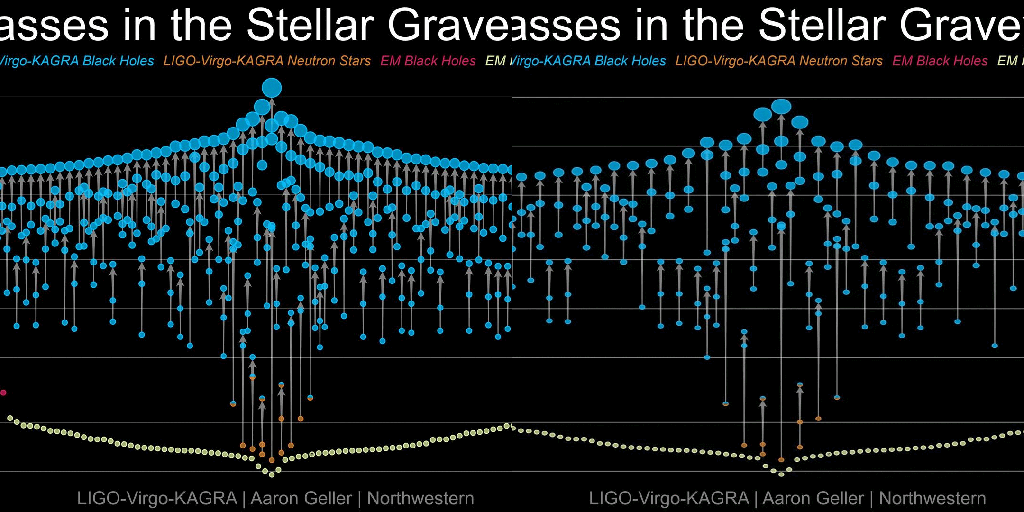
10 years ago, LIGO saw its first gravitational wave. After 218 detections, our view of black holes has changed forever. Can this era endure?

Throughout history, "free energy" has been a scammer's game, such as perpetual motion. But with zero-point energy, is it actually possible?

Just 13.8 billion years after the hot Big Bang, we can see 46.1 billion light-years away in all directions. Doesn't that violate...something?

Einstein is credited with saying, "If the facts don't fit the theory, change the facts." What he actually said has a very different meaning.

Two supermassive black holes on an inevitable death spiral push the limits of Einstein's relativity. New observations reveal even more.

Once you cross a black hole's event horizon, there's no going back. But inside, could creating a singularity give birth to a new Universe?

From high school through the professional ranks, physicists still take incredible lessons away from Newton's second law.
With over 300 high-significance gravitational wave detections, we now have a huge unsolved puzzle. Will we invest in finding the solution?
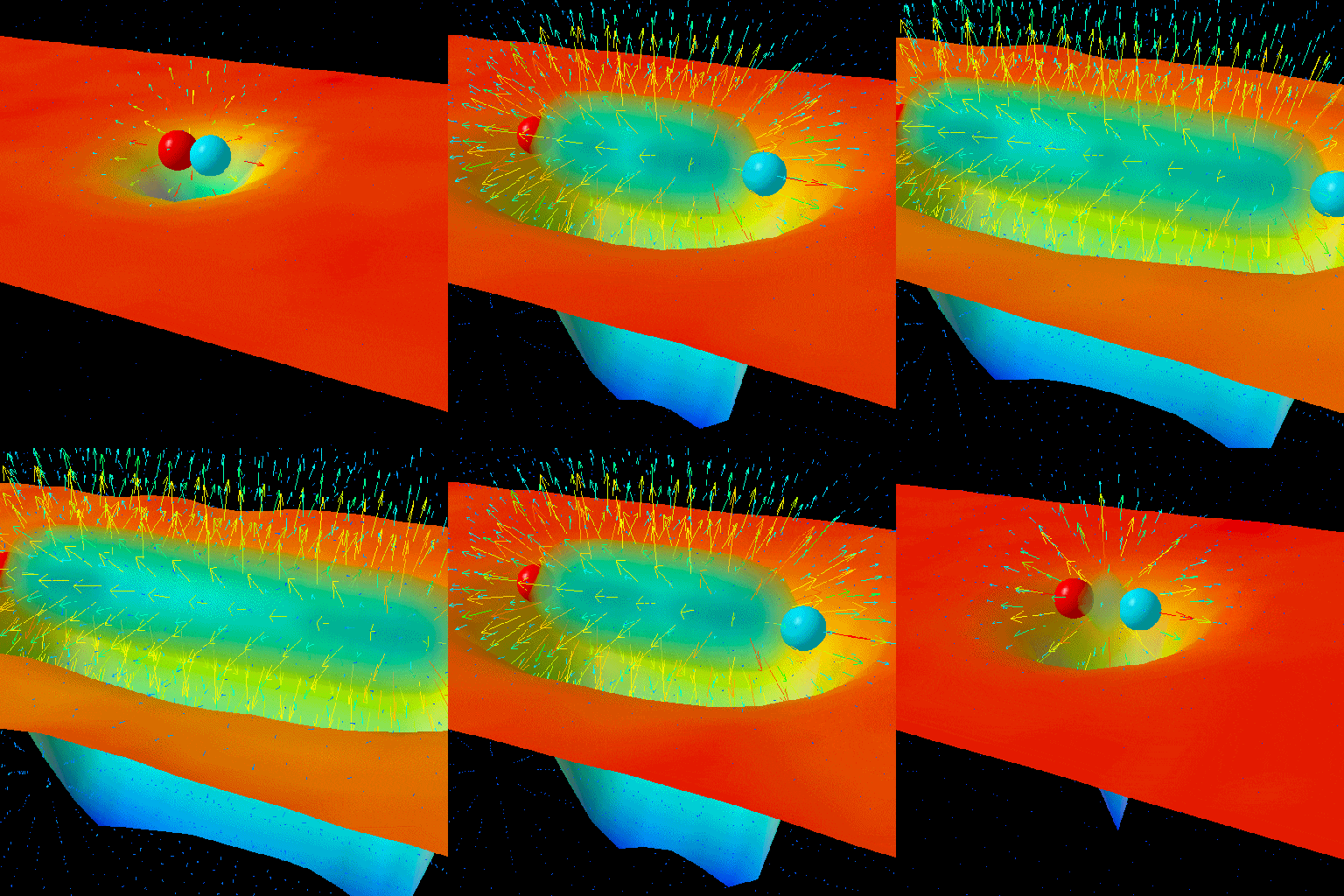
The measured value of the cosmological constant is 120 orders of magnitude smaller than what's predicted. How can this paradox be resolved?

For over 50 years, it’s been the scientifically accepted theory describing the origin of the Universe. It’s time we all learned its truths.

A few physical quantities, in all laboratory experiments, are always conserved: including energy. But for the entire Universe? Not so much.

If you want to understand the Universe, cosmologically, you just can't do it without the Friedmann equation. With it, the cosmos is yours.

Here in our Universe, time passes at a fixed rate for all observers: one second-per-second. Before the Big Bang, things were very different.

If all massive objects emit Hawking radiation, not just black holes alone, then everything is unstable, even the Universe. Can that be true?

Just 10 years ago, humanity had never directly detected a single gravitational wave. We're closing in on 300 now, with so much more to come!

The fact that our Universe's expansion is accelerating implies that dark energy exists. But could it be even weirder than we've imagined?

Since 1998, we've known our Universe isn't just expanding, but the expansion is accelerating. Could the Big Bang itself be the reason why?
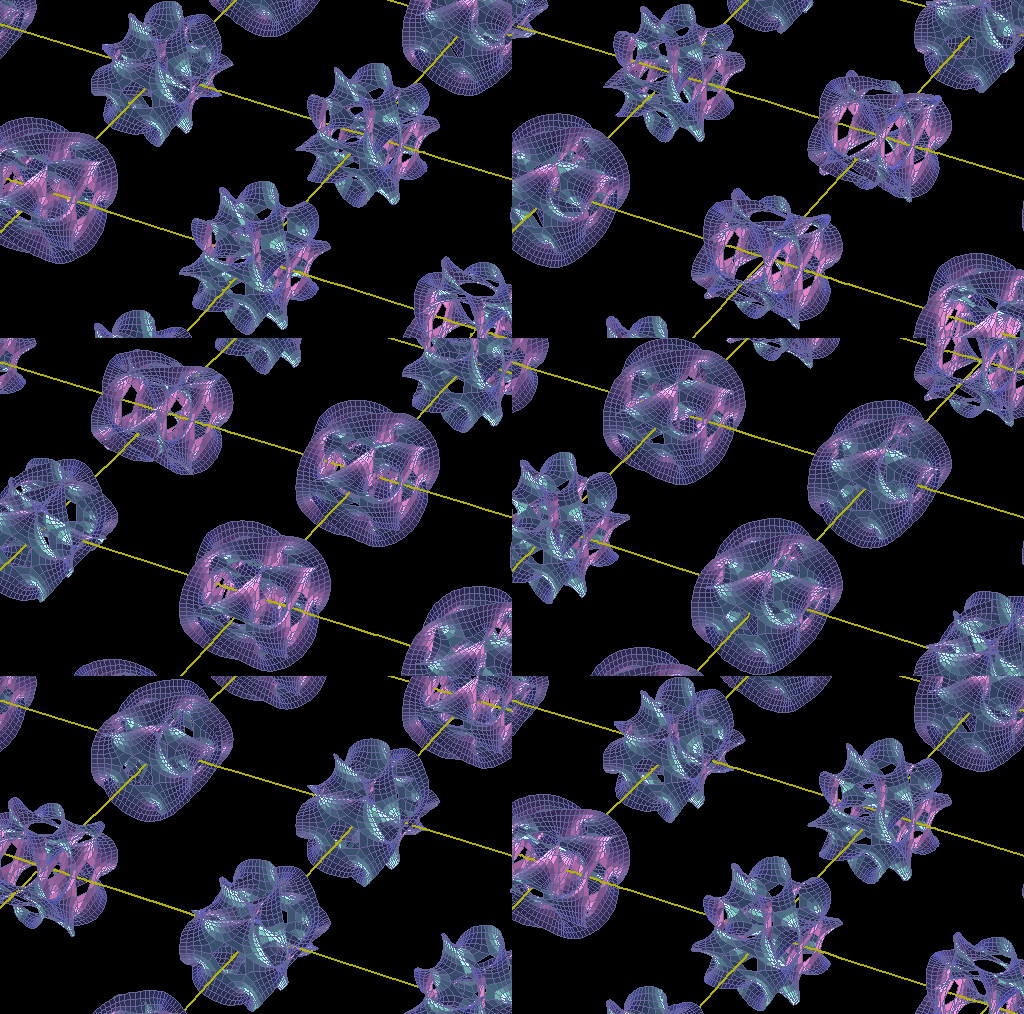
There are limits to where physics makes meaningful predictions: beyond the Planck length, time, or energy. Here's why we can't go further.

According to Stephen Hawking, spontaneously emitted radiation should cause all black holes to decay. But we've never seen it: not even once.

DESI, by mapping galaxies, has claimed they see evidence for dark energy evolving by getting weaker. But that's only one interpretation.

Einstein's general relativity has reigned supreme as our theory of gravity for over a century. Could we reduce it back down to Newton's law?