




















Search
General Relativity

By probing the Universe on atomic scales and smaller, we can reveal the entirety of the Standard Model, and with it, the quantum Universe.

The first observational evidence showing the Universe is expanding is 100 years old now: in 2023. Here's the story of its 100th anniversary.

Some constants, like the speed of light, exist with no underlying explanation. How many "fundamental constants" does our Universe require?

Two fundamentally different ways of measuring the expanding Universe disagree. What's the root cause of this Hubble tension?

How scientists are hearing the gravitational background "hum" of the Universe for the very first time.

Nothing can escape from a black hole. So where do Hawking radiation, relativistic jets, and X-ray emissions around black holes come from?

The concept of the warp drive is currently at odds with everything we know to be true about physics.

For many years, cosmologists have claimed the Universe is 13.8 billion years old. A new paper says no, it's 26.7 billion. How do we decide?

Some 55 million light-years away lies the giant galaxy Messier 87. Its supermassive black hole, inside and out, looks better than ever.

Headlines have blared that quasar ticking confirms that time passed more slowly in the early Universe. That's not how any of this works.

After 15 years of monitoring 68 objects known as millisecond pulsars, we've found the Universe's background gravitational wave signal!

A cute mathematical trick can "rescale" the Universe so that it isn't actually expanding. But can that "trick" survive all our cosmic tests?

In a distant galaxy, a cosmic dance between two supermassive black holes emits periodic flashes of light.

In many ways, we are still novices playing with toy models seeking to understand the stars.

There are 40 billion billion black holes in the universe. Here’s how our Solar System stacks up against ten of them.

When Einstein gave General Relativity to the world, he included an extraneous cosmological constant. How did his 'biggest blunder' occur?

It's been 100 years since we discovered that the Universe was expanding. But if it's expanding, then what is it expanding into?

Einstein's most famous equation is E = mc², which describes the rest mass energy inherent to particles. But motion matters for energy, too.

Yes, "the laws of physics break down" at singularities. But something really weird must have happened for black holes to not possess them.

Contrary to common experience, not everything needs a medium to travel through. Overcoming that assumption removes the need for an aether.

Before there were planets, stars, and galaxies, before even neutral atoms or stable protons, there was the Big Bang. How did we prove it?

The standard model of cosmology has a big new problem: Some galaxies seem to be too old.

Einstein's relativity overthrew the notion of absolute space and time, replacing them with a spacetime fabric. But is spacetime truly real?

The conservation of energy is one of the most fundamental laws governing our reality. But in the expanding Universe, that's just not true.

All forms of energy affect the expanding Universe. But if matter and radiation slow the expansion down, how does dark energy speed it up?

The cosmic microwave background offers clues.
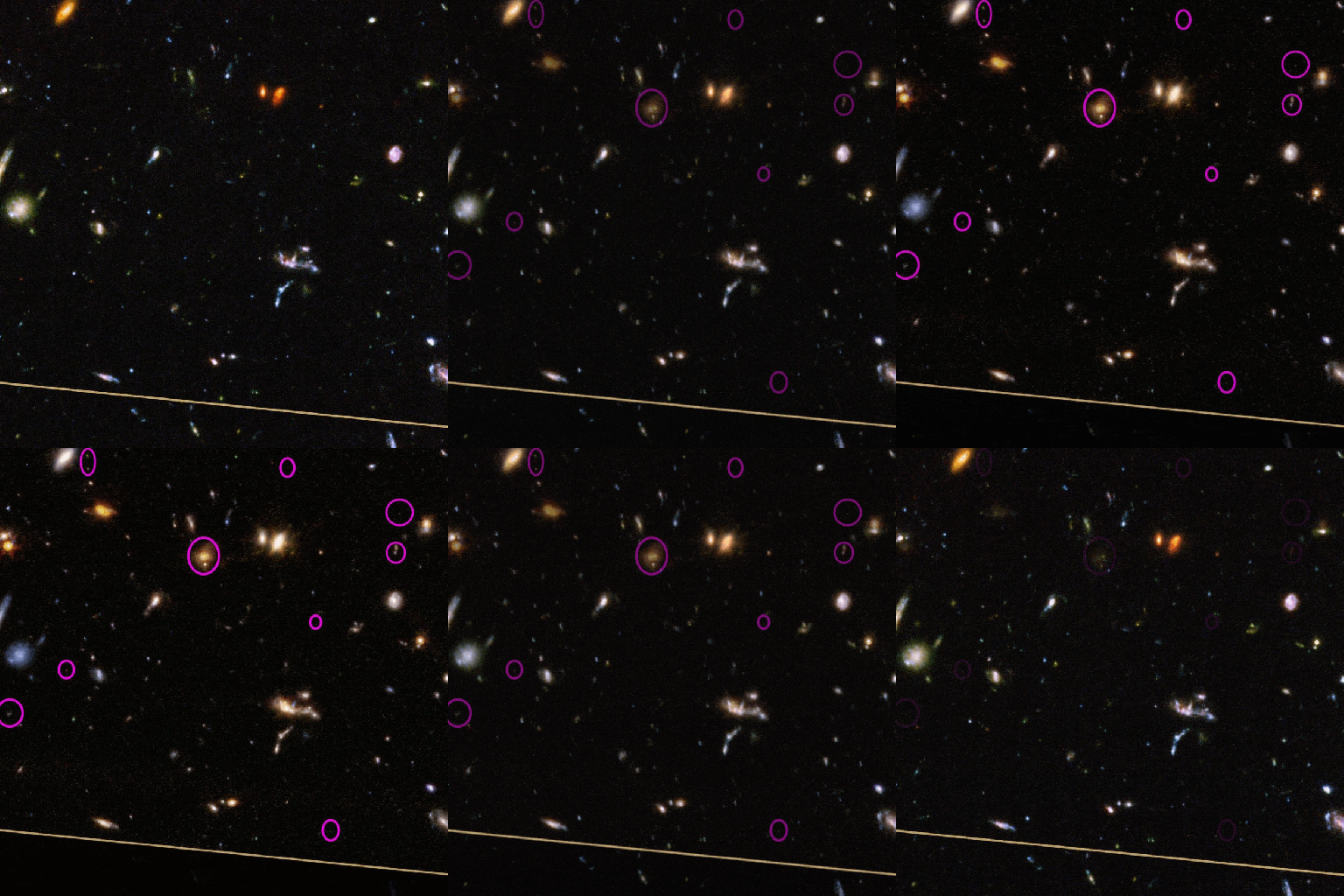
JWST has brought us more distant views of the early Universe than ever before. Is the Big Bang, and all of modern cosmology, in trouble?

Cosmologists are largely still in the dark about the forces that drive the Universe.

Though he renounced philosophy, Stephen Hawking's final theory of the universe redraws the basic foundations of cosmology.

"Imagination is more important than knowledge" is often taken to mean that your conceptions outweigh what's real. That's not what he said.