




















Search
General Relativity

The largest hazardous asteroid found in the last 8 years showcases a little-known class of planet-killers. And we're woefully unprepared.

In 1974, Stephen Hawking showed that even black holes don't live forever, but emit radiation and eventually evaporate. Here's how.

The Universe gravitates so that normal matter and General Relativity alone can't explain it. Here's why dark matter beats modified gravity.

Holograms preserve all of an object's 3D information, but on a 2D surface. Could the holographic Universe idea lead us to higher dimensions?

In the 20th century, many options abounded as to our cosmic origins. Today, only the Big Bang survives, thanks to this critical evidence.

The Big Bang is commonly misunderstood, warping our understanding about the Universe's size and shape.

The theory is accurate within at least one part in a quadrillion.


Einstein's relativity teaches us that time isn't absolute, but passes relatively for everyone. So how do telescopes see back through time?

Einstein's "happiest thought" led to General Relativity's formulation. Would a different profound insight have led us forever astray?

Our model of the Universe, dominated by dark matter and dark energy, explains almost everything we see. Almost. Here's what remains.

We only detected our very first gravitational wave in 2015. Over the next two decades, we'll have thousands more.

We live in a four-dimensional Universe, where matter and energy curve the fabric of spacetime. But time sure is different from space!

There's a speed limit to the Universe: the speed of light in a vacuum. Want to beat the speed of light? Try going through a medium!

At all distances, the Universe expands along our line-of-sight. But we can't measure side-to-side motions; could it be rotating as well?

The idea of gravitational redshift crossed Einstein's mind years before General Relativity was complete. Here's why it had to be there.

The Universe is expanding, and the Hubble constant tells us how fast. But how can it be a constant if the expansion is accelerating?
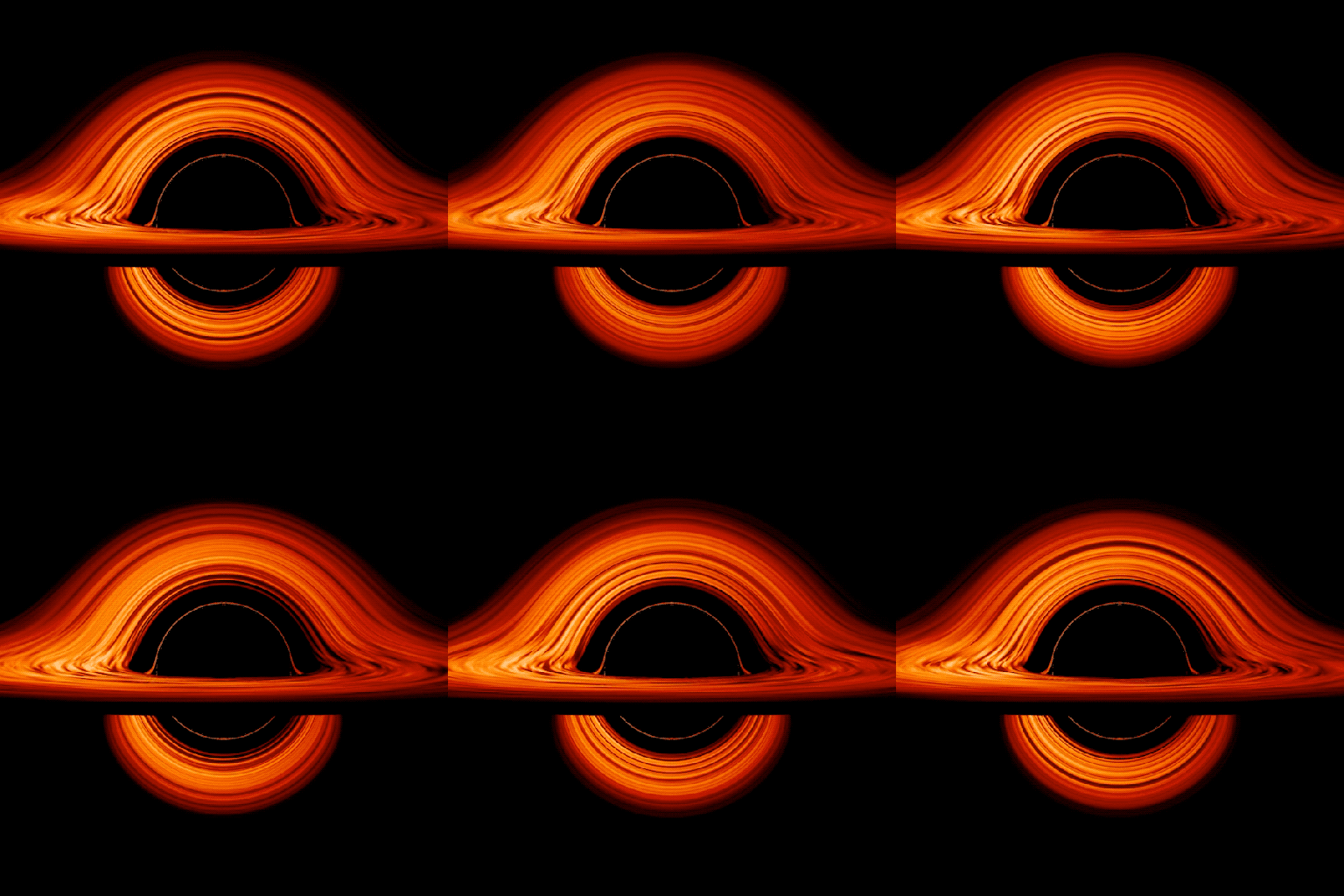
With two different black hole event horizons now directly imaged, we can see that they are, in fact, rings, not disks. But why?
In all of science, no figures have changed the world more than Einstein and Newton. Will anyone ever be as revolutionary again?


13.8 billion years ago, the hot Big Bang gave rise to the Universe we know. Here's why the reverse, a Big Crunch, isn't how it will end.

Atomic clocks keep time accurately to within 1 second every 33 billion years. Nuclear clocks could blow them all away.

Everything is made of matter, not antimatter, including black holes. If antimatter black holes existed, what would they do?

At four million solar masses, the Milky Way's supermassive black hole is quite small for a galaxy its size. Did we lose the original?

Time isn't the same for everyone, even on Earth. Flying around the world gave Einstein the ultimate test. No one is immune from relativity.

The idea of black holes has been around for over 200 years. Today, we're seeing them in previously unimaginable ways.

Popular media often frame scientists as having a cold, sterile view of the world. That couldn’t be further from the truth.
John Templeton Foundation

Astronomers in 2017 caught an image of a supermassive black hole in a galaxy far, far away. Doing it in our own galaxy is a huge milestone.

After years of analysis, the Event Horizon Telescope team has finally revealed what the Milky Way's central black hole looks like.

Equations that describe time travel are fully compatible and consistent with relativity — but physics is not mathematics.