




















Search
Gravitational Waves

The ESA's Gaia mission just broke the record for closest black hole by over 1,000 light-years. Is there an even closer one out there?

The stars circle each other every 51 minutes, confirming a decades-old prediction.

Quantum entanglement may remain spooky, but it has a very practical side.
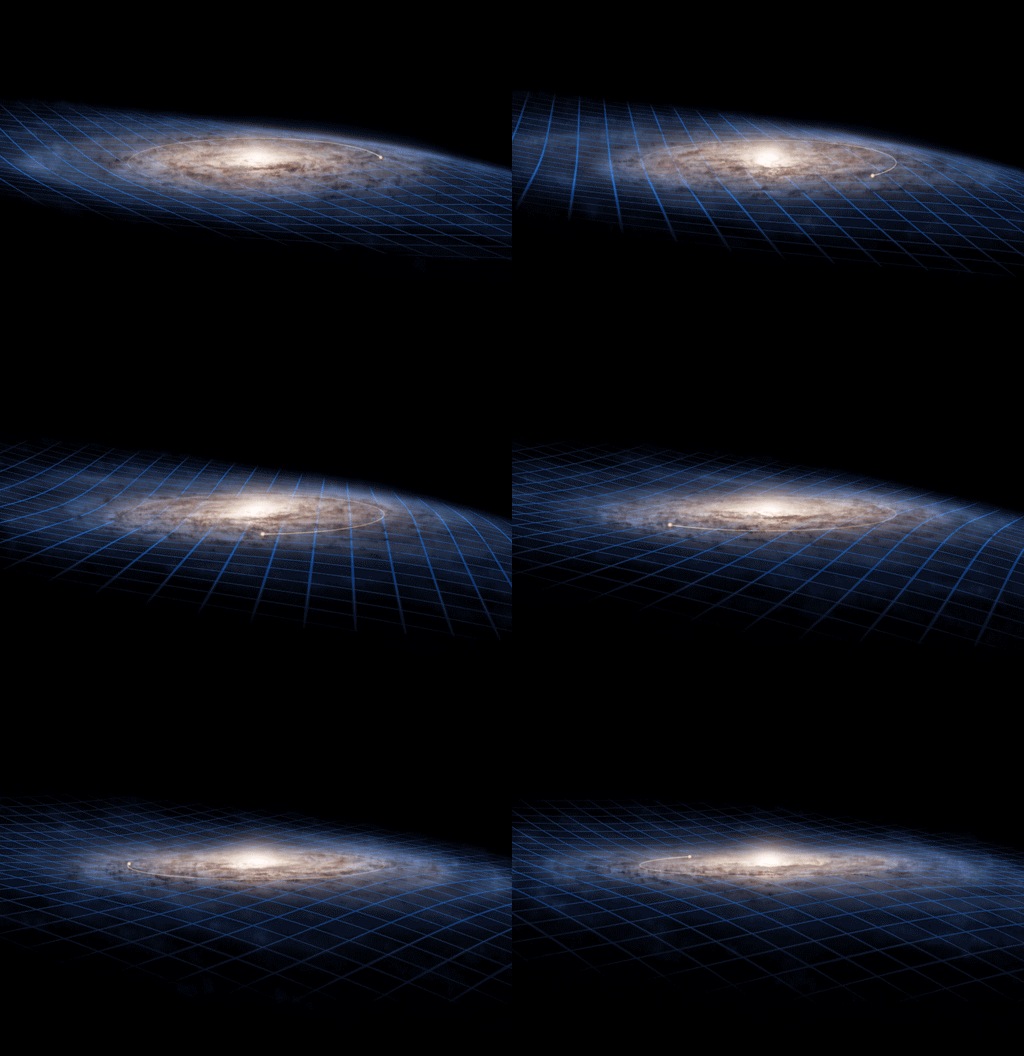
The Universe begins with negligible amounts of angular momentum, which is always conserved. So why do planets, stars, and galaxies all spin?

You would think that with all our technology, like the James Webb Space Telescope, we would know how big the Universe is. But we don't.

We only detected our very first gravitational wave in 2015. Over the next two decades, we'll have thousands more.

LIGO can detect the inspirals and mergers of the lowest-mass black holes, but not the biggest ones. Here's how pulsars can help.

The idea of gravitational redshift crossed Einstein's mind years before General Relativity was complete. Here's why it had to be there.

No matter how beautiful, elegant, or compelling your idea is, if it disagrees with observation and experiment, it's wrong.

The discovery calls into question the few things scientists know about these powerful astronomical phenomena.

Everything is made of matter, not antimatter, including black holes. If antimatter black holes existed, what would they do?

At four million solar masses, the Milky Way's supermassive black hole is quite small for a galaxy its size. Did we lose the original?

The idea of black holes has been around for over 200 years. Today, we're seeing them in previously unimaginable ways.

Our Universe requires dark matter in order to make sense of things, astrophysically. Could massive photons do the trick?

To study the origin of the Universe, we could build a constellation of six expensive spacecraft — or we could just use the Moon.

Astronomers used supercomputers and an international network of antennas to create the stunning map.

The odds are slim, but the consequences would be devastating. Here's what would happen, plus how to avoid it.

As viewed by the MeerKAT telescope, this radio view of the Milky Way blows away every other way we've ever seen our home galaxy.

Just 12 million light-years away, the galaxies Messier 81 and 82 offer a nearby preview of the Milky Way-Andromeda merger.

The Solar System isn't a vortex, but rather the sum of all our great cosmic motions. Here's how we move through space.

Known as primordial black holes, they could thoroughly change our Universe's history. But the evidence is strongly against them.
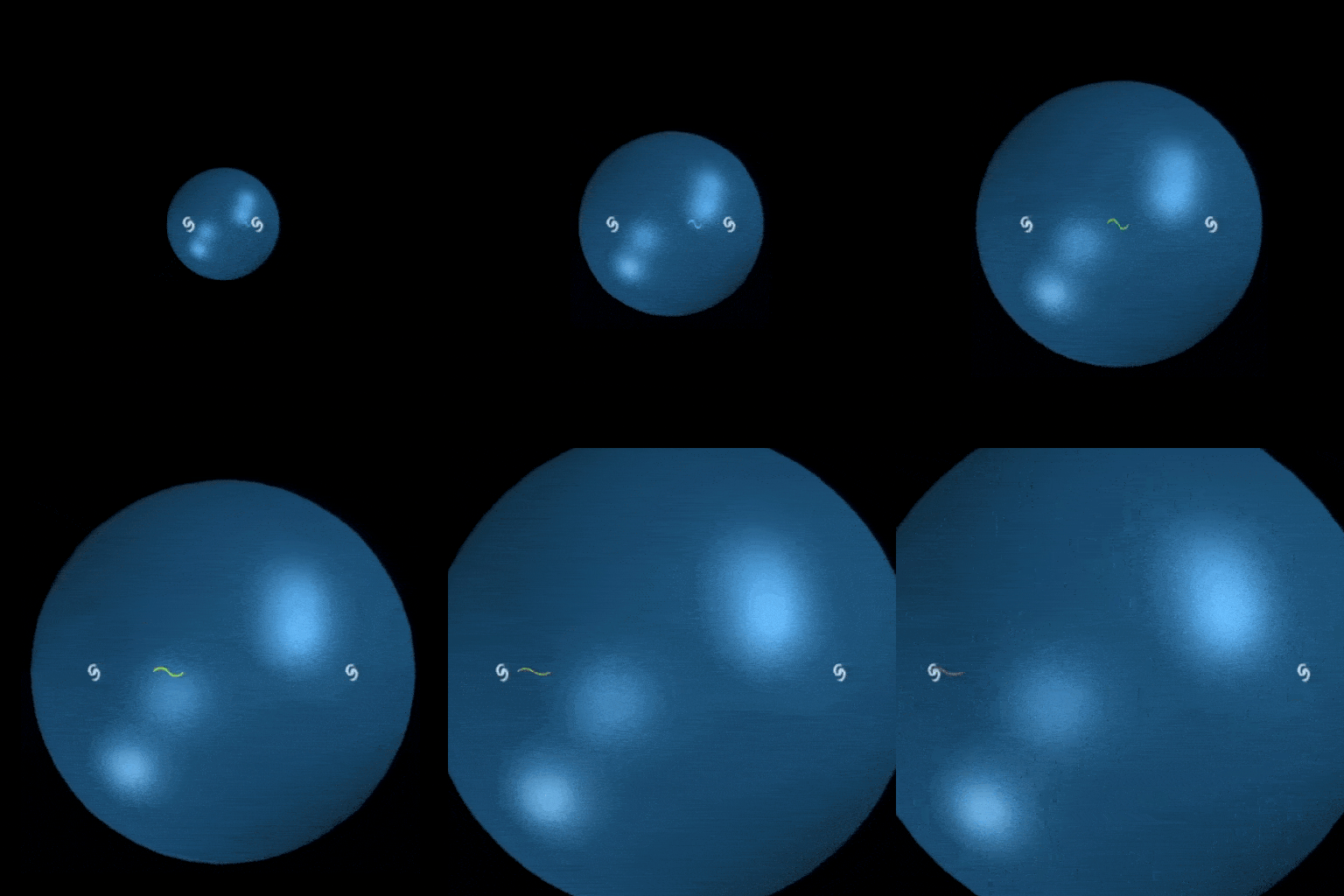
After more than two decades of precision measurements, we've now reached the "gold standard" for how the pieces don't fit.

The stars, planets, and many moons are extremely round. Why don't they take other shapes?

Although most of the Universe's mass is dark matter, which gravitates just as well as normal matter, it still can't make black holes.
The latest gravitational wave data from LIGO and Virgo finally shows us the truth: there are no "gaps" in the masses of black holes.

If it wasn’t a singularity, how small could it have been? Today, when you look out in any direction as far as the laws of physics allow us to see, the […]
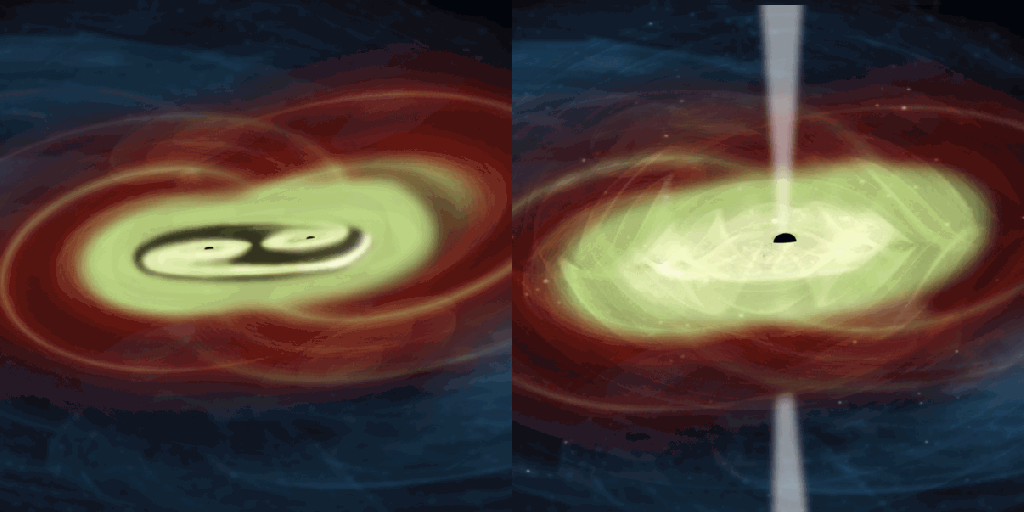
The ‘final parsec problem’ is still a mystery for astronomers. When it comes to black holes in the Universe, we know there are at least two major types. There are […]
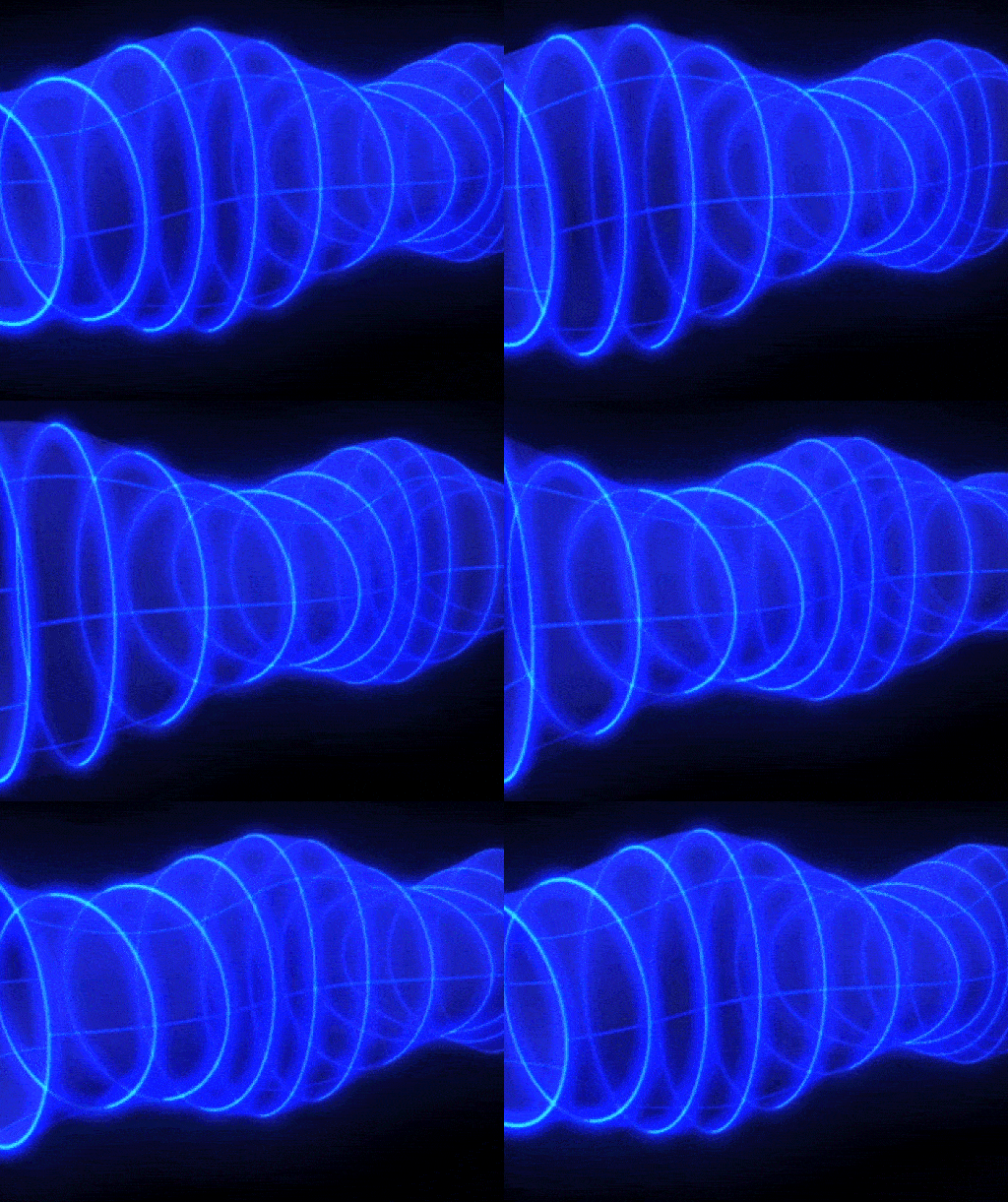
And either way, is energy or information conserved? When two things in the Universe that “always” occur meet one another, how do you know which one will win? Gravitational waves, […]

If you want to find life in the Universe, this is how you do it. When it comes to uncovering the ultimate truths about reality, we can only reap what we […]

Even addition has to play by different rules for black holes. How do you add 28 and 47 together? This simple math question helps us highlight the many different ways that […]