




















Search
History Of Science

The biggest nuclear blast in history came courtesy of Tsar Bomba. We could make something at least 100 times more powerful.

For thousands of years, we puzzled at how far away the Moon was. Today we know its distance, at any time, to within millimeters.

Michael Faraday's 1834 law of induction was the key experiment behind the eventual discovery of relativity. Einstein admitted it himself.

If light can't be bent by electric or magnetic fields (and it can't), then how do the Zeeman and Stark effects split atomic energy levels?

Perhaps the whole Universe is the result of a vacuum fluctuation, originating from what we could call quantum nothingness.

What began as an annoyance ended as a Nobel Prize-winning discovery about the Big Bang and the origin of the Universe.
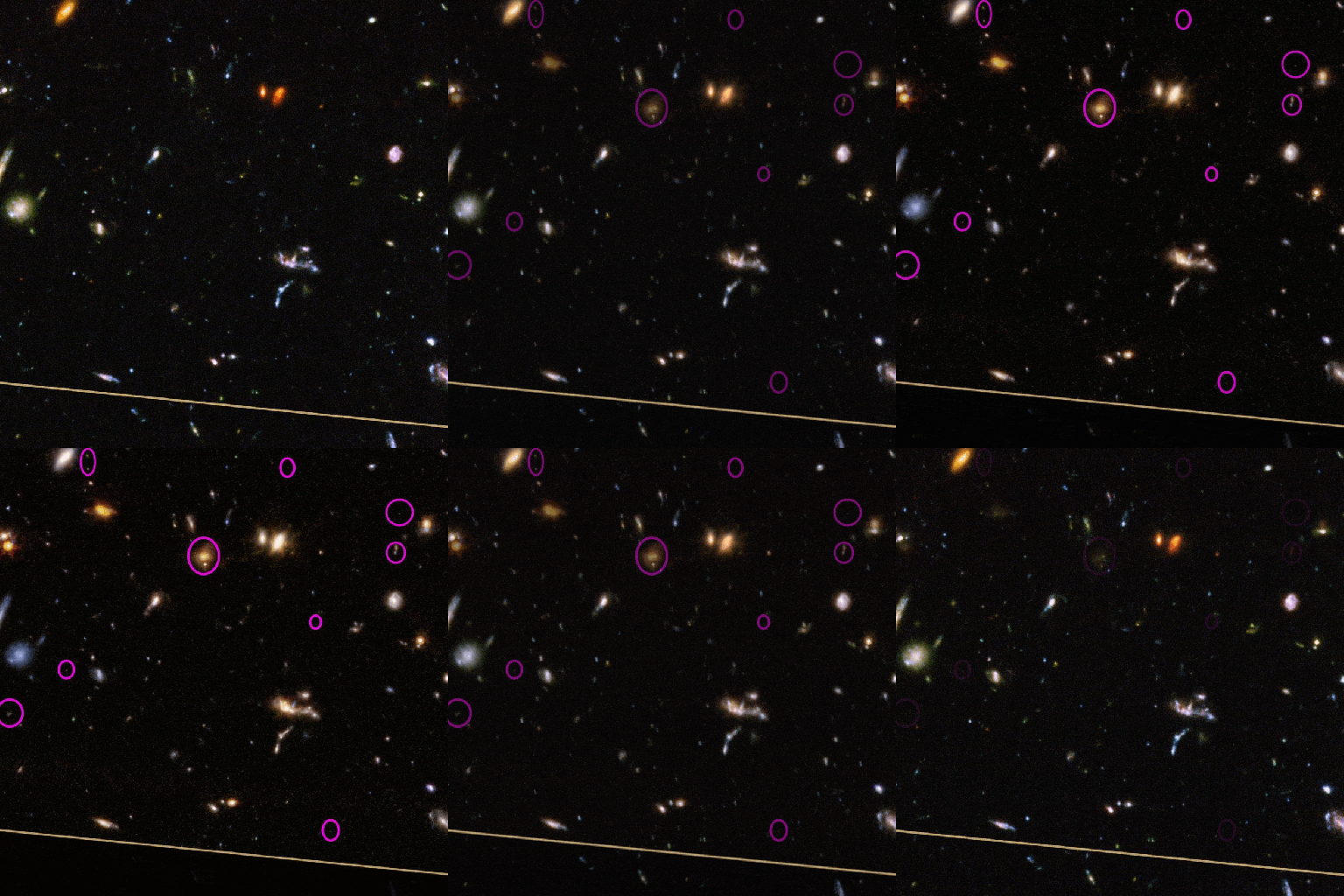
JWST has brought us more distant views of the early Universe than ever before. Is the Big Bang, and all of modern cosmology, in trouble?

If there are three neutrino species, all with different masses, then how is energy conserved when they oscillate from one flavor to another?

In our Solar System, even the two brightest planets frequently align in our skies. But only rarely is it spectacularly visible from Earth.

If you're a massless particle, you must always move at light speed. If you have mass, you must go slower. So why aren't any neutrinos slow?

7mins
Frank Wilczek is celebrated for his investigations into the fundamental laws of nature that have transformed our understanding of the forces that govern our Universe. In this video, the MIT […]

It is a story with nebulous beginnings and no discernible end.

Generations ago, cosmologists asserted that the Universe might not just be the same in all directions, but at all times. But is that true?

A Fermilab study confirms decades-old measurements regarding the size and structure of protons.

Many people out there, including scientists, claim to have discovered a series of game-changing revolutions. Here's why we don't buy it.

The information we have in the Universe is finite and limited, but our curiosity and wonder is forever insatiable. And always will be.

In the early 20th century, a young biochemist named Alexander Oparin set out to connect “the world of the living” to “the world of the dead.”

Though a single measurement is not enough to definitively decide the debate, this is a major win for dark matter proponents.

Is science for everyone, or just the morally upright?

Bathybius haeckelii was briefly thought to be the link between inorganic matter and organic life.

6mins
Darwin, Descartes, and Maxwell all believed in these science ‘demons.’
John Templeton Foundation

Even the dictionary doesn't get the definition right.

What we call "basic research" is actually the most cutting-edge. It underpins knowledge, and without it, technology does not come into being.

It might seem like science and faith are at war, but the two have a historical synergy that extends back in time for centuries.
John Templeton Foundation

The idea of gravitational redshift crossed Einstein's mind years before General Relativity was complete. Here's why it had to be there.

You've heard of Stephen Hawking. Ever heard of Renata Kallosh? Didn't think so.
John Templeton Foundation

Pseudoscience is science’s shadow.


Speculation about the existence of aliens goes all the way back at least to the Greek philosophers. Their arguments will sound familiar.

How efficiently could quantum engines operate?