




















Search
History Of Science

It’s not a gambit. It’s not fraud. It’s not driven by opinion, prejudice, or bias. It's not unchallengeable. And it's more than facts alone.

With new W-boson, top quark, and Higgs boson measurements, the LHC contradicts earlier Fermilab results. The Standard Model still holds.

Lord Kelvin is thought to have said there was nothing new to discover in physics. His real view was the opposite.

In logic, 'reductio ad absurdum' shows how flawed arguments fall apart. Our absurd Universe, however, often defies our intuitive reasoning.

Physicists just can't leave an incomplete theory alone; they try to repair it. When nature is kind, it can lead to a major breakthrough.

Everything acts like a wave while it propagates, but behaves like a particle whenever it interacts. The origins of this duality go way back.

Roger Babson wanted a “partial insulator, reflector, or absorber of gravity” — something, anything, that would stop or dampen it.

All matter particles can act as waves, and massless light waves show particle-like behavior. Can gravitational waves also be particle-like?

The second law of thermodynamics is an inviolable law of reality. Here's what everyone should know about closed, open, and isolated systems.

From ancient Greek cosmology to today's mysteries of dark matter and dark energy, explore the relentless quest to understand the Universe's invisible forces.

From unexplained tracks in a balloon-borne experiment to cosmic rays on Earth, the unstable muon was particle physics' biggest surprise.

If nature were perfectly deterministic, atoms would almost instantly all collapse. Here's how Heisenberg uncertainty saves the atom.

How can you maximize the amount of love and happiness in your life? One of history's greatest scientists found the answer: with math.

It is easy to mock Nobel Laureates who go astray, but eccentricity often accompanies brilliance. We should have some sympathy.

Alchemy had its golden age in the 17th century, when it counted Isaac Newton and Robert Boyle among its adherents.
John Templeton Foundation

Scientists can make substantial progress without fully understanding exactly what they're doing.

Science fiction met nuclear fission when Hungarian physicist Leó Szilárd pondered the explosive potential of nuclear energy.

Philosophy is often seen as little more than armchair speculation. This is a shame, as philosophy often has helped science reach new heights.

If you've found yourself befuddled by extraordinary scientific-sounding claims, you're not alone. But this centuries-old lesson can help.

From the present day all the way to less than 400 million years after the Big Bang, we're seeing how the Universe grew up like never before.

The biggest nuclear blast in history came courtesy of Tsar Bomba. We could make something at least 100 times more powerful.

For thousands of years, we puzzled at how far away the Moon was. Today we know its distance, at any time, to within millimeters.

Michael Faraday's 1834 law of induction was the key experiment behind the eventual discovery of relativity. Einstein admitted it himself.

If light can't be bent by electric or magnetic fields (and it can't), then how do the Zeeman and Stark effects split atomic energy levels?

Perhaps the whole Universe is the result of a vacuum fluctuation, originating from what we could call quantum nothingness.

What began as an annoyance ended as a Nobel Prize-winning discovery about the Big Bang and the origin of the Universe.
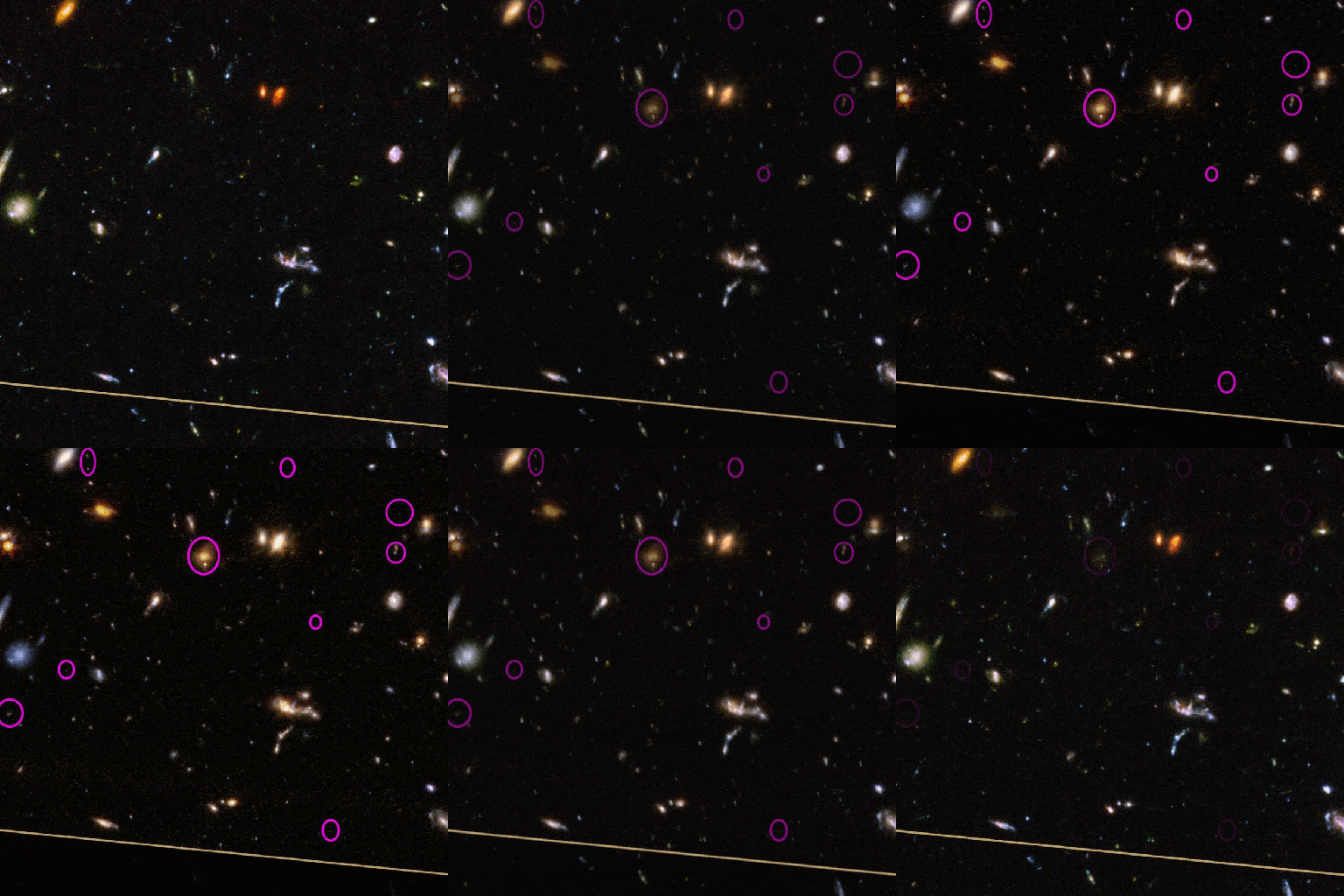
JWST has brought us more distant views of the early Universe than ever before. Is the Big Bang, and all of modern cosmology, in trouble?

If there are three neutrino species, all with different masses, then how is energy conserved when they oscillate from one flavor to another?

In our Solar System, even the two brightest planets frequently align in our skies. But only rarely is it spectacularly visible from Earth.

If you're a massless particle, you must always move at light speed. If you have mass, you must go slower. So why aren't any neutrinos slow?