




















Search
History and Society

Welcome to The Nightcrawler — a weekly newsletter from Eric Markowitz covering tech, innovation, and long-term thinking.

The writer’s tragic death at age 46 has led many to view him as a tortured artist. Here’s why this label is reductive.

Despite many ultra-distant galaxy candidates found with JWST, we still haven't seen anything from the Universe's first 250 million years.

Mike Bechtel, chief futurist with Deloitte Consulting LLP, joins Big Think for a wide-ranging look at what’s next — and why.

A scientist’s first-hand account shows the world can tackle a global environmental crisis.

How technology could change everything we thought we knew about reproduction.

It's possible to remove all forms of matter, radiation, and curvature from space. When you do, dark energy still remains. Is this mandatory?

AI has become a black box in more ways than one.

With the discovery of Porphyrion, we've now seen black hole jets spanning 24 million light-years: the scale of the cosmic web.

From hunter-gathers to desk jockeys, we work best when short, intense sessions are followed by lighter fare.

It would get rid of our hazardous, radioactive, and pollutive waste for good, but physics tells us it's a losing strategy for elimination.

The hidden story behind Greek surnames and how they trace family origins across the country — starting with the name of a would-be U.S. president.

"We’re acting more like fans of a football team going to a game than a banker carefully choosing investments."

Does Platonic love actually exist?

Quantum computing brings significant opportunities — but equally significant cybersecurity risks.

Welcome to The Nightcrawler — a weekly newsletter from Eric Markowitz covering tech, innovation, and long-term thinking.

In a world of distractions, several remarkable companies show why focus is the ultimate strategy for endurance.

In the expanding Universe, different ways of measuring its rate give incompatible answers. Nobel Laureate Adam Riess explains what it means.

3mins
From nothing to everything: How zero changed our understanding of the universe, forever.

The Lyman-α emission line has never been seen earlier than 550 million years after the Big Bang. So why does JADES-GS-z13-1-LA have one?

"No matter how long you’ve been doing a job or how good people say you are, you need to care as if you’ve never done it before."

5mins
Who decides what’s “normal” and why? As social norms increasingly dissolve, here’s how to find true guidance.

1mins
What would the world be like if we focused on “the inherent beauty of math,” rather than its technical aspects? A statistician reflects:
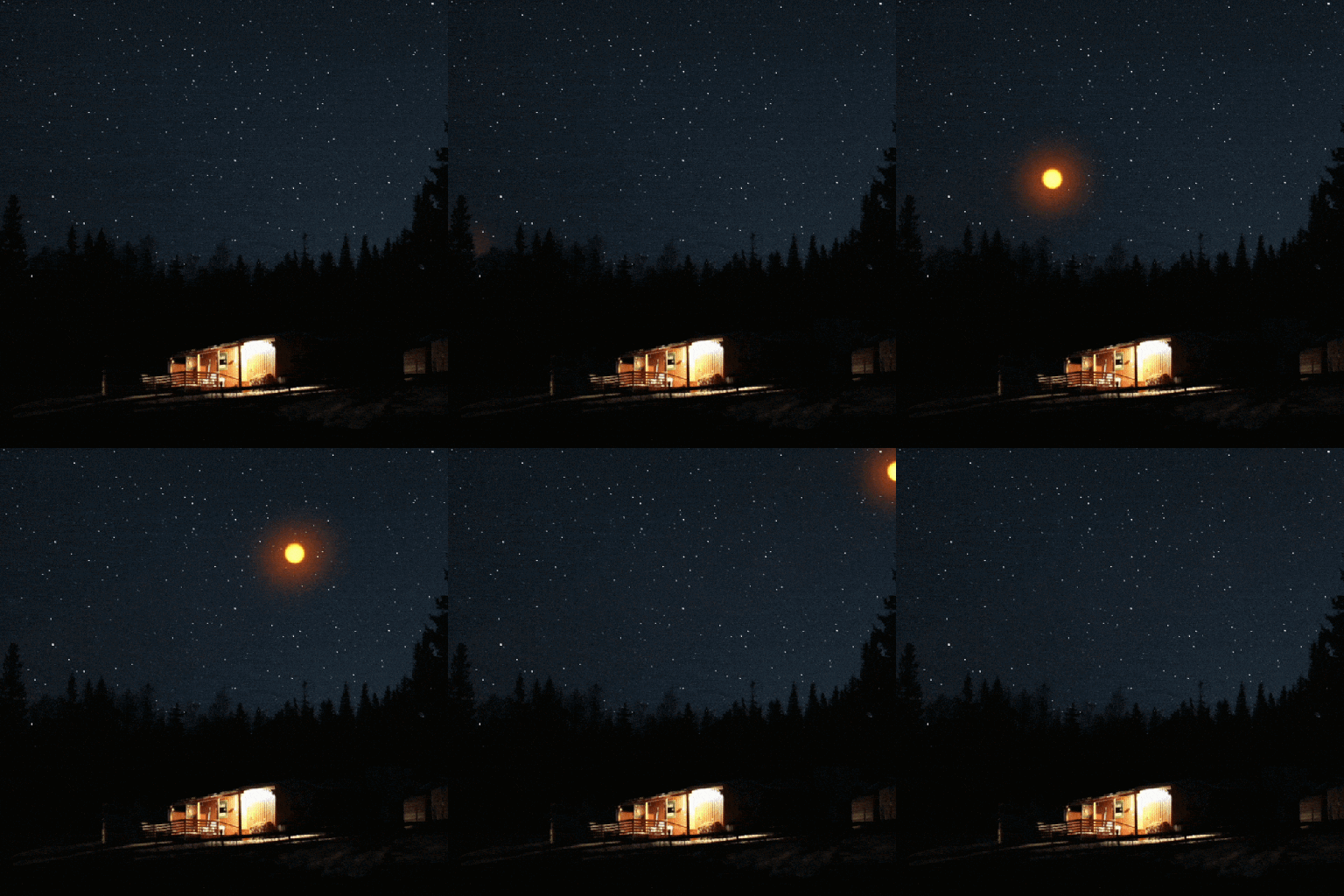
Although a great many unidentified sights have been seen in the skies, none have conclusively demonstrated the presence of aliens. So far.

The salinity of the oceans is not just a matter of taste. Saltier water behaves differently, too.

The annual rite of passage has always been more about the ambivalence of adults than the amusement of children.

With the right prompts, large language models can produce quality writing — and make us question the limits of human creativity.

Philosophy cures no disease and invents nothing new. What's even the point?

7mins
The winners of the remote work boom? Utah, Arizona, and Maine. Here’s what the US’ post-pandemic migration looks like.

The mass that gravitates and the mass that resists motion are, somehow, the same mass. But even Einstein didn't know why this is so.