




















Search
History and Society

"What’s happening now has, in fact, been happening since the very invention of language and writing."

Early warning signs show AI is eating into the entry-level job market — a potential harbinger of things to come.

In "We the People," Harvard historian Jill Lepore examines how the U.S. Constitution became unamendable and its implications for the health of the democracy.

Nearly 30 would be "nones" — an amorphous group that spans from zealous atheists to the vaguely spiritual.

Welcome to The Nightcrawler — a weekly newsletter from Eric Markowitz covering tech, innovation, and long-term thinking.

Since the time of Galileo, Saturn's rings have remained an unexplained mystery. A new idea may have finally solved the longstanding puzzle.

If AI is modeled only on human intelligence, will it inherit only human ways of seeing the world?

Quantum mechanics was first discovered on small, microscopic scales. 2025's Nobel Prize brings the quantum and large-scale worlds together.

In 2025, Earth remains the only planet where life is known to exist. Without a second example, "The Stand" has a vital lesson to teach us.

By deeply imaging a large volume of space, COSMOS-Web provides JWST's widest cosmic views. Its gravitational lenses reveal a big surprise.

As the Universe ages, it continues to gravitate, form stars, and expand. And yet, all this will someday end. Do we finally understand how?

In this excerpt from "America's Most Gothic," Leanna Hieber and Andrea Janes examine the history and folklore of Maine's vanished schooner.
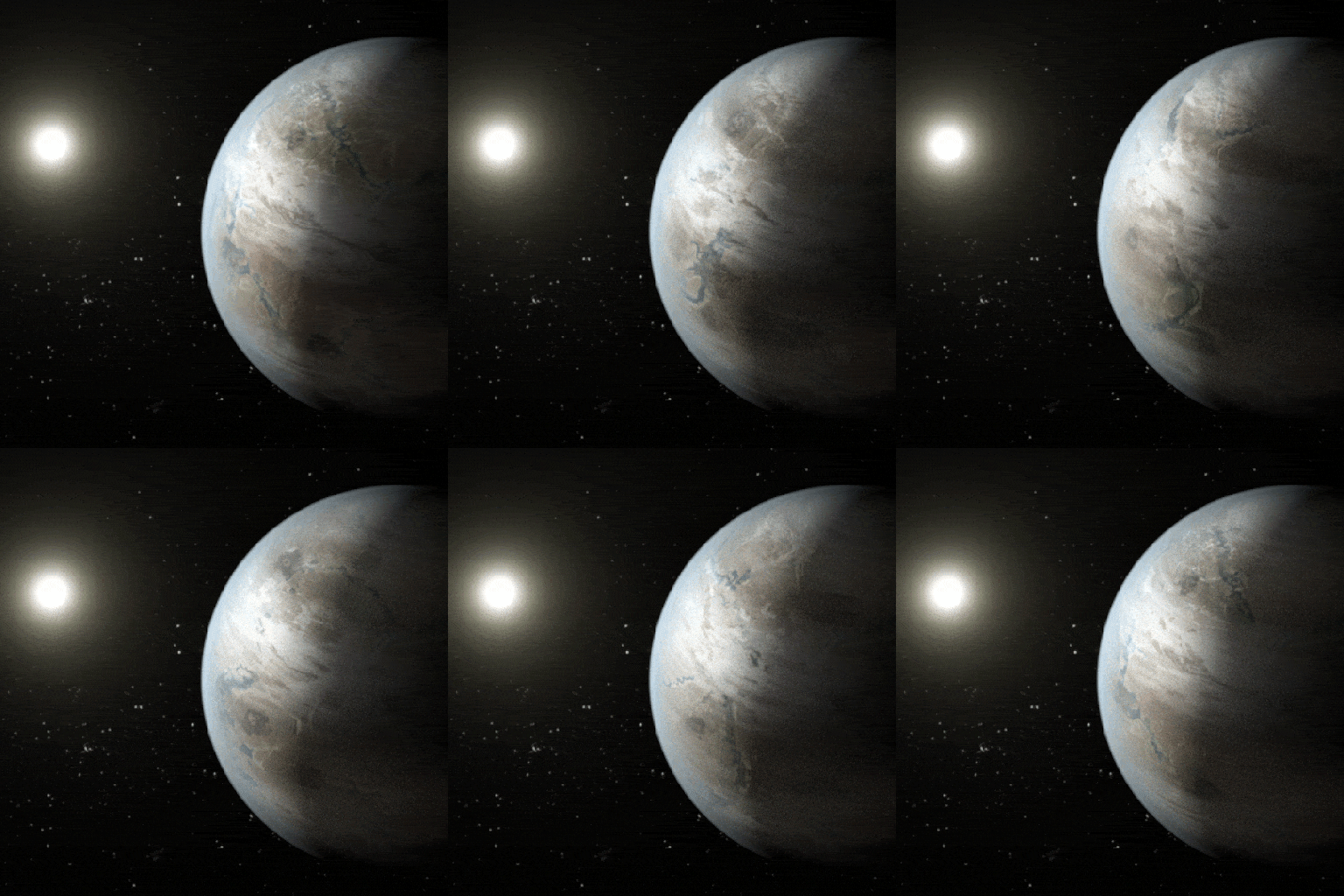
From here on Earth, looking farther away in space means looking farther back in time. So what are distant Earth-watchers seeing right now?

As October begins, thousands of longtime NASA employees are leaving the agency. 4000+ will exit by January 9, 2026, changing NASA forever.

In this excerpt from "The Formula for Better Health," Tom Frieden explores how Alice Hamilton transformed public health in her fight against lead poisoning.

The incredible story of how the US Army began the march toward generative AI in 1943 — and what it means for your business today.

From the Big Bang to a prior period of cosmic inflation, our cosmic origins are clearer than ever. Yet these 5 big mysteries still remain.

If you think of the Big Bang as an explosion, we can trace it back to a single point-of-origin. But what if it happened everywhere at once?

A childhood spent under the spell of sleight-of-hand taught me skepticism, curiosity, and the habit of looking beneath appearances.

Big Think spoke with astronomer David Kipping about technosignatures, "extragalactic SETI," and being a popular science communicator in the YouTube age.

In this excerpt from "Seven Rivers," historian Vanessa Taylor explores how Ancient Egyptian pharaohs harnessed the Nile River to build empires and secure their power.

How to look cool in post-war France in black and white photos.

Welcome to The Nightcrawler — a weekly newsletter from Eric Markowitz covering tech, innovation, and long-term thinking.

The universe is filled with unlikely events, but it is also full of ways to fool ourselves.

We don't learn from history because we can't learn from history.

Welcome to The Nightcrawler — a weekly newsletter from Eric Markowitz covering tech, innovation, and long-term thinking.

It's not just an odd quirk of numbers that makes it true, but a deep mathematical insight that dates all the way back to Pythagoras.

10 years ago, LIGO first began directly detecting gravitational waves. Now better than ever, it's revealing previously unreachable features.

Questions about our origins, biologically, chemically, and cosmically, are the most profound ones we can ask. Here are today's best answers.

Even when leaders know disruption is a smart long-term decision, the pain of transition can produce a titanic shambles. Just ask Kodak.