




















Search
Philosophy

The tech world’s fixation on artificial intelligence has spawned beliefs and rituals that resemble religion — complete with digital deities, moral codes, and threats of damnation.

"We do not experience primarily because we have brains; we experience because we are alive."

Just because you can't experience it doesn't mean it's not real.

We have it in our power to forgive a debt — and learning to use this power in the workplace can be golden.

By improving quantum error correction, quantum computations are now faster than ever. But parallel universes? That's utter nonsense here.

Welcome to The Nightcrawler — a weekly newsletter from Eric Markowitz covering tech, innovation, and long-term thinking.

What if the barrier to a fulfilled life isn’t technology but culture?

The problem for galactic-scale civilizations comes down to two numbers.

If atoms are mostly empty space, then why can't two objects made of atoms simply pass through each other? Quantum physics explains why.

“Could you create a god?” Nietzsche's titular character asks in "Thus Spoke Zarathustra."

With no reliable way to discern the author of an artwork, we may eventually abandon the question of whether something was made by humans or not.

Plato's cave metaphor illustrates the cognitive trap of ignorance, where we may be unaware of the limitations of our understanding.

"Personhood" credentials could cleanse the internet of bots — but are the costs worth it?

Will "Sausage Party" survive the test of time?

Welcome to The Nightcrawler — a weekly newsletter from Eric Markowitz covering tech, innovation, and long-term thinking.

By looking back at future dreams we can see our current hopes and visions in a whole new light.

Most waves need a medium to travel through. But the way that light and gravitational waves travel shows that space can't be a medium at all.

For J.R.R. Tolkien, the single most important element of a fairy tale was the dramatic reversal of misfortune in the story's ending.

How many scientists does it take to ruin a good conspiracy?

This supremely simple hack can help you establish good habits, break bad ones, and guard against failure.

One of the fundamental constants of nature, the fine-structure constant, determines so much about our Universe. Here's why it matters.

Two great philosophies — but do they work better together?

Welcome to The Nightcrawler — a weekly newsletter from Eric Markowitz covering tech, innovation, and long-term thinking.
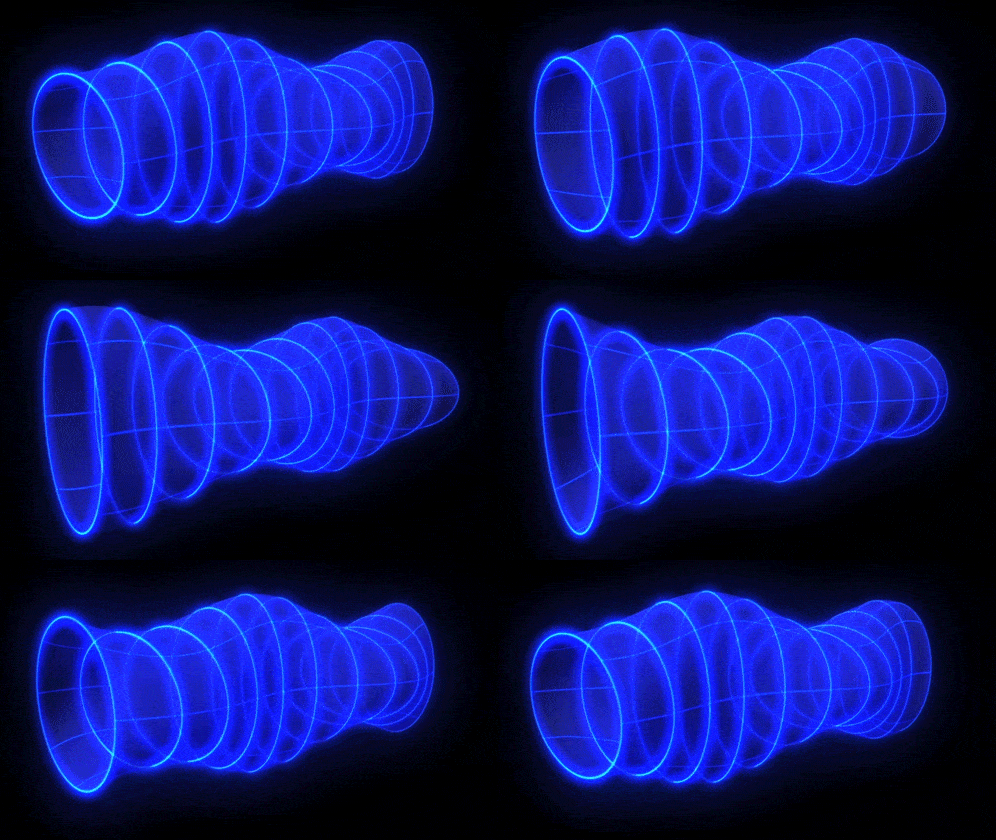
Gravitational waves are the last signatures that are emitted by merging black holes. What happens when these two phenomena meet in space?

All religions have three traits: metaphysical commitments, ethical guidance, and daily rituals or practices. So does Stoicism.

"A person’s mass is made not of 'stuff' in the way we normally think about it, but rather our mass is made of energy."

"I was stunned. Here in front of me was the original apparatus through which a new vision of the world was slowly and painfully brought to light."

Scalars, vectors, and tensors come up all the time in physics. They're more than mathematical structures. They help describe the Universe.

If you're an atheist with a vocation, who laid that path for you?

Our classical intuition is no good in a quantum Universe. To make sense of it, we need to learn, and apply, an entirely novel set of rules.