




















Search
Quantum Field Theory

For decades, theorists have been cooking up "theories of everything" to explain our Universe. Are all of them completely off-track?

"Color" with respect to the strong force is just an analogy. Here's how to understand it without colors, group theory, or any advanced math.

Is dark energy evolving with at least 99.99% confidence? Despite the quality of recent data, scientists have every reason to be skeptical.

We have two descriptions of the Universe that work perfectly well: general relativity and quantum physics. Too bad they don't work together.

When what we predict and what we measure don't add up, that's a sign there's something new to learn. Could it be a new fundamental force?

The combination of charge conjugation, parity, and time-reversal symmetry is known as CPT. And it must never be broken. Ever.

Many view the development of fringe, alternative theories as a useless waste of time. But when they can be tested, it shows what reality is.

It's not about particle-antiparticle pairs falling into or escaping from a black hole. A deeper explanation alters our view of reality.

The very word "quantum" makes people's imaginations run wild. But chances are you've fallen for at least one of these myths.

Since even before Einstein, physicists have sought a theory of everything to explain the Universe. Can positive geometry lead us there?

Throughout history, "free energy" has been a scammer's game, such as perpetual motion. But with zero-point energy, is it actually possible?

Realizing that matter and energy are quantized is important, but quantum particles aren't the full story; quantum fields are needed, too.

Whether you run the clock forward or backward, most of us expect the laws of physics to be the same. A 2012 experiment showed otherwise.
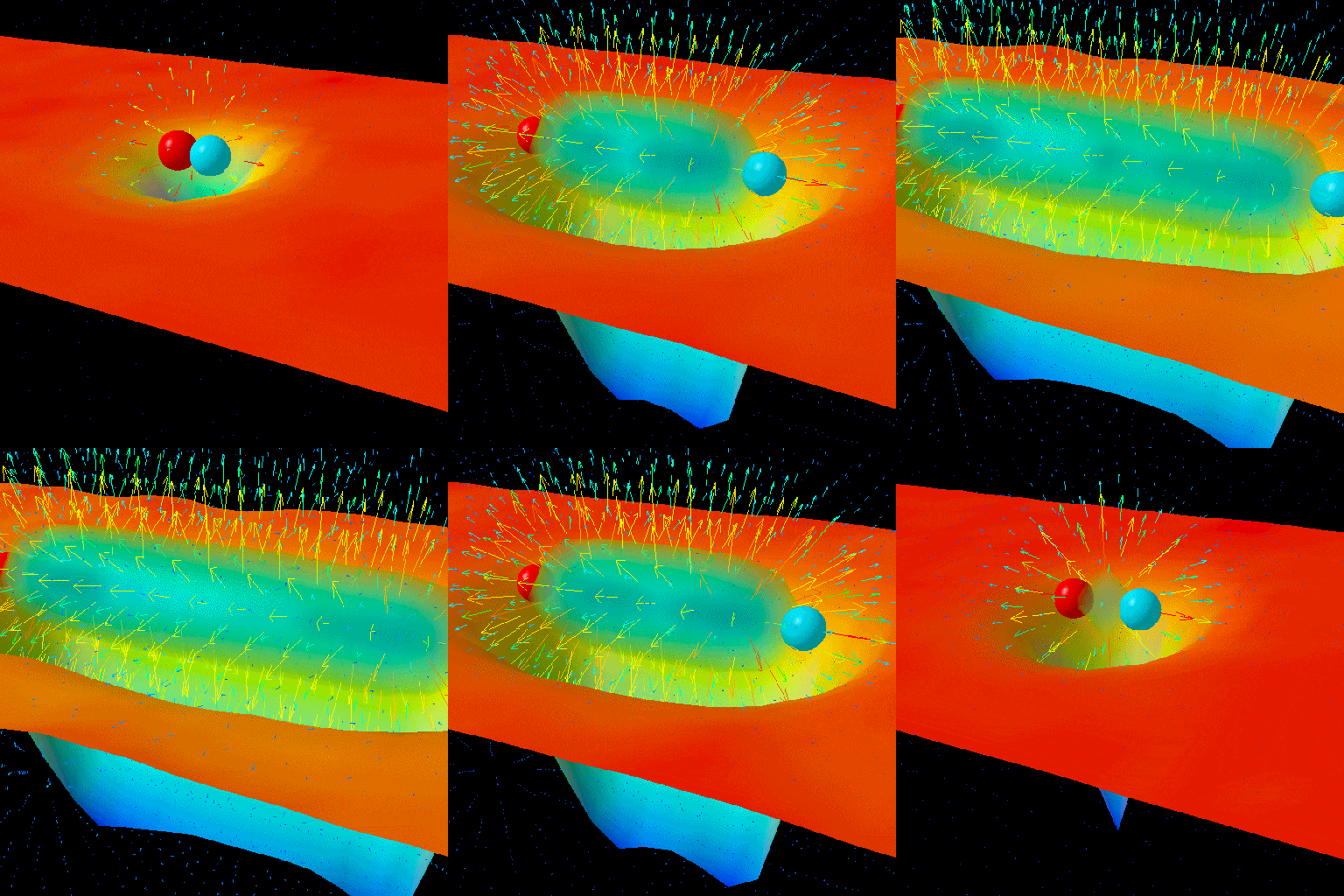
The measured value of the cosmological constant is 120 orders of magnitude smaller than what's predicted. How can this paradox be resolved?

A few physical quantities, in all laboratory experiments, are always conserved: including energy. But for the entire Universe? Not so much.

When theory and experiment disagree, it could mean new physics. This time, they solved the muon g-2 puzzle, and saved the Standard Model.

If all massive objects emit Hawking radiation, not just black holes alone, then everything is unstable, even the Universe. Can that be true?

The fact that our Universe's expansion is accelerating implies that dark energy exists. But could it be even weirder than we've imagined?

The laws of nature are almost perfectly symmetric between matter and antimatter, and yet our Universe is made ~100% of matter only. But why?

Empty space itself, the quantum vacuum, could be in either a true, stable state or a false, unstable state. Our fate depends on the answer.

When we divide matter into its fundamental, indivisible components, are those particles truly point-like, or is there a finite minimum size?

A proton is the only stable example of a particle composed of three quarks. But inside the proton, gluons, not quarks, dominate.

The electromagnetic force can be attractive, repulsive, or "bendy," but is always mediated by the photon. How does one particle do it all?
In the year 2000, physicists created a list of the ten most important unsolved problems in their field. 25 years later, here's where we are.

Electromagnetism, both nuclear forces, and even the Higgs force are mediated by known bosons. What about gravity? Does it require gravitons?

Matt Strassler's journey into fundamental physics culminates in a brilliant explanation of the Higgs field. Enjoy this exclusive interview.
50 years ago, Stephen Hawking showed that black holes emit radiation and eventually decay away. That fate may now apply to everything.

"A person’s mass is made not of 'stuff' in the way we normally think about it, but rather our mass is made of energy."

Scalars, vectors, and tensors come up all the time in physics. They're more than mathematical structures. They help describe the Universe.

One of the 20th century's most famous, influential, and successful physicists is lauded the world over. But Feynman is no hero to me.