




















Search
Quantum Mechanics

11mins
Theoretical physics professor Michio Kaku outlines the evolution of computers from analog to digital and introduces quantum computers as the next frontier.

Some constants, like the speed of light, exist with no underlying explanation. How many "fundamental constants" does our Universe require?

Nature may not allow us full access to the weirdness of quantum mechanics.

LK-99, almost certainly, isn't a room-temperature superconductor. The underlying physics of the phenomenon helps us understand why.

There may be unknown particles lurking inside the quantum foam.

Ultracold gases in the lab could help scientists better understand the universe.
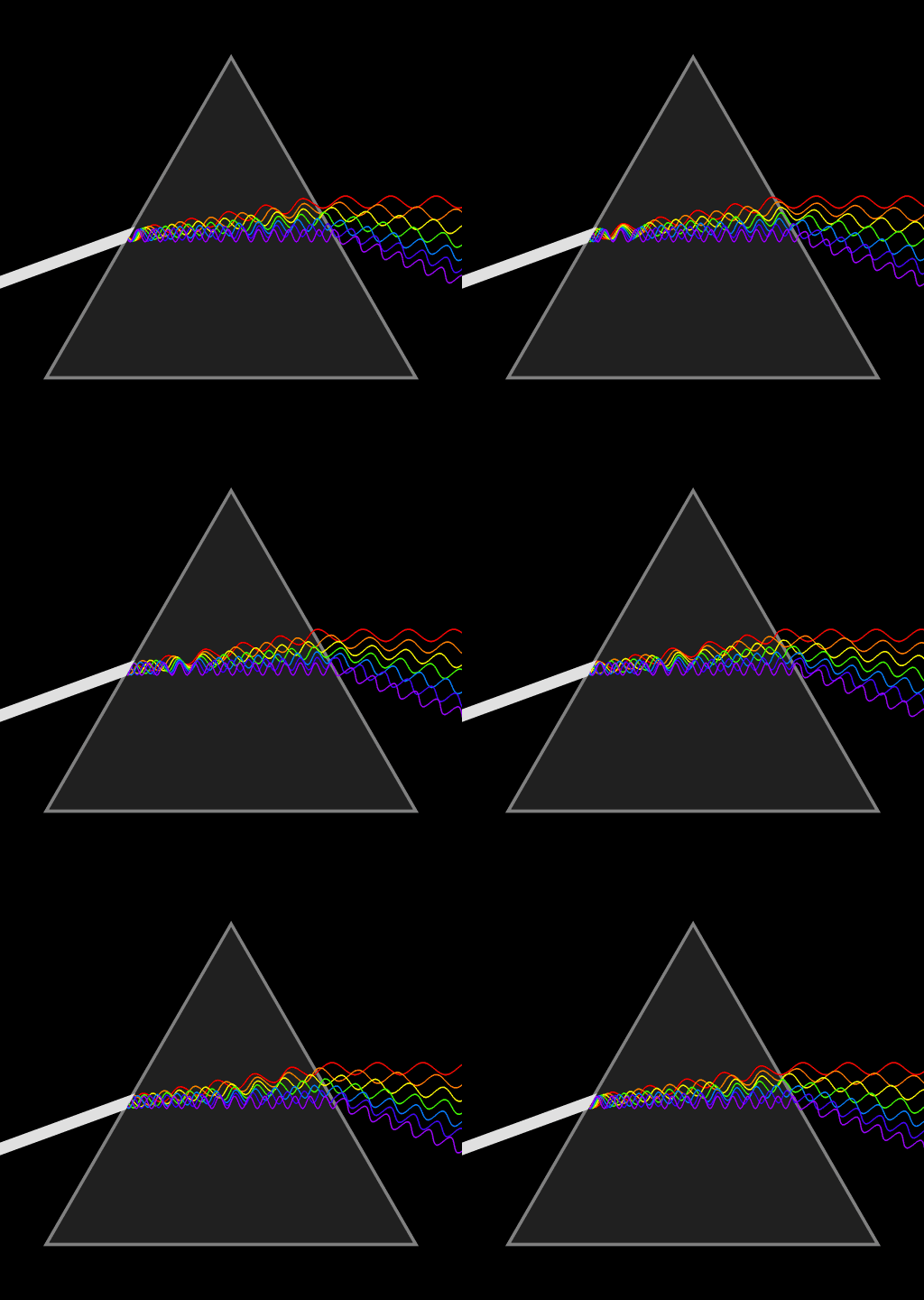
Invisible cloaks. Ghost imaging. Scientists are manipulating light in ways that were once only science fiction.

Scientists can make substantial progress without fully understanding exactly what they're doing.

Some processes, like quantum tunneling, have been shown to occur instantaneously. But the ultimate cosmic speed limit remains unavoidable.
Is mathematics woven into the very fabric of reality? Or is it merely a product of the human mind?

If we waited long enough, would even protons themselves decay? The far future stability of the Universe depends on it.

Neuroscientist and author Bobby Azarian explores the idea that the Universe is a self-organizing system that evolves and learns.

If light can't be bent by electric or magnetic fields (and it can't), then how do the Zeeman and Stark effects split atomic energy levels?
The concept of ‘relativistic mass’ has been around almost as long as relativity has. But is it a reasonable way to make sense of things?

Plants at room temperature show properties we had only seen near absolute zero.

Perhaps the whole Universe is the result of a vacuum fluctuation, originating from what we could call quantum nothingness.

42mins
Sabine Hossenfelder talks about Albert Einstein, dead grandmothers, the physics of aging, and more in this full interview with Big Think.

Einstein's relativity overthrew the notion of absolute space and time, replacing them with a spacetime fabric. But is spacetime truly real?

9mins
Sabine Hossenfelder discusses the physics of… dead grandmothers?

Quantum uncertainty and wave-particle duality are big features of quantum physics. But without Pauli's rule, our Universe wouldn't exist.

You are an energy field — but not the “chakras” or “auras” kind.

With a massive, charged nucleus orbited by tiny electrons, atoms are such simple objects. Miraculously, they make up everything we know.

Leading a scientific revolution is easy: you just have to succeed where the current theory fails while equaling its successes. Good luck!

The multiverse is an idea that has gained a lot of traction in popular culture. But what does science have to say about it?

That scary swirling void from which nothing can escape is our perfect universal translation tool.

If there are three neutrino species, all with different masses, then how is energy conserved when they oscillate from one flavor to another?

Two very different ideas, wormholes and quantum entanglement, might be fundamentally related. What would "ER = EPR" mean for our Universe?


Even with quantum teleportation and the existence of entangled quantum states, faster-than-light communication still remains impossible.

5mins
Is science close to explaining everything about our Universe? Physicist Sabine Hossenfelder reacts.