




















Search
Relativity Theory

Nothing lives forever, at least, not in the known Universe. But relativity allows us to get closer than ever: from a physics perspective.

Even space and time are relative in Einstein's universe. That means our old notions of "where" and "when" no longer apply on cosmic scales.

The very word "quantum" makes people's imaginations run wild. But chances are you've fallen for at least one of these myths.

We think of physical reality as what objectively exists, independent of any observer. But relativity and quantum physics say otherwise.

Times dilate and lengths contract near the speed of light. Bizarre and confusing? Sure. But under relativity, it can't be any other way.

There's some, but not overwhelming, evidence that dark energy is evolving. What would it take for a "Big Crunch" to be our cosmic fate?

Physicist Daniel Whiteson challenges the notion that all intelligent species would eventually uncover the same laws of nature. Do you agree?

Explanations for the cosmic speed limit often conflate mass with inertia.

Just 13.8 billion years after the hot Big Bang, we can see 46.1 billion light-years away in all directions. Doesn't that violate...something?

Realizing that matter and energy are quantized is important, but quantum particles aren't the full story; quantum fields are needed, too.

If you want to understand the Universe, cosmologically, you just can't do it without the Friedmann equation. With it, the cosmos is yours.

Einstein's general relativity has reigned supreme as our theory of gravity for over a century. Could we reduce it back down to Newton's law?
Perhaps the most well-known equation in all of physics is Einstein's E = mc². Does mass or energy increase, then, near the speed of light?

The problem for galactic-scale civilizations comes down to two numbers.
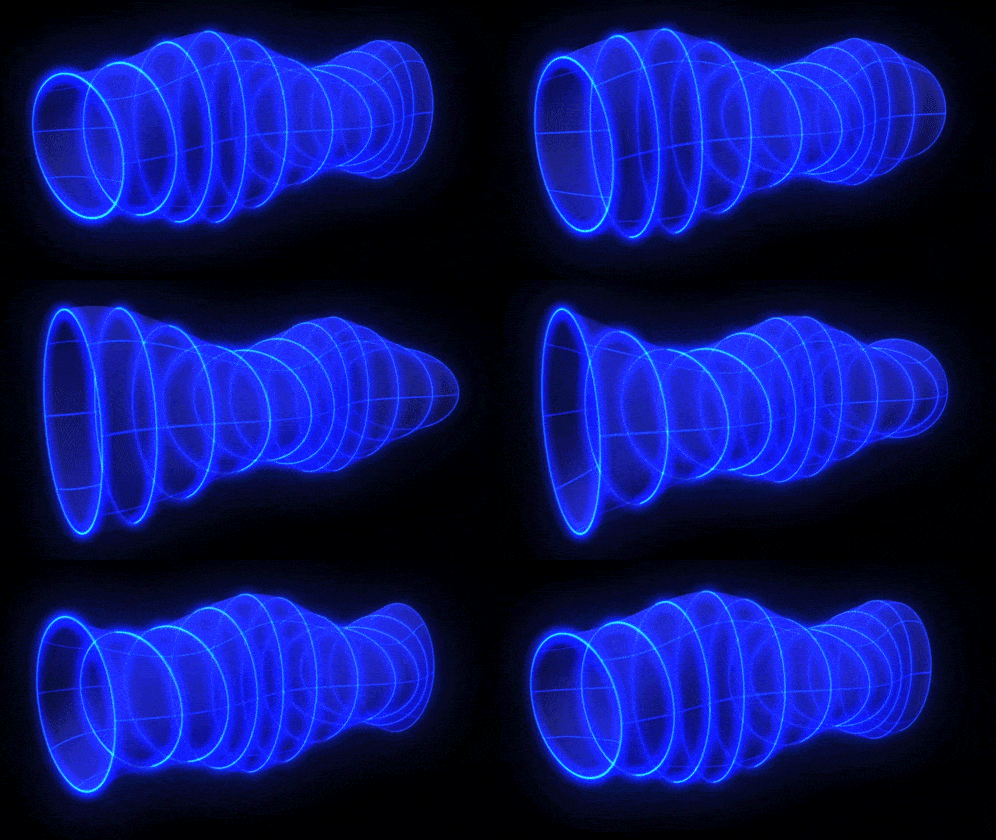
Gravitational waves are the last signatures that are emitted by merging black holes. What happens when these two phenomena meet in space?

"A person’s mass is made not of 'stuff' in the way we normally think about it, but rather our mass is made of energy."

Many mavericks look to Einstein as a unique figure, whose lone genius revolutionized the Universe. The big problem? It isn't true.

The secret sauce is the real world.

The fabric of spacetime is four-dimensional, with three for space and only one for time. But wow, time sure is different from space!
For centuries, Newton's inverse square law of gravity worked beautifully, but no one knew why. Here's how Einstein finally explained it.

The passage of time is something we all experience, as it takes us from one moment to the next. But could it all just be an illusion?

Just 13.8 billion years after the hot Big Bang, we can see objects up to 46.1 billion light-years away. No, this doesn't violate relativity.

Our thermodynamic arrow of time explains why the entropy of any isolated system always increases. But it can't explain what we perceive.

Lord Kelvin is thought to have said there was nothing new to discover in physics. His real view was the opposite.

The most celebrated genius in human history didn't just revolutionize physics, but taught many valuable lessons about living a better life.

Our intuitive understanding of time is very different from a physicist's understanding of time. How do we reconcile these views?

Isaac Newton and Albert Einstein are locked in an eternal battle over the nature of gravity. Whose side are you on?

From unexplained tracks in a balloon-borne experiment to cosmic rays on Earth, the unstable muon was particle physics' biggest surprise.

In the quest to measure how antimatter falls, the possibility that it fell "up" provided hope for warp drive. Here's how it all fell apart.

Newton thought that gravitation would happen instantly, propagating at infinite speeds. Einstein showed otherwise; gravity isn't instant.