




















Search
Science Fiction

See the world through the eyes of a horse — or a cake pan.

"If we find just one other example of biology out there, then life is not an accident."

Although we still don't know the question, we know that the answer to life, the Universe, and everything is 42. Here are 5 possibilities.

There's nothing like the end of the world to make you a philosopher.

In the quest to measure how antimatter falls, the possibility that it fell "up" provided hope for warp drive. Here's how it all fell apart.

Humanity is never fully in control of its creations. This lesson from Mary Shelley has remained relevant for over 200 years.
John Templeton Foundation
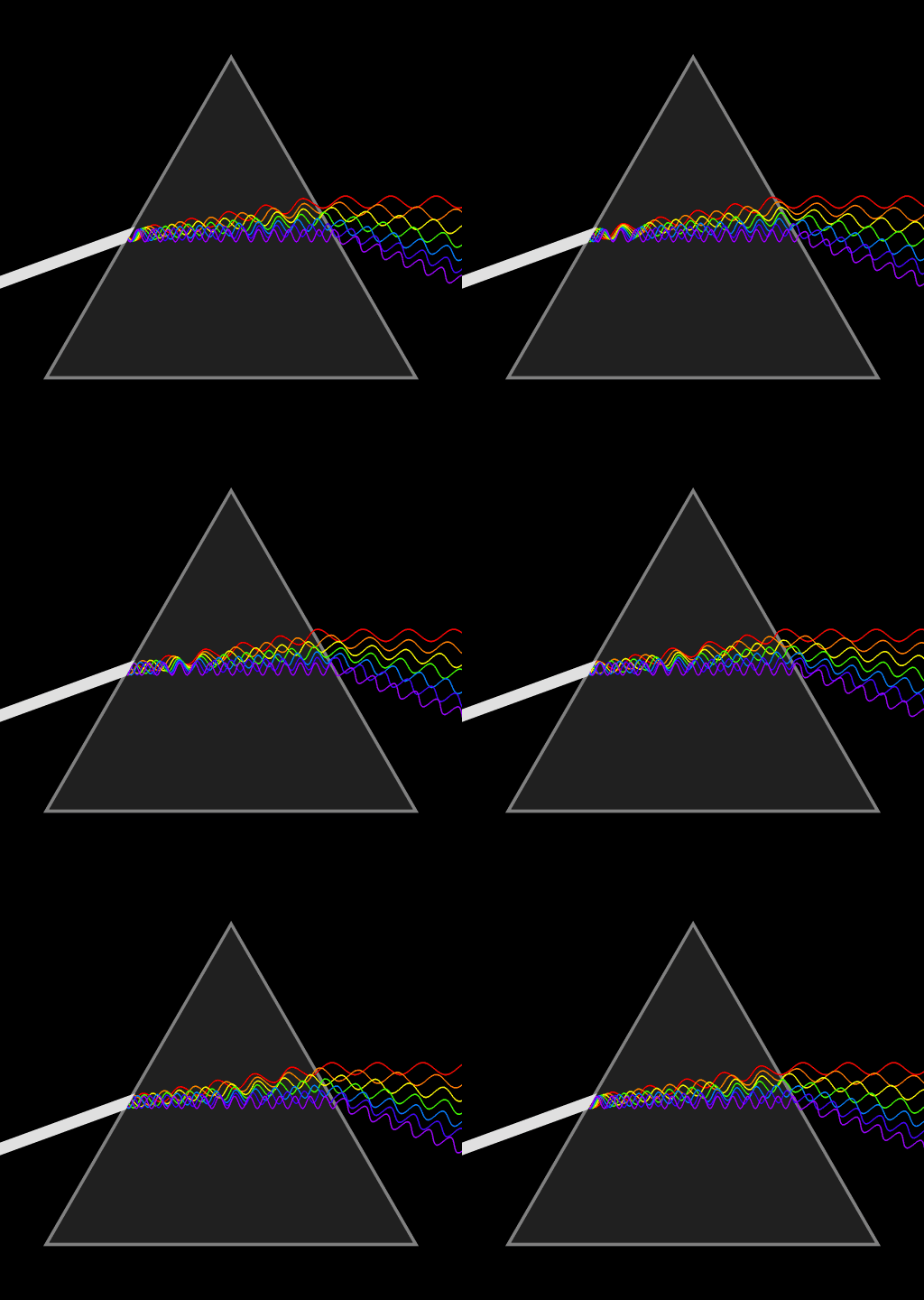
Invisible cloaks. Ghost imaging. Scientists are manipulating light in ways that were once only science fiction.

Science fiction met nuclear fission when Hungarian physicist Leó Szilárd pondered the explosive potential of nuclear energy.

Gods and angels have been replaced with hi-tech extraterrestrials.
John Templeton Foundation

The key to its success lies not in its understanding of technology, but in its understanding of human nature.

From forgotten Hollywood movies to Frank Herbert’s "Dune," science fiction illustrates some of our deepest fears about technology.

Science fiction movies capture a classic human flaw: getting the future mostly wrong.

"The Man in the High Castle" may be the most beloved alternate history book, but it is not the most historically accurate.

Eternal twilight.

What is Captain America doing in ancient Mesopotamia?

Jules Verne wrote about gasoline-powered vehicles, weapons of mass destruction, and global warming more than a century ago.

Take a trip through these master-crafted fantasy societies and ask yourself: Could I actually live there?


Astronomers have been looking for radio waves sent by a distant civilization for more than 60 years.

In the future, people may look back with horror at how humans treated AI in the 21st century.


Not too hot, not too cold...

On Earth, carbon can form millions of compounds, while silicon is largely stuck inside rocks. But elsewhere, silicon could form the basis of life.

Quite a lot, actually, even though it has no identifiable value as a scientific concept.

Equations that describe time travel are fully compatible and consistent with relativity — but physics is not mathematics.

Nanofabricators could quickly synthesize whatever we need, molecule by molecule.

We should not expect aliens to look anything like us. Creatures that resemble octopuses or birds or even robots are legitimate possibilities.

We’re still not sure what the ultimate question is. Here are 5 excellent candidates. One of the most amusing stories in all of science fiction is Douglas Adams’ The Hitchhiker’s […]

And what role, if any, does gravity play? While most of us have never had the opportunity to go into space, we all have the chance to dream about it and […]

We’ve never found eight stars bound together in the same stable system. But nature might make it so. The Universe that we have is often more wondrous and bizarre than even […]