
















Science and Tech

Science and Tech

An artist's impression of a cluster of stars.
With several seemingly incompatible observations, cosmology faces many puzzles. Could early, supermassive stars be the unified solution?
As we look to larger cosmic scales, we get a broader view of the expansive cosmic forest, eventually revealing the grandest views of all.
a red and orange abstract background with lines.
Explanations for the cosmic speed limit often conflate mass with inertia.
A man sits on a chair in a photo studio, flanked by black-and-white illustrations of an early human ancestor on the left and a modern man running on the right.
1hr 13mins
“Nothing about human behavior makes sense except in the light of culture and in anthropology, and we need to understand the cultural component to our behaviors as well.”
An abstract animation of white, textured patterns symmetrically forming on a blue and black background evokes the mysterious dance of dark energy, subtly hinting at its weakening presence as if guided by the precision of DESI.
The Universe isn't just expanding; the expansion is accelerating. If different methods yield incompatible results, is dark energy evolving?
Two diagrams: the left shows a complex, circular, multicolored network; the right displays a theoretical physics diagram with labeled axes and colored particle symbols, capturing the intricate nature of physics hard concepts.
When you don't have enough clues to bring your detective story to a close, you should expect that your educated guesses will all be wrong.
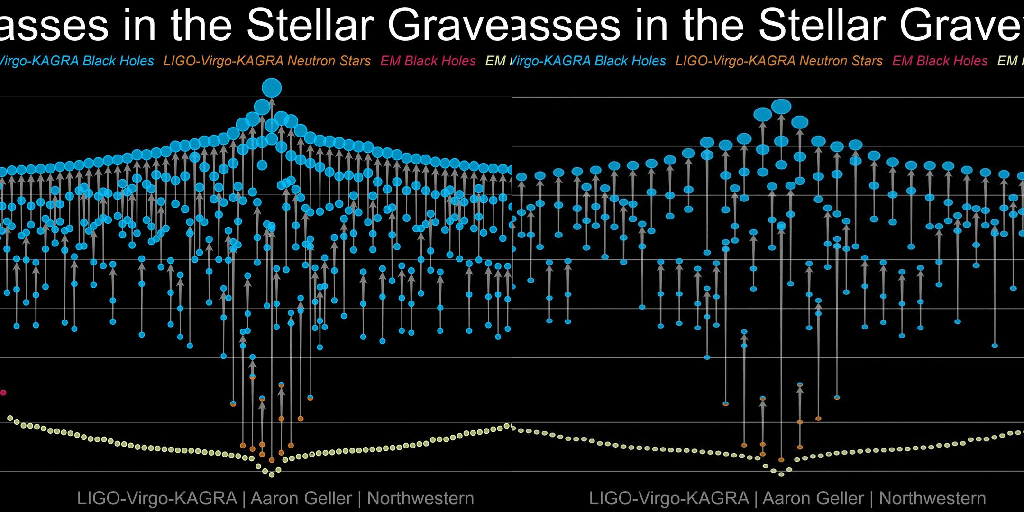
A chart titled "Masses in the Stellar Graveyard" shows the black holes and neutron stars detected by LIGO-Virgo-KAGRA, plotted on a logarithmic scale in solar masses, highlighting how LIGO triples black hole haul with each new discovery.
10 years ago, LIGO saw its first gravitational wave. After 218 detections, our view of black holes has changed forever. Can this era endure?
Technical drawing of an oval-shaped mechanical object with measurements and annotations, overlaid with orange scribble lines, subtly hinting at themes of colonial propaganda.
In this excerpt from "Tales of Militant Chemistry," Alice Lovejoy exposes how the need for uranium during WWII led the Allied governments to turn a blind eye to colonial exploitation.
Illustrated map showing streets, parks, and landmarks of a coastal city bordered by Hob's River and Delaware Bay, with a compass rose in the lower right corner.
The latest "Superman" film sets Metropolis in the First State.
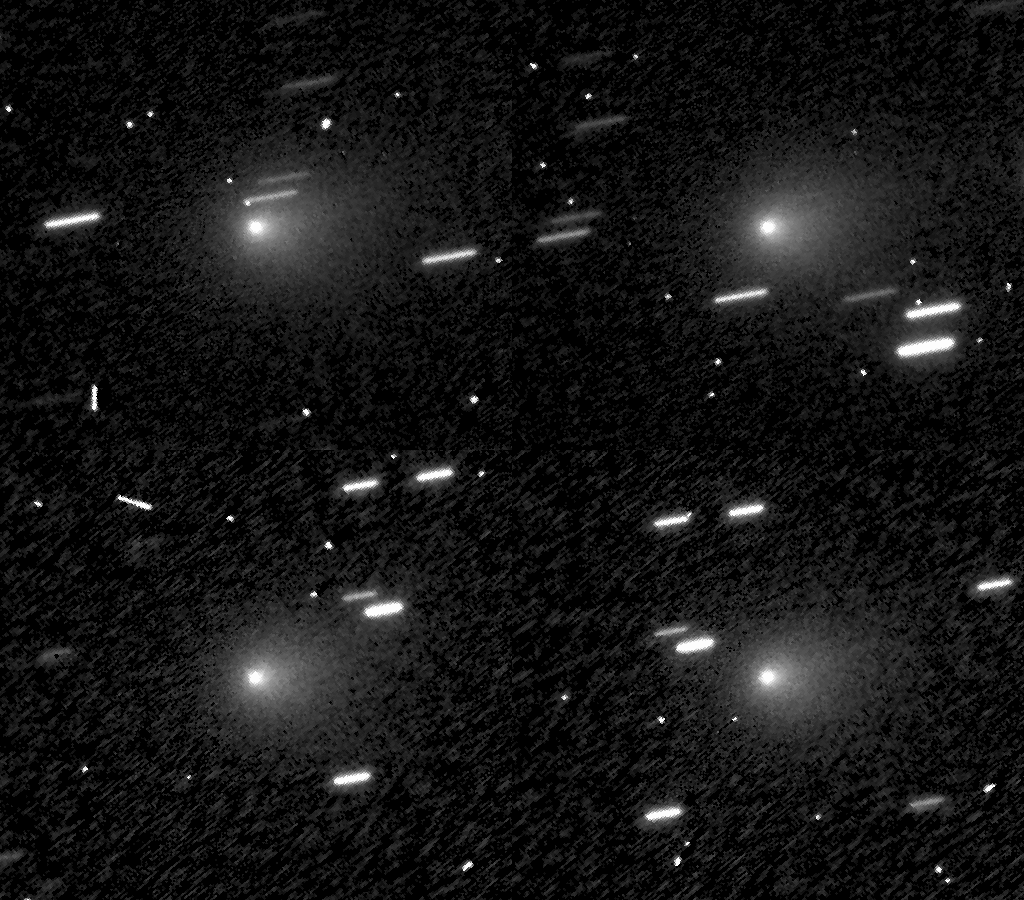
A grainy black and white image shows SPHEREx comet 3I/ATLAS gleaming at the center, surrounded by stars appearing as streaks due to long exposure.
Designed to map galaxies, the SPHEREx mission's first science result is instead about interstellar interloper 3I/ATLAS. No, it's not aliens.
Four images of a nebula, sculpted by a dead star, are shown side by side in radio, optical, and X-ray wavelengths; the fourth composite image reveals the so-called "Hand of God." Each is labeled at the bottom.
In our own Milky Way, a recently deceased star creates a ghostly, hand-like shape in X-rays some 150 light-years wide. Here's how it's made.
A man in a suit sits on a chair against a yellow background with abstract blue and green wave patterns behind him.
1hr 26mins
“I like to say that physics is hard because physics is easy, by which I mean we actually think about physics as students.”
A 3D potential energy surface with a central peak and surrounding valley illustrates zero-point energy power; two blue spheres indicate positions atop the peak and within the valley. Axes labeled Re(φ), Im(φ), and V(φ).
Throughout history, "free energy" has been a scammer's game, such as perpetual motion. But with zero-point energy, is it actually possible?
A small, irregular brown stone with holes—possibly linked to Denisovans—is shown next to a 1990 U.S. dime for size comparison.
In “The Secret History of Denisovans,” Silvana Condemi and François Savatier trace the story of our mysterious hominin ancestor.
There could be variables beyond the ones we've identified and know how to measure. But they can't get rid of quantum weirdness.
Abstract collage with a butterfly, brain sketches, graphs, and scientific diagrams overlaid with red, black, and beige shapes and textured patterns.
A conversation with neuroscientist Erik Hoel about the future of consciousness research.
Abstract illustration featuring five circles with various designs connected by curved white lines on a purple and blue background, symbolizing science or interconnected concepts.
A conversation with Annaka Harris on shared perception, experimental science, and why our intuition about consciousness is wrong.
A split image showing the left half of a frog and the right half of a chemical structure on a green and white textured background.
5-MeO-DMT may offer a practical way to access and study consciousness in its most basic form.
A digital illustration of a hermit crab with a shell resembling a human brain, shown in two square sections over the shell.
A conversation about intelligence and consciousness with philosopher Peter Godfrey-Smith.
Abstract illustration of a human figure with glowing neural-like lines and bright light concentrated around the head, set against a red and orange gradient background.
Introducing Big Think's Consciousness Issue.
A man in a suit sits in front of a large NASA logo sign, symbolizing the determination to defy charter limits and push the boundaries of space exploration.
NASA's 1958 charter's top priority was, "the expansion of human knowledge of phenomena in the atmosphere and space." Is this how it ends?
Close-up of a human eye with a digital interface overlay and a red laser beam targeting the pupil, illustrating the science of LASIK and advanced vision correction technology.
For many of us, our imperfect vision compels us to wear corrective lenses to see properly. Here's what everyone should know about LASIK.
Silhouetted quiver trees under a starry night sky, with the Milky Way forming a bright arc above the horizon—perfect for fans of stunning 2025 night sky images.
Across planet Earth, dark and pristine night skies are an increasingly rare resource. These photos showcase the best of what we still have.
Three white smokestacks emit thick, swirling clouds of orange and white smoke against a black background, hinting at the dramatic effect of going nuclear.
Nuclear chemist Tim Gregory joins Big Think to make the case that nuclear energy can still transform the world for the better.
space expanding
Just 13.8 billion years after the hot Big Bang, we can see 46.1 billion light-years away in all directions. Doesn't that violate...something?
A person in a suit holds up a NOAA map showing the forecast track and intensity of Hurricane Dorian, reminding us that, unlike Einstein, we can't change the facts—only prepare for them—in an office setting.
Einstein is credited with saying, "If the facts don't fit the theory, change the facts." What he actually said has a very different meaning.
Microscopic view of a single-celled organism with a translucent body and clustered orange structures inside, set against a plain background.
Our Earthbound definitions of life could leave us blind to the Universe’s strangest forms.
An image of an ancient black hole
At the center of Hubble's famous "cosmic horseshoe," a very heavy supermassive black hole has been robustly measured. How is it possible?
A bright green book cover titled "Me, my Customer & AI: The New Rules of Entrepreneurship" by Henrik Werdelin and Nicholas Thorne, featuring bold white and black text, explores topics like headless agents in modern business.
In the post-AI startup landscape, the role of the entrepreneur will evolve from operator to orchestrator. Are you ready?
A vintage, hexagonal brooch featuring a realistic painted human eye in the center, surrounded by a metallic frame.
2mins
Astrobiologist Betül Kaçar on why the simple act of asking questions (without needing a reason) is one of the most powerful things a human can do.