




















Search
Science and Tech

The tiniest galaxies of all are the most susceptible to violence by their larger, bullying siblings. That's why we need them in isolation.

1hr 17mins
"It's not that I don't think these problems are big or that they're urgent, but I can start to see that these problems are solvable."

The Universe is expanding, and individual, bound structures are all receding away from one another. How, then, are galaxies still colliding?

Welcome to The Nightcrawler — a weekly newsletter from Eric Markowitz covering tech, innovation, and long-term thinking.

Barnard's star, the closest singlet star system to ours, has long been a target for planet-hunters. We've finally confirmed it: they exist!

Back in 1970, Sister Mary Jucunda wrote NASA, decrying large investments in science. A former Nazi's legendary response is still relevant.

Cognitive neuroscientist and AI researcher Christopher Summerfield explores the differences, and similarities, of how AI and humans make meaning of the world.

Since the dawn of history, humans have pondered our ultimate cosmic origins. Now in the 21st century, science has gone beyond the Big Bang.

Memory takes effort, and our brains know it.

21mins
"Asking the question of, where did the entire universe come from, is no longer a question for poets and theologians and philosophers. This is a question for scientists, and we have some amazing scientific answers to this question that have defied even the wildest of our expectations."

Just 165,000 light-years away, the Large Magellanic Cloud is suspected to house a supermassive black hole. At last, evidence has arrived.

Fears of celestial collisions — and calculations of their likelihood — go back to the very origins of modern science itself.

There are some 26 fundamental constants in nature, and their values enable our Universe to exist as it does. But where do they come from?

Welcome to The Nightcrawler — a weekly newsletter from Eric Markowitz covering tech, innovation, and long-term thinking.

Under extreme conditions, matter takes on properties that lead to remarkable, novel possibilities. Topological superconductors included.

One of the most promising dark matter candidates is light particles, like axions. With JWST, we can rule out many of those options already.

Astronomers see spiral and elliptical nebulae nearly everywhere, except by the Milky Way's plane. We didn't know why until the 20th century.
Perhaps the most well-known equation in all of physics is Einstein's E = mc². Does mass or energy increase, then, near the speed of light?

We've wasted our time and resources ideologically policing and punishing each other for far too long. Here's a better route to prosperity.
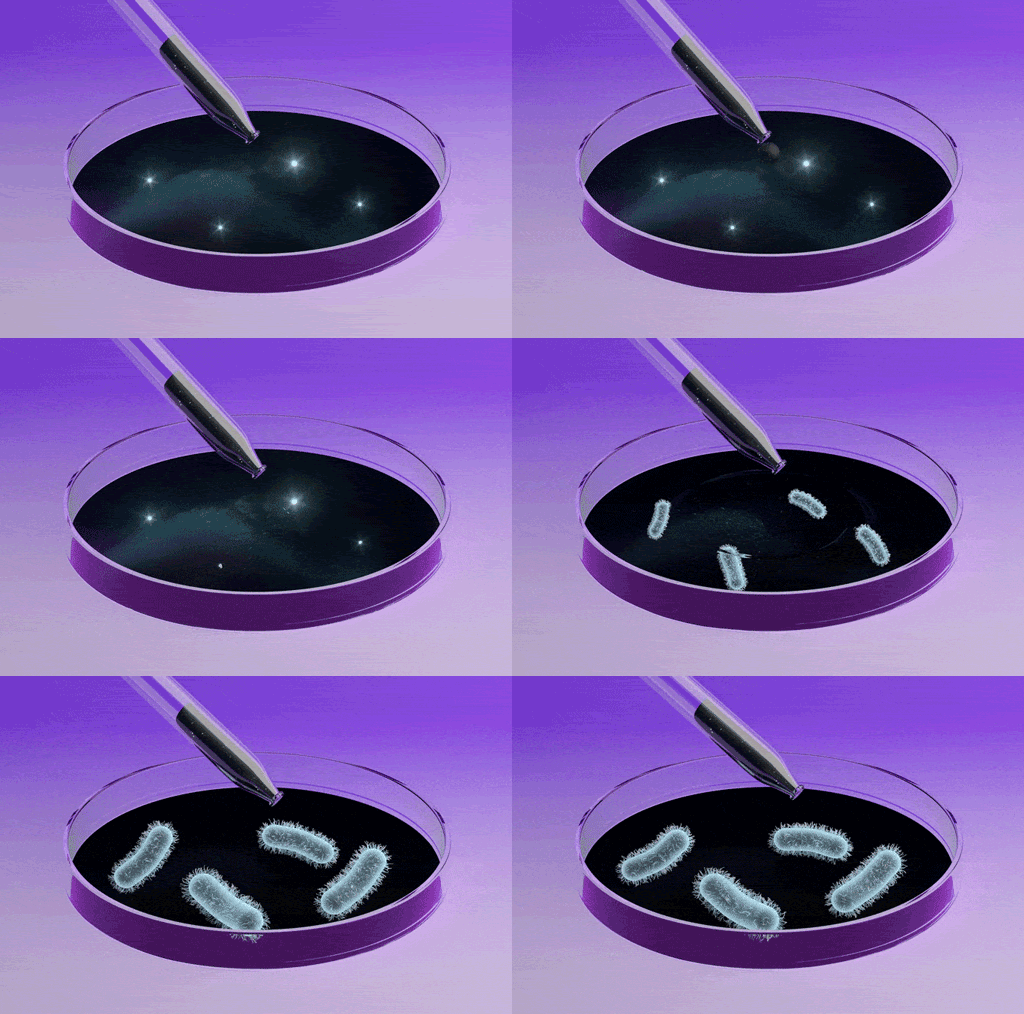
“I want to change the way we think about the past altogether,” says Dr. Betül Kaçar, an astrobiologist who studies the origin of life.

From the tiniest subatomic scales to the grandest cosmic structures of all, everything that exists depends on two things: charge and mass.

Groundbreaking invention does not always translate to commercial benefits. The challenges that faced Microsoft Research help explain why.

The CMB gives us critical information about our cosmic past. But it doesn't give us everything, and galaxy mapping can fill in a key gap.

"Gyroscope-on-a-chip" technology could soon enable us to navigate over long distances without GPS.

The full extent of the Andromeda galaxy, the nearest large galaxy to our own, has been entirely imaged with Hubble's exquisite cameras.

“Can we push these cells to do something other than what they normally do?" asks developmental biologist Michael Levin. "Can they build something completely different?”

Dark matter doesn't absorb or emit light, but it gravitates. Instead of something exotic and novel, could it just be dark, normal matter?

We're all entitled to our own opinions, no matter how ill-informed they are. But facts are facts; we can't just choose the ones we prefer.

The more you know, the better you can act.

Asteroid 2024 YR4, which could devastate a city's worth of humans, has gone from 1.2% to 2.3% to 2.6% to 3.1% chances of impact. Here's why.