




















Search
Science and Tech

A photographer captured Bern’s eclectic and charming feline structures.
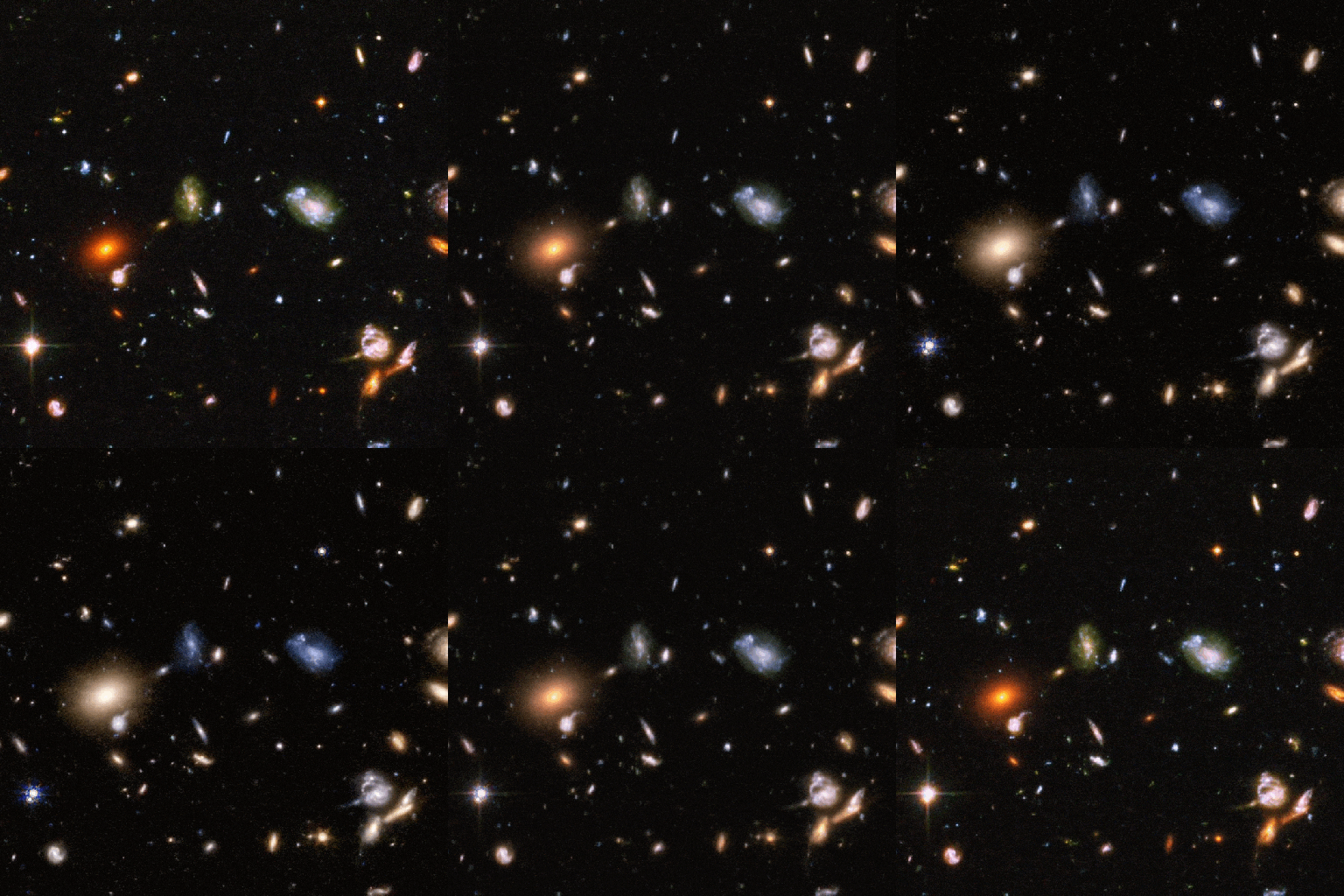
The farther away they get, the smaller distant galaxies look. But only up to a point, and beyond that, they appear larger again. Here’s how.

From a photon's viewpoint, the Universe is timeless and dimensionless.

The fear of deep bodies of water may be evolutionarily ingrained.

"The only options left were experimental approaches in clinical trials."

In many ways, we are still novices playing with toy models seeking to understand the stars.

Despite the enormous mass of the Earth, simply depleting our groundwater is changing our axial tilt. Simple Newtonian physics explains why.

On the menu: stews, cheese, and fermented drinks.

The idea that consciousness emerges naturally alongside intelligence could be an anthropocentric distortion.

To advance the gender-affirming healthcare of all those who transition, we must also understand the nature and causes of those who detransition.

In physics, we reduce things to their elementary, fundamental components, and build emergent things out of them. That's not the full story.

"Domesticated viral genes" may not be domesticated as scientists thought.

Who — or what — really controls your mind?

More than a century ago, Halifax suffered an accidental blast one-fifth the size of the atomic bomb dropped on Hiroshima.

Embark on a journey through one of the most profound ecological transitions in the history of complex life.

And it seems to work alongside popular weight-loss medications, like Ozempic.

Pessimism reigned supreme.

In a far-reaching discovery with astrophysicist Karolina Garcia, we discuss what's in the Universe and how it grew up.

Cancer likes glucose. So take it away.

If we waited long enough, would even protons themselves decay? The far future stability of the Universe depends on it.

Rich data on the global state of our feathered friends presents plenty of bad news — but also some bright spots.

Nobody actually knows what will come of AI. But we can console ourselves with the knowledge that nobody has ever really known anything about the future.

Origin of life studies have always focused on a set of strict environments that could give rise to life. Ante-life opens new possibilities.

From cosmetic procedures to heart operations, the introduction of AI will create an ethical minefield.

What do the dark recesses of the early Universe and Zelda: Tears of the Kingdom have in common? More than you could have ever hoped for.

Walter Pitts rose from the streets to MIT, but couldn’t escape himself.

How are we to deal with the quantization of spacetime and gravity?

There may be more energy in methane hydrates than in all the world’s oil, coal, and gas combined. It could be the perfect "bridge fuel" to a clean energy future.

Up until 2002, we thought that the heaviest stable element was bismuth: #83 on the periodic table. That's absolutely no longer the case.

A series of charts shows how prevalent different mental illnesses are across the globe — but how we define them matters.