
















Science and Tech

Science and Tech

Black and white portrait of Alex Osterwalder with glasses and facial hair, framed against a graphic background featuring striking orange, white, and beige geometric patterns.
Strategyzer CEO Alex Osterwalder on why entrepreneurs should take a leaf from Amazon’s innovation playbook.
A dense star field with dark, irregular dust clouds—where cosmic dust come from—obscures parts of the glowing stars in the Milky Way.
Dust is ubiquitous in the modern Universe, appearing in nearly all galaxies. But our cosmos was born dust-free. So where does it originate?
A drawing of a group of people soaring in a plane, embodying cosmism.
In revolutionary Russia, a group of forward-thinking philosophers offered an alternative to both futurism and communism.
It's the origin of our entire observable Universe, but it's still not the very beginning of everything.
Split image: Left side shows a painting of hands peeling apples with a knife; right side features a modern mechanical apple peeler, echoing Jeff DeGraff’s spirit of innovation bridging tradition and progress.
Real understanding, argues Jeff DeGraff, doesn’t come from outputs — it comes from practice.
A dark, rocky planet orbits in space with the sun illuminating its edge, surrounded by stars and distant cosmic clouds.
The most common type of exoplanet is neither Earth-sized nor Neptune-sized, but in between. Could these haze-rich worlds house alien life?
Book cover for "Facing Infinity: Black Holes and Our Place on Earth" by Jonas Enander, featuring a starry night sky, a swirling black hole graphic, and a faint silhouette of a priest gazing into the cosmic abyss.
In this excerpt from "Facing Infinity," Jonas Enander examines how John Michell conceived of "dark stars," or massive bodies with enough gravity to trap light, all the way back in 1783.
Two identical, intricate, circular geometric patterns with symmetrical, multicolored lines and shapes are displayed side by side on a white background—each subtly reflecting the argument against theory of everything’s promise of perfect symmetry.
The Holy Grail of physics is a Theory of Everything: where a single equation describes the whole Universe. But maybe there simply isn't one?
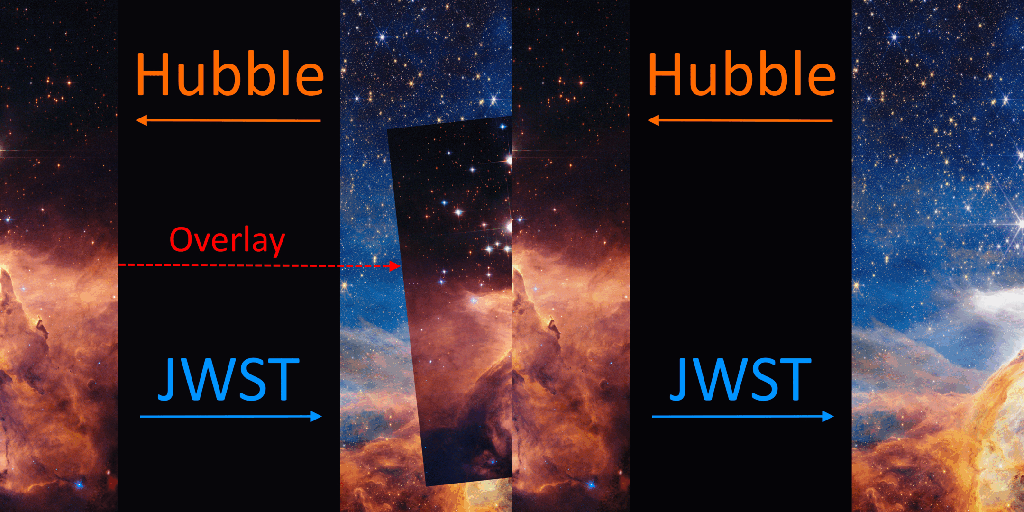
Side-by-side comparison of the Pismis 24 nebula as seen by Hubble (top left) and JWST (bottom right), with an overlay highlighting image differences.
JWST isn't the first telescope to peer into this factory of star-birth some 5500 light-years away, but its views are the most educational.
A bright, circular blue and white object is centered against a black background, with a smaller red object to the lower left.
Going back to 1990, we hadn't even found one planet outside of our Solar System. As we close in on 6000, we now see many of them directly.
Abstract 3D geometric surface with intersecting translucent orange and brown planes, inspired by the amplituhedron theory of everything, set against a blurred orange background with white network lines.
Since even before Einstein, physicists have sought a theory of everything to explain the Universe. Can positive geometry lead us there?
Compton gamma-ray observatory deployment
Across all wavelengths of light, the Sun is brighter than the Moon. Until we went to the highest energies and saw a gamma-ray surprise.
An artist's rendering of the nasa jupiter spacecraft.
The Juno spacecraft, orbiting and imaging Jupiter since 2016, is still succeeding. Without a further extension, the mission now faces death.
A world map comparing landmass outlines of the Equal Earth projection in pink and Mercator projection in green, with grid lines overlaid.
The African Union argues that the Mercator projection distorts the continent, both in size and global attention.
An artist's impression of a cluster of stars.
With several seemingly incompatible observations, cosmology faces many puzzles. Could early, supermassive stars be the unified solution?
As we look to larger cosmic scales, we get a broader view of the expansive cosmic forest, eventually revealing the grandest views of all.
a red and orange abstract background with lines.
Explanations for the cosmic speed limit often conflate mass with inertia.
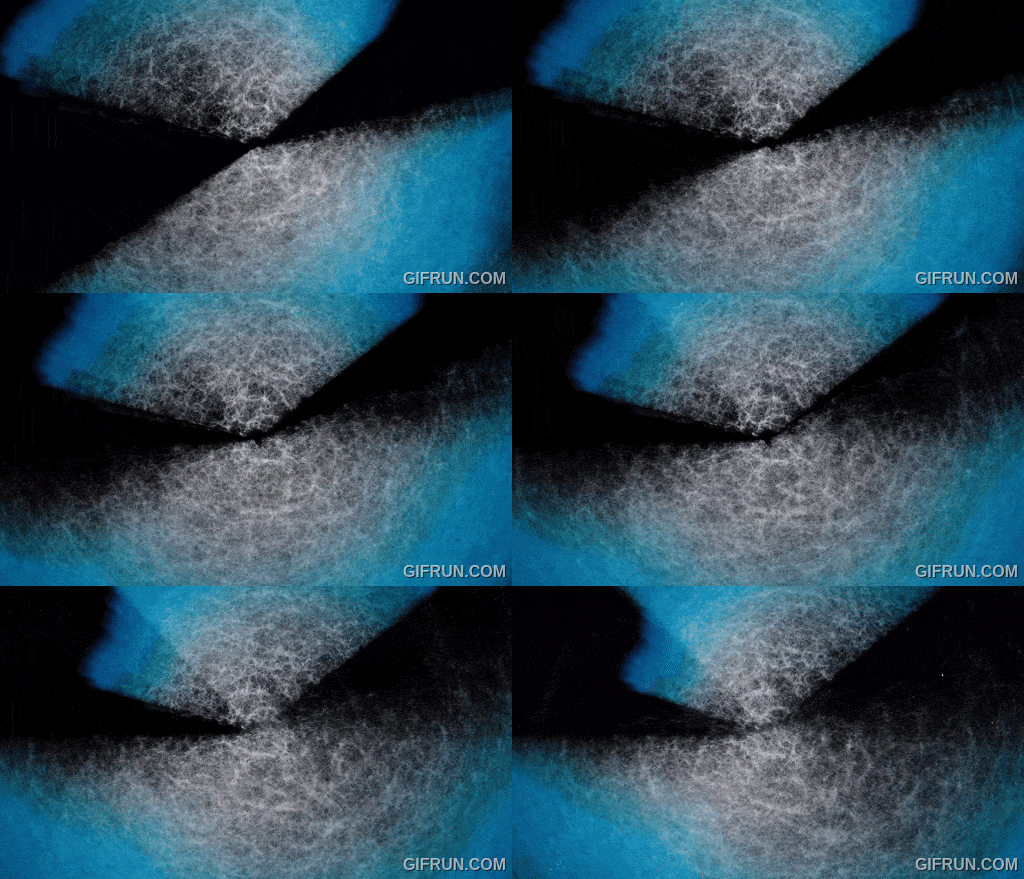
An abstract animation of white, textured patterns symmetrically forming on a blue and black background evokes the mysterious dance of dark energy, subtly hinting at its weakening presence as if guided by the precision of DESI.
The Universe isn't just expanding; the expansion is accelerating. If different methods yield incompatible results, is dark energy evolving?
Two diagrams: the left shows a complex, circular, multicolored network; the right displays a theoretical physics diagram with labeled axes and colored particle symbols, capturing the intricate nature of physics hard concepts.
When you don't have enough clues to bring your detective story to a close, you should expect that your educated guesses will all be wrong.
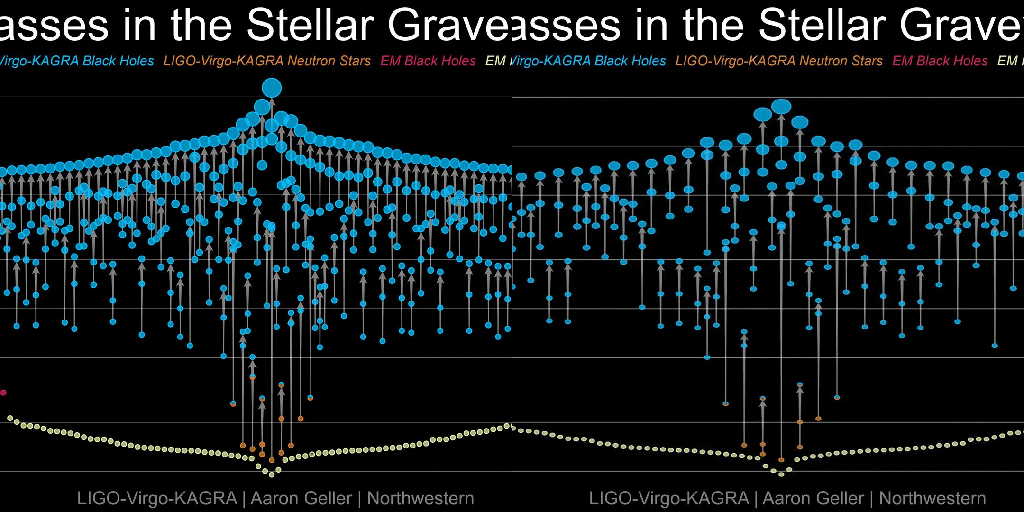
A chart titled "Masses in the Stellar Graveyard" shows the black holes and neutron stars detected by LIGO-Virgo-KAGRA, plotted on a logarithmic scale in solar masses, highlighting how LIGO triples black hole haul with each new discovery.
10 years ago, LIGO saw its first gravitational wave. After 218 detections, our view of black holes has changed forever. Can this era endure?
Technical drawing of an oval-shaped mechanical object with measurements and annotations, overlaid with orange scribble lines, subtly hinting at themes of colonial propaganda.
In this excerpt from "Tales of Militant Chemistry," Alice Lovejoy exposes how the need for uranium during WWII led the Allied governments to turn a blind eye to colonial exploitation.
Illustrated map showing streets, parks, and landmarks of a coastal city bordered by Hob's River and Delaware Bay, with a compass rose in the lower right corner.
The latest "Superman" film sets Metropolis in the First State.
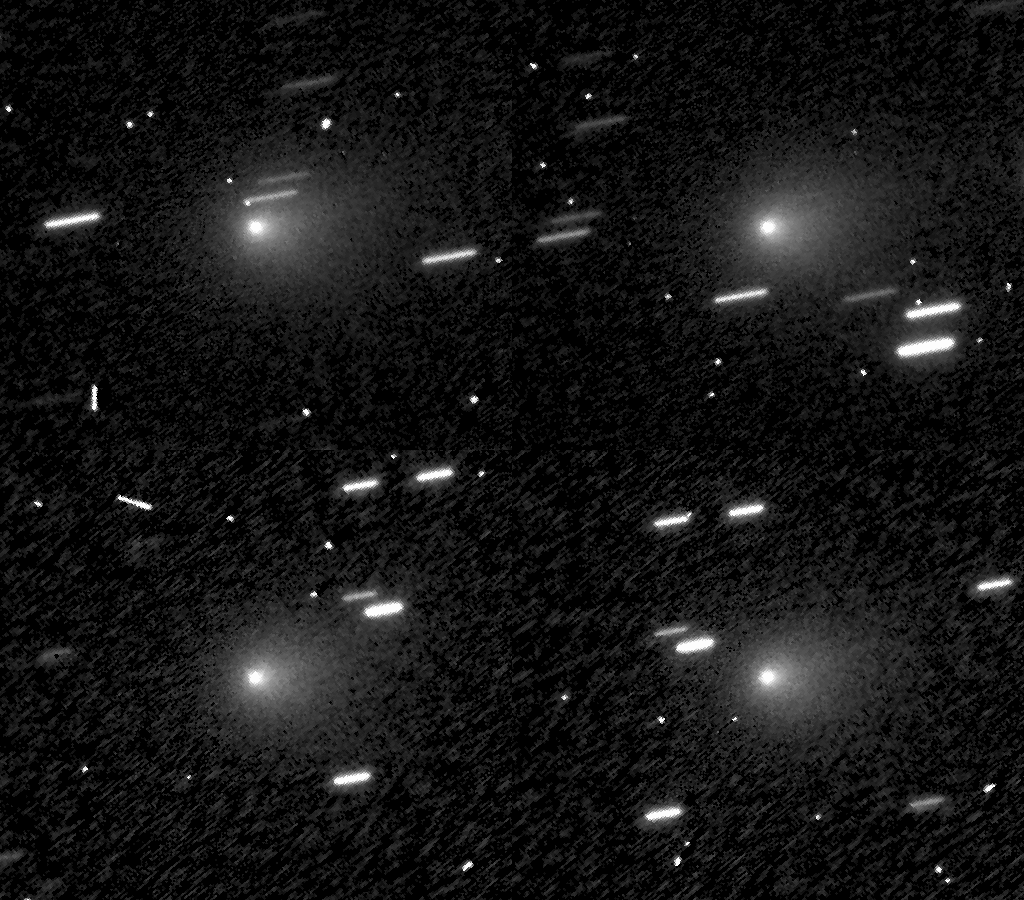
A grainy black and white image shows SPHEREx comet 3I/ATLAS gleaming at the center, surrounded by stars appearing as streaks due to long exposure.
Designed to map galaxies, the SPHEREx mission's first science result is instead about interstellar interloper 3I/ATLAS. No, it's not aliens.
Four images of a nebula, sculpted by a dead star, are shown side by side in radio, optical, and X-ray wavelengths; the fourth composite image reveals the so-called "Hand of God." Each is labeled at the bottom.
In our own Milky Way, a recently deceased star creates a ghostly, hand-like shape in X-rays some 150 light-years wide. Here's how it's made.
A 3D potential energy surface with a central peak and surrounding valley illustrates zero-point energy power; two blue spheres indicate positions atop the peak and within the valley. Axes labeled Re(φ), Im(φ), and V(φ).
Throughout history, "free energy" has been a scammer's game, such as perpetual motion. But with zero-point energy, is it actually possible?
A small, irregular brown stone with holes—possibly linked to Denisovans—is shown next to a 1990 U.S. dime for size comparison.
In “The Secret History of Denisovans,” Silvana Condemi and François Savatier trace the story of our mysterious hominin ancestor.
There could be variables beyond the ones we've identified and know how to measure. But they can't get rid of quantum weirdness.
Abstract collage with a butterfly, brain sketches, graphs, and scientific diagrams overlaid with red, black, and beige shapes and textured patterns.
A conversation with neuroscientist Erik Hoel about the future of consciousness research.
Abstract illustration featuring five circles with various designs connected by curved white lines on a purple and blue background, symbolizing science or interconnected concepts.
A conversation with Annaka Harris on shared perception, experimental science, and why our intuition about consciousness is wrong.