




















Search
Science and Tech

Massive galaxy cluster Abell S1063, 4.5 billion light-years away, bends and distorts the space nearby. Here's what a JWST deep field shows.

Is the Universe's expansion rate 67 km/s/Mpc, 73 km/s/Mpc, or somewhere in between? The Hubble tension is real and not so easy to resolve.

The ANITA experiment found cosmic rays shooting out of Antarctica. One interpretation claims "parallel Universes," but is that right?

Different methods of measuring the Universe's expansion rate yield high-precision, incompatible answers. But is the problem robustly real?

"The rise of the internet brought about similar fears, yet it ultimately made learning richer and more accessible."
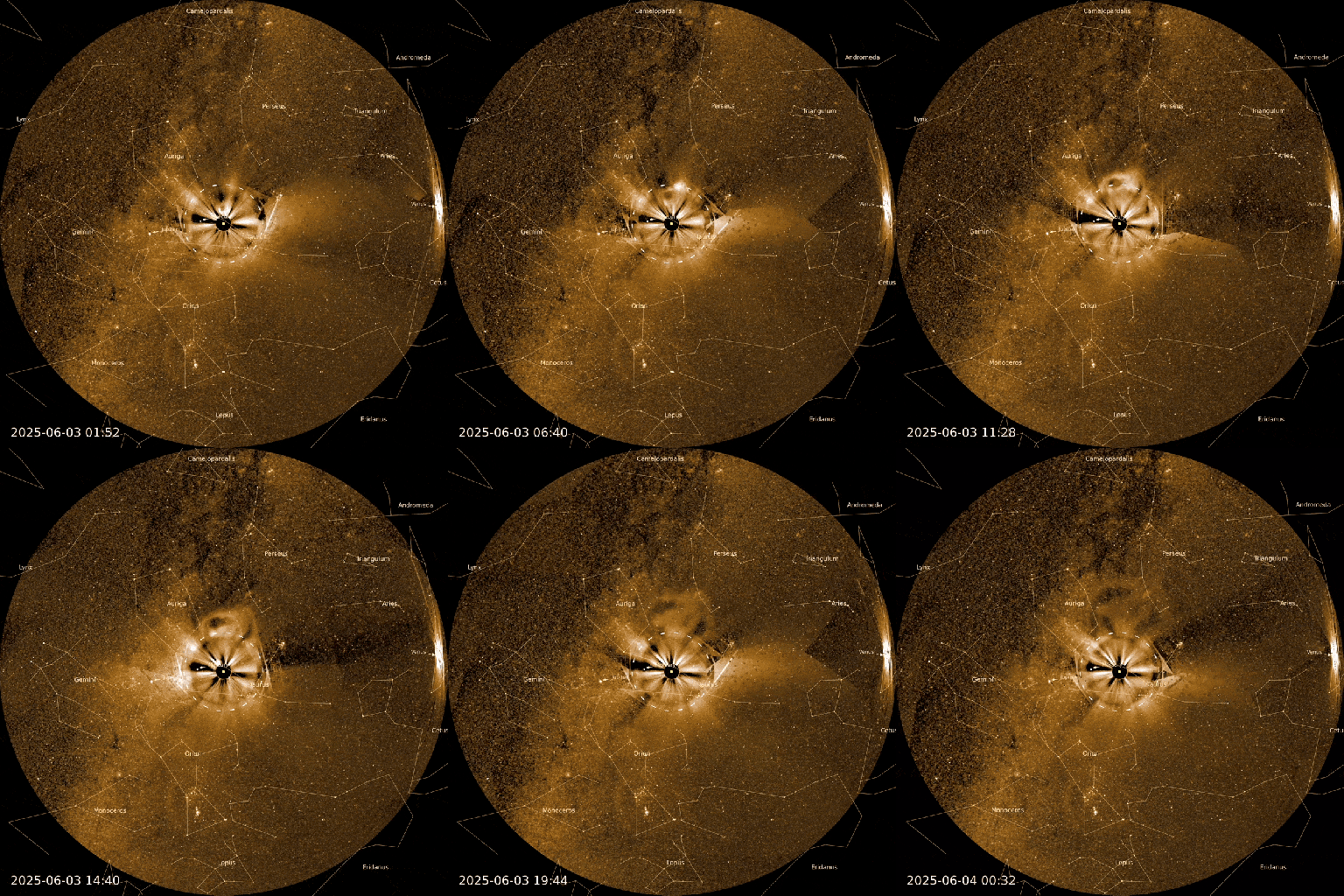
Launched in March, the PUNCH mission has viewed two incredible coronal mass ejections, tracking them farther from the Sun than ever before.

Annie Duke, a poker champion turned decision scientist, talks with Big Think about how to choose well under uncertainty.

The tiniest galaxies of all are the most severely dominated by dark matter. Could black holes be the cause of the extra gravity instead?

A few physical quantities, in all laboratory experiments, are always conserved: including energy. But for the entire Universe? Not so much.

For his new book, “The Ghost Lab,” Matt Hongoltz-Hetling spent time with paranormal investigators to understand their relationship with science and society.

If you want to understand the Universe, cosmologically, you just can't do it without the Friedmann equation. With it, the cosmos is yours.

If happiness is an absolute good, would 1 billion slightly happy people be better than 1 million incredibly happy people?

Viewing Uranus's largest moons with Hubble, astronomers hoped to find darkening on the trailing side. They found the exact opposite instead.

The cofounders of think tank RethinkX are convinced that humanity is undergoing civilizational phase change.

In "The Shortest History of the Dinosaurs," Riley Black reveals the bold mammals that thrived in the Age of Reptiles.

On Earth, our particle accelerators can reach tera-electron-volt (TeV) energies. Particles from space are thousands of times as energetic.

The first galaxies were irregular blobs of gas and stars. But modern features, like spiral arms and bars, appeared earlier than expected.

The hunt for extraterrestrial life begins with planets like Earth. But our inhabited Earth once looked very different than Earth does today.

If the Universe is 13.8 billion years old today, but different ages the farther we look back, what does it mean for a star to be the first?

John Green opens up about his struggle to remain hopeful while writing about suffering and injustice.

The COSMOS-Web has just finalized their release of their full field: larger and deeper than any other JWST program. Here's what's inside.

When theory and experiment disagree, it could mean new physics. This time, they solved the muon g-2 puzzle, and saved the Standard Model.

The Vera C. Rubin Observatory in Chile will image the southern sky using the largest digital camera ever built.

In "Raising AI," De Kai argues that today's AIs are already more like us than we think they are.

For decades, astronomers have claimed the Milky Way will merge with Andromeda in ~4 billion years. Here's why, in 2025, that seems unlikely.

"The stars made our minds, and now our minds look back."
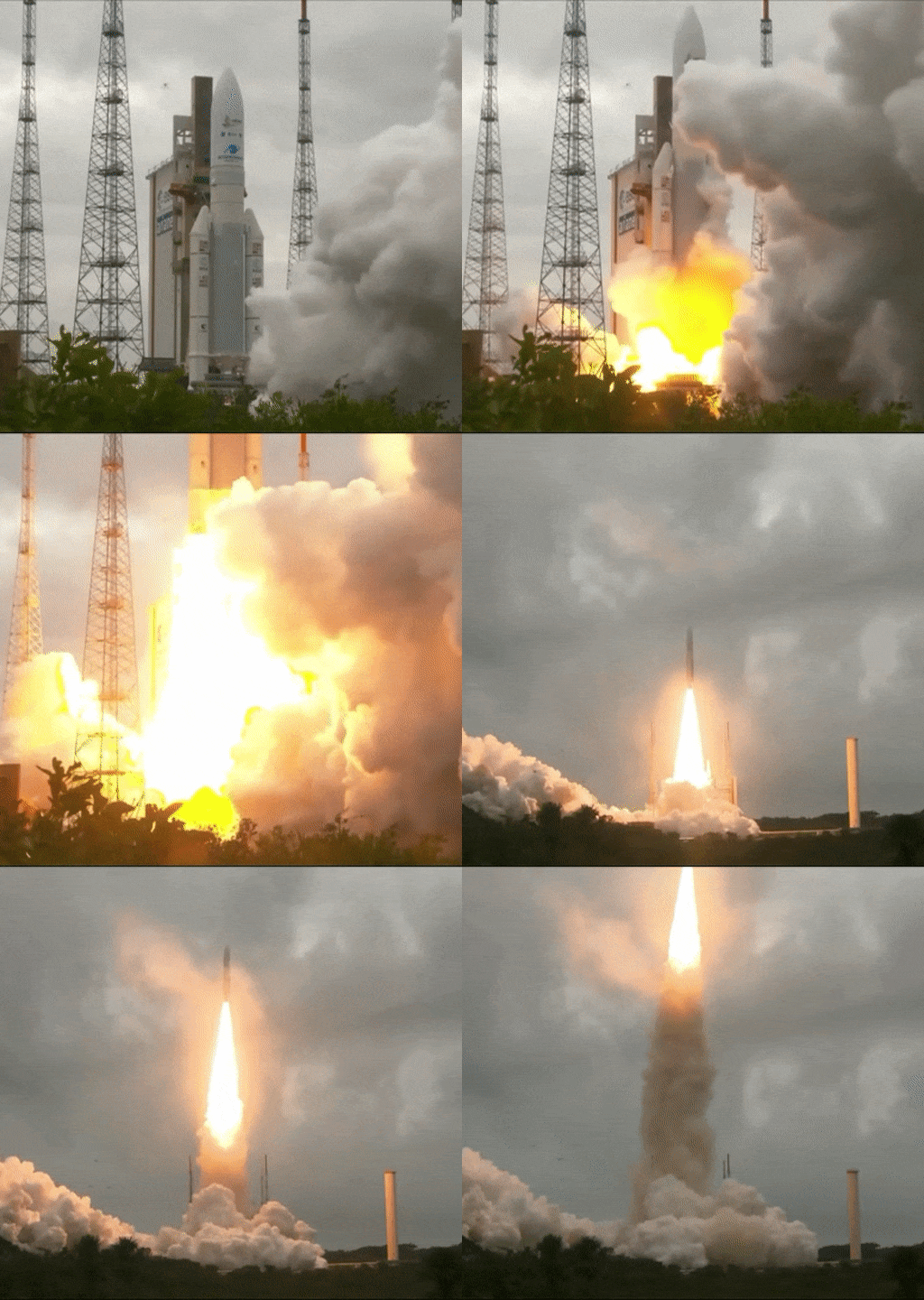
As US science faces record cuts to funding, jobs, and facilities, these 10 quotes help remind us how science brings value to us all.

In our Universe, dark matter outmasses normal matter by a 5-to-1 ratio, shaping the Universe as we know it. What if it simply weren't there?

Welcome to The Nightcrawler — a weekly newsletter from Eric Markowitz covering tech, innovation, and long-term thinking.

It rotates on its axis, revolves around the Sun, moves throughout the Milky Way, and gets carried by our galaxy all throughout space.