




















Search
Science and Tech

The existence of another watery world in the outer solar system may offer clues to how such seas form — and hope for another spot to search for life.

How Daniel Kahneman and Amos Tversky cracked open behavioral economics and enlightened all our choices.

In the expanding Universe, different ways of measuring its rate give incompatible answers. Nobel Laureate Adam Riess explains what it means.

Benjamin Oakes — CEO of buzz-worthy biotech company Scribe Therapeutics — joins Big Think for a chat about innovation, human endeavor, and more.

The Lyman-α emission line has never been seen earlier than 550 million years after the Big Bang. So why does JADES-GS-z13-1-LA have one?

When AI eats its own product, it gets sick.

Galactic activity doesn't just arrive when supermassive black holes feast on matter. Before, during, and after all create fascinating signs.
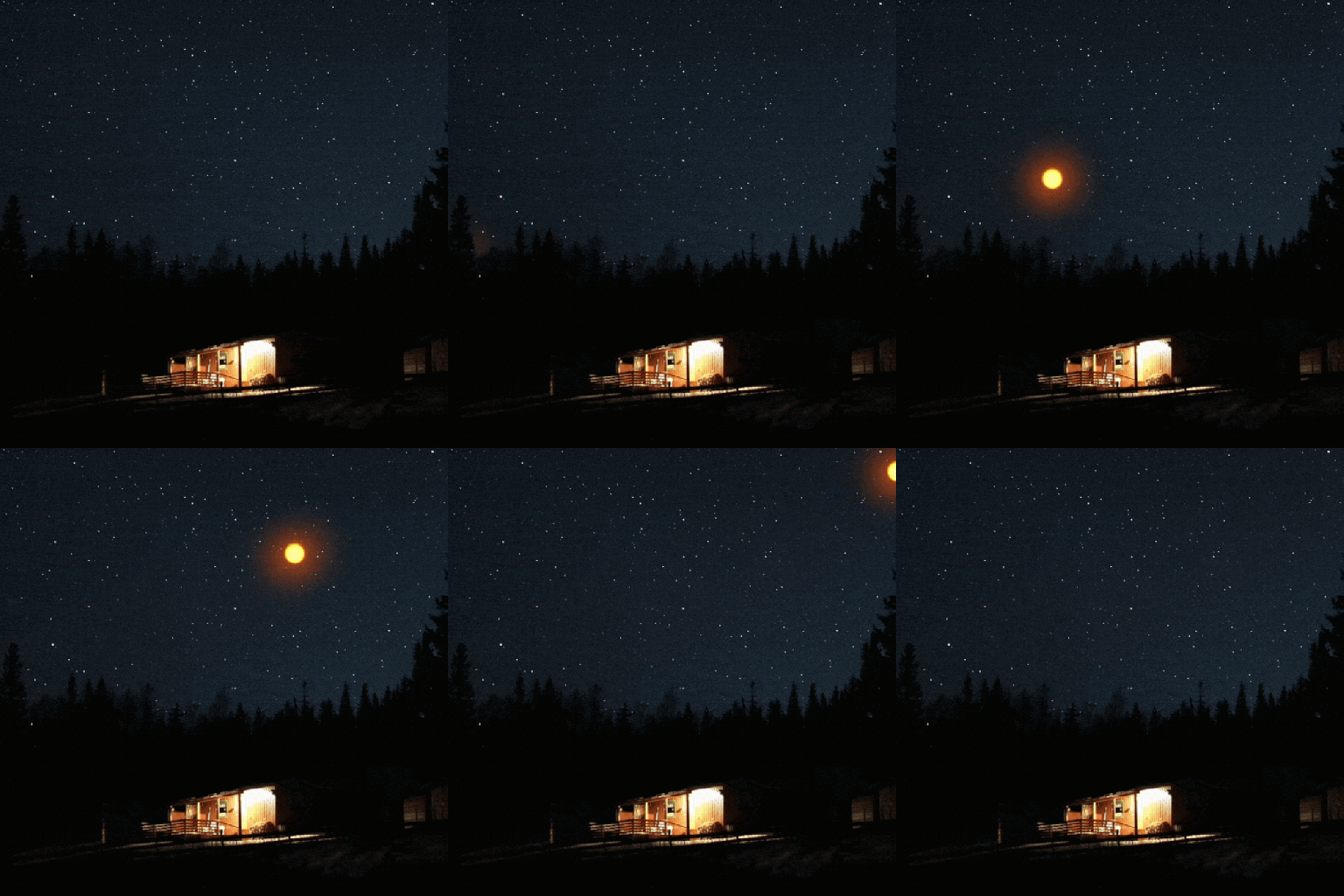
Although a great many unidentified sights have been seen in the skies, none have conclusively demonstrated the presence of aliens. So far.

Finding life beyond our Solar System requires understanding its host planet.

Taught in every introductory physics class for centuries, the parabola is only an imperfect approximation for the true path of a projectile.

The salinity of the oceans is not just a matter of taste. Saltier water behaves differently, too.

Inflation, dark matter, and string theory are all proposed extensions to the prior consensus picture. But what does the evidence say?

The observation that everything we know is made out of matter and not antimatter is one of nature's greatest puzzles. Will we ever solve it?

"The Big Map of Who Lived When" plots the lifespans of historical figures — from Eminem all the way back to Genghis Khan.

With the right prompts, large language models can produce quality writing — and make us question the limits of human creativity.

Why human attempts to mechanize logic keep breaking down.

Thinking of a number between one and ten? Here's how predictable human responses create the illusion of telepathy.

"When you feel the isolation setting in at times, you have to reframe your mindset."

Scientific surprises, driven by experiment, are often how science advances. But more often than not, they’re just bad science.

As creatures and machines meld together in increasingly advanced forms, ethicists are starting to take note.
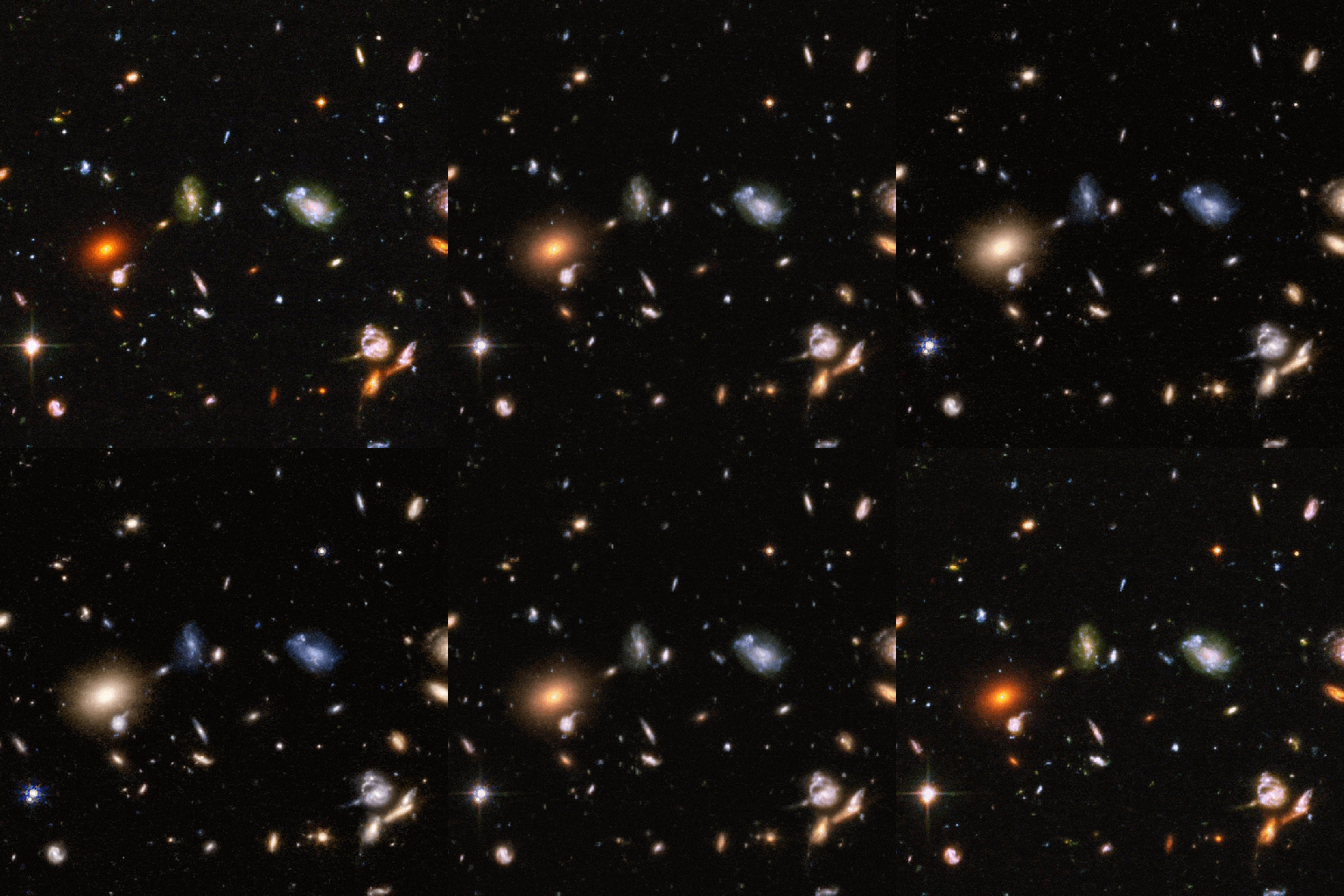
The "little red dots" were touted as being too massive, too early, for cosmology to explain. With new knowledge, everything adds up.

Researchers at the Brookhaven National Laboratory recently created the heaviest exotic antimatter hypernucleus ever observed.

Here on Earth, we commonly use terms like weight (in pounds) and mass (in kilograms) as though they're interchangeable. They're not.

In "Life As No One Knows It," Sara Imari Walker explains why the key distinction between life and other kinds of "things" is how life uses information.

So far, Earth is the only planet that we're certain possesses active life processes. Here's what we shouldn't assume about life elsewhere.


The Universe isn't just expansion, but the expansion itself is accelerating. So why can't we feel it in any measurable way?

Welcome to The Nightcrawler — a weekly newsletter from Eric Markowitz covering tech, innovation, and long-term thinking.

No matter how good our measurement devices get, certain quantum properties always possess an inherent uncertainty. Can we figure out why?

In a world of rising cynicism, a celebration of our capacity to create, adapt, and thrive.