




















Search
Science and Tech
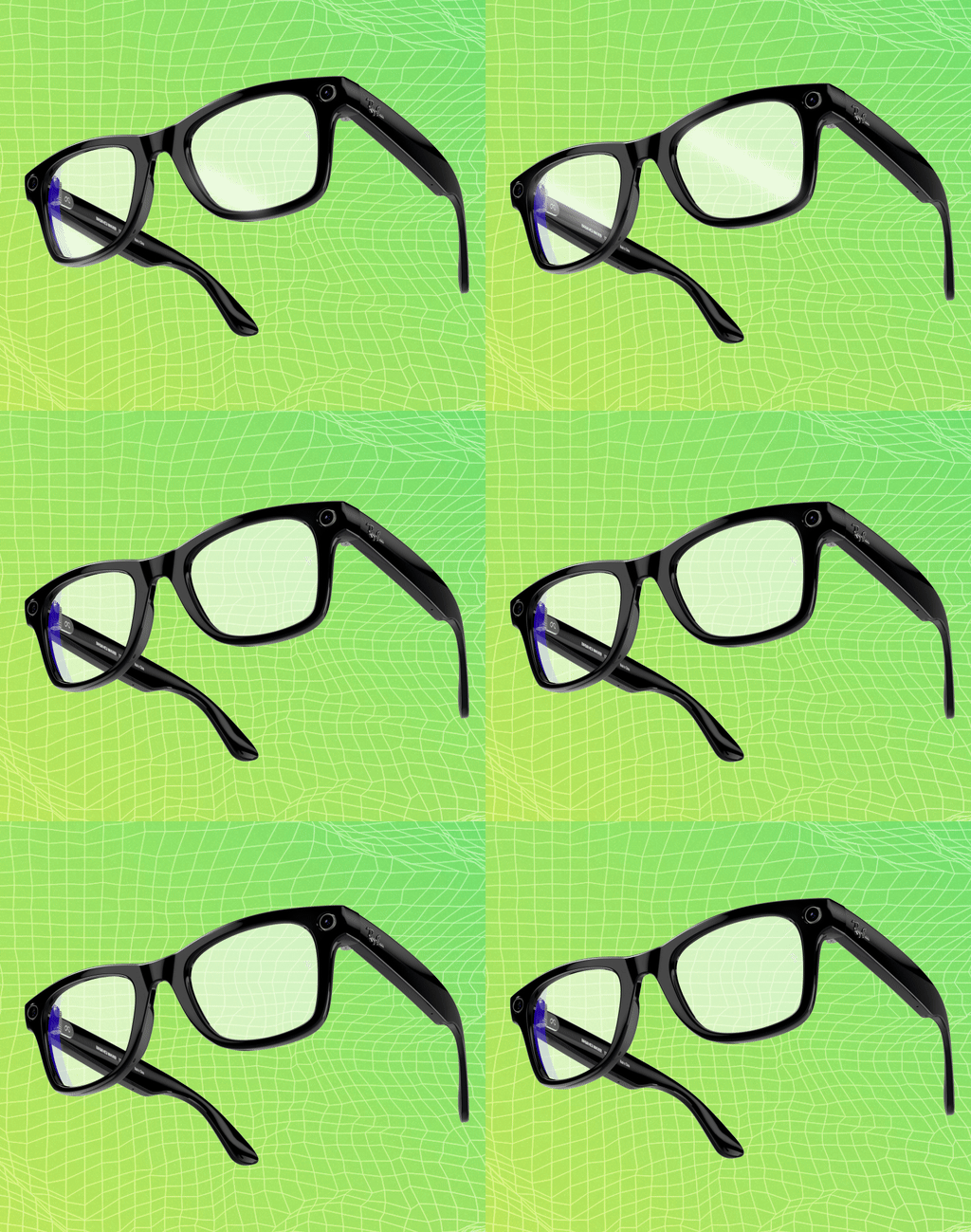
Smart glasses have flopped before. AI could finally make them mainstream.

Kurzweil predicts that AI will combine with biotechnology to defeat degenerative diseases this decade. Then things will get really interesting.

Sure, there's less daylight during winter than summer, as your hemisphere is tilted away from the Sun. But darkness goes deeper than that.

"We should be informed and educated about the risks of AI, but we can’t be afraid,” Khan Academy founder Sal Khan told Big Think.

Our thermodynamic arrow of time explains why the entropy of any isolated system always increases. But it can't explain what we perceive.

The near and far sides of the Moon are so different from each other, and no one is sure why. New lunar samples could confirm a wild theory.

This research team is working out how to detect extraterrestrial cells in the liquid water ocean hidden beneath Enceladus’s icy crust.

The evolution of quantum technology is far from over.

Our “embodied minds” suggest an eventual escape from mortality via computer is unlikely.

All telescopes are fundamentally limited in what they can see. JWST reveals more distant galaxies than Hubble, but still can't see them all.

Thanks to the Coriolis force, hurricanes never cross the equator.

There was a time where no starlight was visible throughout the entire cosmos. That time was short-lived: shorter than astronomers imagined.

Hunger rates are rising. These technologies could turn the tide.

Gravitational waves carry enormous amounts of energy, but spread out quickly once they leave the source. Could they ever create black holes?

CERN's NA64 experiment used a high-energy muon beam technique to advance the elusive search for dark matter, offering new hope for solving one of astronomy's greatest mysteries.

The sharpest optical images, for now, come from the Hubble Space Telescope. A ground-based technique can make images over 100 times sharper.

Almost 100 years ago, an asymmetric pathology led Dirac to postulate the positron. A similar pathology could lead us to supersymmetry.

Neuroscientist Christof Koch on human minds, AI, and bacteria.

From the coldest planets to spacecraft that have exited the Solar System, these little-known facts stump even many professional astronomers.

A look back at the rise of solar power in the US and what's next.

The Universe's history, from cosmic inflation to the Big Bang to the present, is known. But whether it's infinite or not is still a mystery.

An excerpt from renowned neuropsychologist Nicholas Humphrey’s book “Sentience: The Invention of Consciousness.”

The future belongs to complexity.

Although the Big Bang occurred at an instant in time long ago, we still see the light from it. Will the evidence ever disappear completely?

"How long someone thinks about [a] problem is a really good proxy of how humans behave."

Known as hypervelocity stars, we originally thought just one would be ejected every 100,000 years. The real number is much greater.

Northern lights in the American South, clusters of huge geomagnetic storms—the Sun is throwing a tantrum right on schedule.

Waistlines are expanding in most countries, except for a skinny list of nations bucking the trend.

Newborn stars are surrounded only by a featureless disk. Debris disks persist for hundreds of millions of years. So when do planets form?

In December 1968, human beings made their first-ever journey to the Moon aboard Apollo 8. Their most important discovery? Planet Earth.