




















Search
Science and Tech

The sober reality behind the effectiveness of two new drugs touted as Alzheimer's breakthroughs: lecanemab and donanemab.

The least exciting of all eclipses, a penumbral lunar eclipse, foreshadows the spectacular show that April 8th's total eclipse will bring.

Twin Health lets patients with diabetes see what’s happening inside their own body and can model each patient’s unique metabolism.

CRISPR study helps answer a question that has long puzzled scientists.

You can only create or destroy matter by creating or destroying equal amounts of antimatter. So how did we become a matter-rich Universe?

No matter how you define the end, including the demise of humanity, all life, or even the planet itself, our ultimate destruction awaits.

The secret sauce of humor is incongruity. AI knows this as well as we do.

Harvard astronomer Avi Loeb claimed to track down and find alien spherules on the ocean bottom. Here's the sober truth.

Because of dark energy, distant objects speed away from us faster and faster as time goes on. How long before every galaxy is out of reach?

New radiocarbon dating reveals astonishing insights.

Given enough time, all galaxies will expel their star-forming material and wind up dead. Is this the earliest one, or is it just asleep?

People who have a regional accent might prefer robots who speak like them over generic voices.

Galaxies don't simply feed their central supermassive black holes, but the activity generated inside affects the entire galaxy and more.
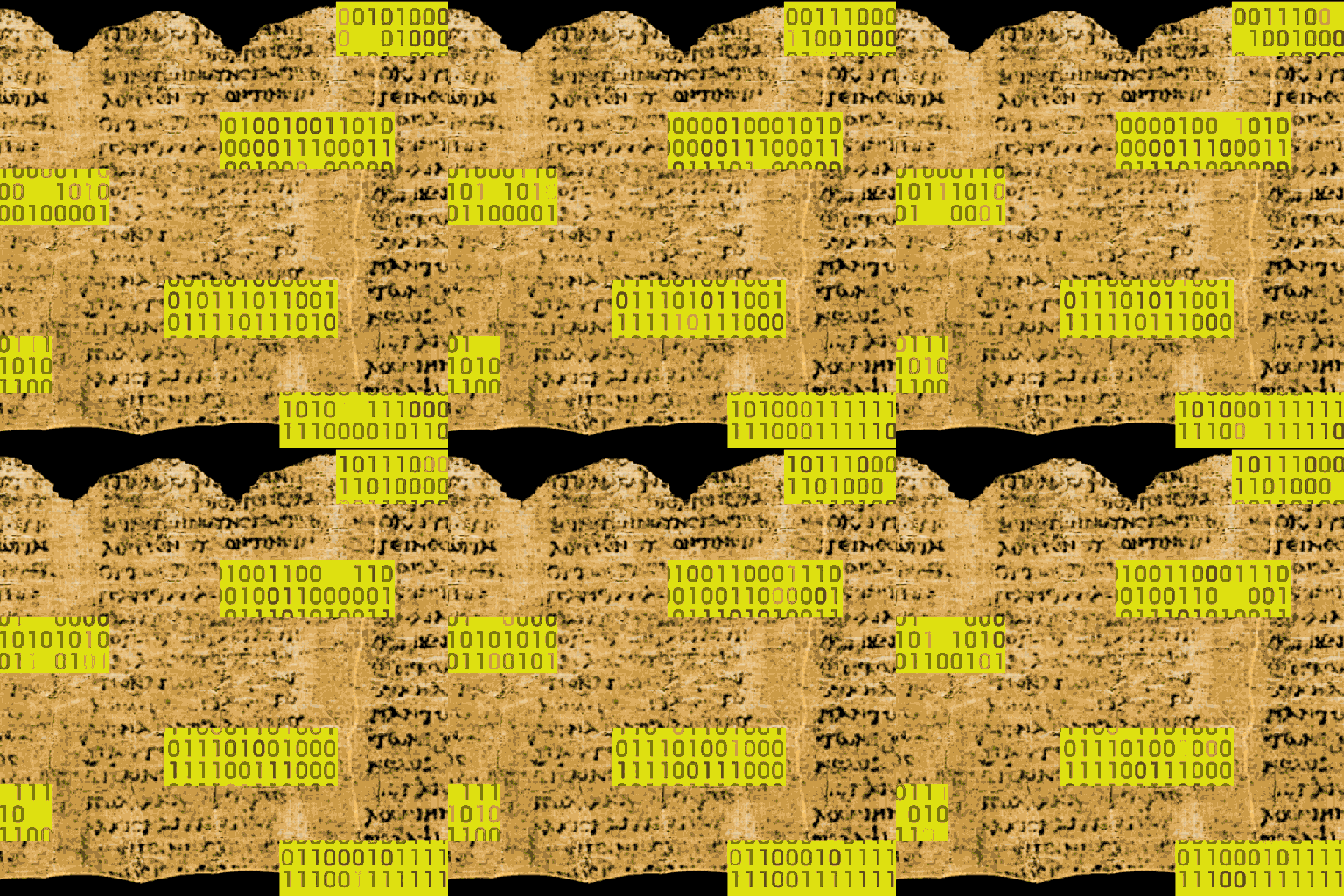
These scrolls are the only remaining intact library of ancient Rome — and they will crumble at a touch.

Police forces are choosing humans over algorithms to make some identifications.

Symmetries aren't just about folding or rotating a piece of paper, but have a profound array of applications when it comes to physics.

The National Defense Education Act of 1958 meshed with white anxiety about the desegregation of schools.

Here's the case for why science can't keep ignoring human experience.

Ground-based facilities enable the greatest scientific production in all of astronomy. The NSF needs to be ambitious, and it's now or never.

The Multiverse fuels some of the 21st century's best fiction stories. But its supporting pillars are on extremely stable scientific footing.

Save and group content to support your unique learning programs

Genes are sometimes called the “blueprint of life,” but that doesn't make them the behavioral playbook.

To Fred Hoyle, the Big Bang was nothing more than a creationist myth. 75 years later, it's cemented as the beginning of our Universe.

JWST has puzzled astronomers by revealing large, bright, massive early galaxies. But the littlest ones pack the greatest cosmic punch.

Tech designed to fuse atoms might be able to clean up space, too.

Former GitHub CEO Nat Friedman just invested $100 million into the company.

When cosmic inflation came to an end, the hot Big Bang ensued as a result. If our cosmic vacuum state decays, could it all happen again?

13.8 columnist Marcelo Gleiser reflects on his recent voyage to Earth's last wild continent.

In 1957, humanity launched our first satellite; today's number is nearly 10,000, with 500,000+ more planned. Space is no longer pristine.

Leap day only comes once every four years, including in 2024. But the reason we have it, including when we do and don't, may surprise you.