




















Search
Science and Tech

The Metaverse could be the most dangerous tool of persuasion humanity has ever created.

Yes, NASA's Perseverance rover found organics on Mars. So did Curiosity. Unfortunately, that doesn't mean anything in the search for life.

An average undergraduate student in physics is better than the AI.

These dissolvable pills aren’t meant to be swallowed, though.

The separation of conjoined twins is fraught with stomach-churning biomedical and ethical challenges.

Elon Musk suggested remote-controlled, vibrating anal beads. Thankfully, there are more mundane explanations.

These salamanders are helping unlock the mysteries of brain evolution and regeneration.

Certain cancers are striking earlier than they used to.

Advances in ancient DNA analysis gave researchers a new way to trace the movements of peoples across Eurasia.


"Our risk-benefit analysis showed that benefits exceeded procedural risks... by up to 200 to 1."

Black holes aren't just the densest masses in the Universe, but they also spin the fastest of all massive objects. Here's why it must be so.

In our common experience, you can't get something for nothing. In the quantum realm, something really can emerge from nothing.

The “first-of-its-kind” archeological find is being reburied despite the fact that researchers haven’t finished studying it.

Sex can be a death trap even for modern toad and frog species.

Anything, good or bad, about Henry Ford can be contradicted — except his ambition and his work.
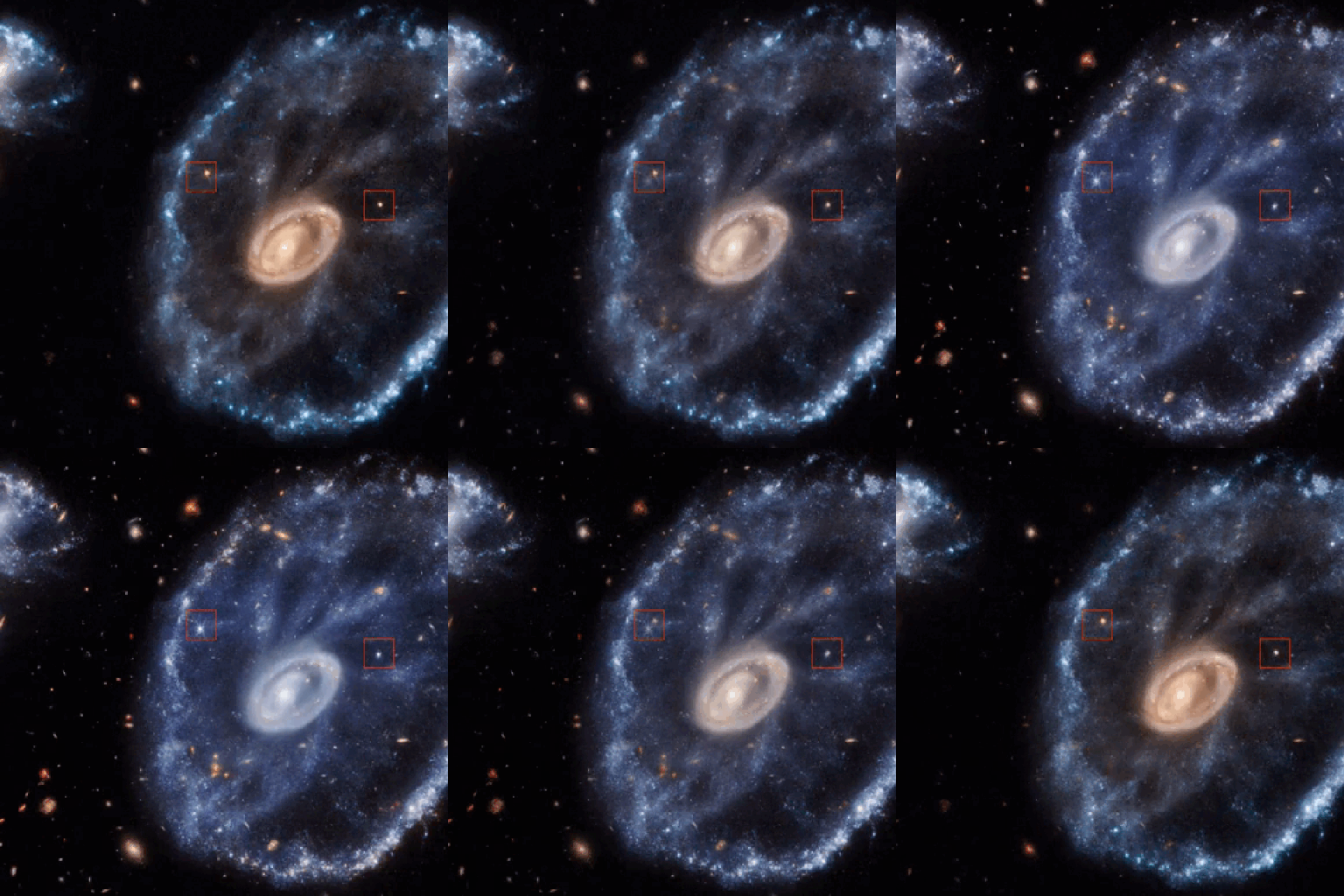
The first set of James Webb's images blew us all away. In just 2 mere months, it's seen highlights that no one could have predicted.

The spray uses snippets of DNA to gum up virus replication.

As recently as 1990, we didn't know of any planets beyond our Solar System. Today, with 5000+, we're deep into the weeds of how they form.

Following the advent of human space flight, NASA began naming missions after children of Zeus.

Each of us carries our own version of the Multiverse in our heads.

At a fundamental level, only a few particles and forces govern all of reality. How do their combinations create human consciousness?

One book will gather all topics on the search for life in the Cosmos.


The war in Ukraine is unlikely to trigger a catastrophic nuclear meltdown. Physics and smart engineering are the reasons why.

No planet enters retrograde more frequently than Mercury, which does so 3-4 times each year. Here’s the scientific explanation for why.

HIV mutates rapidly, which has made the development of a vaccine an enormous challenge for decades. Finally, we might have one.

Even the dictionary doesn't get the definition right.

Athletes often use creatine to boost performance and aid muscle recovery. Accumulating evidence suggests it could also help with depression.

Asteroid collisions aren't always bad.